

Angular is a popular open-source framework that simplifies web development by creating interactive single-page applications (SPAs). Unlike traditional websites that load new pages for each click, SPAs offer a smoother user experience by updating content on the same page.
- Syncs model and view in real-time, minimizing DOM manipulation.
- Organizes code for scalability and maintainability in SPAs.
- Simplifies dynamic UI creation with reusable HTML components.
Basics Interview Questions
In this section, we will discuss basic Angular questions asked in the interview suitable for the freshers.
1. Why was a client-side framework introduced?
Client-side frameworks were introduced to handle the growing complexity of modern web applications. Earlier, with plain JavaScript or jQuery, developers had to manually update the DOM, which became messy and hard to maintain as applications grew.
Frameworks like Angular and React solved this by:
- Supporting Single Page Applications (SPAs) for smooth, fast user experiences without full page reloads.
- Providing features like two-way data binding (Angular) or virtual DOM (React) to keep UI and data in sync automatically.
- Offering a component-based architecture so code is reusable, organized, and easier to maintain.
- Giving built-in tools (routing, forms, state management) that increased developer productivity.
2. How does an Angular application work?
An Angular app is a Single Page Application (SPA) that runs in the browser. It bootstraps the root module, builds the UI with components and templates, uses services for logic, manages navigation with the router, and keeps the UI updated through data binding and change detection.
- App bootstraps from main.ts with AppModule and AppComponent.
- Modules group app features.
- Components build UI with logic, template, and styles.
- Data binding links view and logic.
- Directives modify DOM.
- Services share reusable logic via DI.
- Routing handles navigation.
- Change detection updates DOM on data change.
- Compiler renders templates into JavaScript.
3. How are Angular expressions different from JavaScript expressions?
- JavaScript expressions are evaluated by the browser’s JS engine directly.
- Angular expressions are written inside {{ }} in templates and evaluated by Angular.
| Angular Expressions | JavaScript Expressions | |||||||||||||||||||||||||||||||||||||||||||||||||||||||
|---|---|---|---|---|---|---|---|---|---|---|---|---|---|---|---|---|---|---|---|---|---|---|---|---|---|---|---|---|---|---|---|---|---|---|---|---|---|---|---|---|---|---|---|---|---|---|---|---|---|---|---|---|---|---|---|---|
| Used inside Angular templates ({{ }}, *ngIf, *ngFor). | Used in .js/.ts files or 29. How can you pass data between components in Angular?Data can be passed between components using Input and Output decorators, services, or router state. Passing data from a parent component to a child component using @Input decorator. 30. Explain lazy loading in Angular?Lazy loading in Angular is a technique used to improve the performance of an application by loading feature modules only when they are needed, rather than loading all modules upfront. This reduces the initial load time of the application and speeds up the startup process. 31. What is MVVM architecture in Angular?MVVM (Model-View-ViewModel) is a software architectural pattern that is commonly used in Angular applications, providing a clean separation of concerns between different components of an application. This ensures that changes in one part of the application (like in the logic or data) do not directly affect or interfere with the user interface. 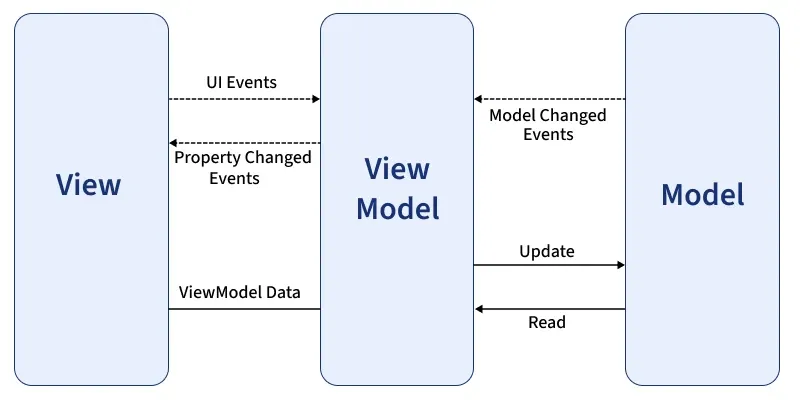 Here's how MVVM works in Angular: Model:
View:
ViewModel:
32. What are Angular lifecycle hooks?Angular lifecycle hooks are methods that allow you to tap into key moments in a component's lifecycle. Here are the main lifecycle hooks:
33. What is a pipe in Angular?A pipe is a way to transform data in the template. It allows you to format or manipulate data before displaying it to the user. Angular provides several built-in pipes like DatePipe, UpperCasePipe, and CurrencyPipe, and you can also create custom pipes. Pipes are typically used to modify the display of data without altering the original data itself. 34. What is Angular Universal?Angular Universal is a technology that enables server-side rendering (SSR) for Angular applications, improving performance, initial load times, and search engine optimization (SEO) by pre-rendering the application on the server before sending it to the client. This results in faster, more interactive user experiences and better indexing by search engines. 35. How do you optimize Angular applications?To optimize Angular applications, you can:
36. What are Angular interceptors?Angular interceptors are services that intercept and modify HTTP requests and responses. They allow you to perform actions such as adding headers (e.g., authentication tokens), logging, or handling errors globally. Interceptors are useful for managing HTTP communication centrally in Angular applications. 37. Explain the purpose of NgZone in Angular?NgZone in Angular is a service that helps Angular know when to update the view by tracking asynchronous operations. It runs change detection whenever an asynchronous operation, like a setTimeout or HTTP request, completes. NgZone ensures that Angular is aware of changes in the application state and triggers the necessary updates to the view. 38. What is the difference between @Input() and @Output() in Angular?
39. How do you implement authentication in Angular?Authentication can be implemented using JWT tokens, Angular guards, and interceptors to manage login and secure routes. Securing a route with an AuthGuard. 40. What are Standalone Components in Angular 19?In Angular 19, standalone components provide a simpler and more flexible way to build applications without depending on NgModules. They reduce complexity, improve optimization through better tree-shaking, and make components easier to manage, test, and reuse. This leads to cleaner code, improved performance, and a streamlined development workflow.
41. How do you use Typed Forms?Typed Forms in Angular 19 provide enhanced type safety for reactive forms. By defining strict types for FormGroup, FormControl, and FormArray, developers can prevent runtime errors, ensure consistency, and handle form data more robustly. This improves maintainability and the overall developer experience.
42. What is the purpose of the Signal API?The Signal API in Angular simplifies state management by providing reactive signals that automatically track changes and update the view. This reduces the need for manual change detection, improves performance, and makes applications more responsive and efficient.
43. How does the inject() function work?The inject() function simplifies the process of dependency injection (DI). It allows developers to access and inject services or dependencies directly within the component’s constructor or lifecycle methods without the need for constructor injection. 44. What improvements have been made to standalone testing?Standalone components can now be tested directly, reducing boilerplate code and enhancing tree-shaking by avoiding unnecessary module dependencies. The testing framework has been optimized for better performance and developer experience. Angular 19 also improves integration with testing libraries like Jasmine and Karma, allowing for more straightforward configuration, faster tests, and a smoother testing process. 45. Explain the use of Functional Components?Functional components focus purely on rendering UI based on inputs and outputs, without requiring a class structure. This approach brings a more functional programming style to Angular, making it easier to write and test components with better performance, especially for simple and reusable components. 46. What is Ahead-of-Time (AOT) compilation in Angular?Ahead-of-Time (AOT) compilation in Angular is the process of compiling Angular templates and TypeScript code into efficient JavaScript code during the build process, before the application is run in the browser. This reduces the size of the application, improves startup performance, and allows for earlier detection of template errors, resulting in faster rendering and better overall performance in production. 47. What is Ivy in Angular?Ivy is Angular's next-generation rendering engine, introduced to improve performance and reduce bundle sizes. It offers faster compilation, more efficient rendering, and enhanced debugging capabilities. Ivy's advanced tree-shaking features eliminate unused code, leading to smaller and faster applications. Additionally, Ivy provides better backward compatibility, making it easier to update and maintain Angular applications. 48. Explain the purpose of Angular Elements.
49. What is a Resolver in Angular?A Resolver in Angular is a service that pre-fetches data before a route is activated, ensuring that the necessary data is available when the route is accessed. This is particularly useful for loading important data that a component depends on, thereby enhancing user experience by avoiding loading indicators or incomplete views. Advanced Interview QuestionsIn this set we will be covering Angular interview question for experienced developers with over 5 years of experience. 50. What is difference between Angular and React?
51. How are Angular expressions are different from JavaScript expressions?
52. What is the purpose of NgModule in Angular?The purpose of NgModule in Angular is to organize an application into cohesive blocks of functionality by grouping related components, directives, pipes, and services. NgModule defines a compilation context for these elements, providing modularity and maintainability. 53. What is the difference between Template-driven and Reactive Forms?
54. What are Angular Guards?Angular Guards are services that control access to routes in an Angular application. They are used to protect routes from unauthorized access or to prevent unwanted navigation. Common types of guards include:
55. How do you create custom validators in Angular?Custom validators can be created by implementing the ValidatorFn interface and using it in the form controls. Creating a custom validator to check if a username is available. 56. What is the purpose of Angular animations?The purpose of Angular animations is to add dynamic visual effects to applications, improving user experience by making transitions, state changes, and movements more engaging. They enable smooth animations for elements such as fading, sliding, or resizing, triggered by user interactions or state changes in the application. 57. Explain dynamic components in Angular.Dynamic components in Angular are components that are created and inserted into the application at runtime, rather than being statically declared in the template. This allows for greater flexibility and responsiveness in applications. 58. What is Angular Material?Angular Material is a UI component library for Angular applications that provides pre-built, reusable, and customizable user interface components, following Google’s Material Design principles. It offers components like buttons, dialogs, form controls, and navigation elements, helping developers create modern, responsive, and visually appealing applications quickly. 59. What is Eager?In AngularJS, eager loading refers to the process where modules, services, and controllers are loaded at the start of the application, even if they are not immediately needed. Eager loading is typically used when the developer expects all parts of the application to be used early on. 60. What is the purpose of Angular's Renderer2?
61. What is the difference between AOT and JIT?
62. What are the benefits of using Web Workers in Angular?
63. What is Data Binding in Angular?Data binding in Angular is a mechanism that allows communication between the component and the view (HTML template). It synchronizes the data between the model (component) and the view, making it easy to reflect changes in the UI whenever data changes in the component. There are the 4 types of the data binding in Agular:
64. What are impure pipes in angular?Impure pipes in Angular are pipes that can change the output when input values change over time, even without the change detection running. Unlike pure pipes, impure pipes are evaluated every time change detection runs, which can lead to performance issues if not used carefully. 65. What are pure pipes in angular?Pure pipes in Angular are pipes that only re-evaluate when their input data changes. This makes them more efficient compared to impure pipes, as they are only executed when the values of the inputs change. 66. What is Pipe transform Interface in Angular?In Angular, the PipeTransform interface is used to define the structure of a custom pipe. It is part of the Pipe decorator, which helps in creating custom pipes to transform data within templates. Angular Scenario Based Interview QuestionsIn this section, we will look at real-world scenarios and how to handle them in Angular. 67. Scenario: Handling Data from Multiple APIsQuestion: We are developing an Angular application that needs to fetch data from multiple APIs and display them together on the same page. How would we handle asynchronous API calls and ensure the data is displayed after all responses are received? Answer: I would use the RxJS forkJoin operator to handle multiple API calls concurrently. This ensures that all API responses are received before processing the data. Here's how I would implement it:
68. Scenario: Optimizing Angular Performance with Lazy LoadingQuestion: Your Angular application is getting slower due to a large number of modules and components. How would you optimize the application’s performance? Answer: One way to optimize an Angular application is by implementing lazy loading to load modules only when needed. This reduces the initial bundle size, improving load times. Here's an example of setting up lazy loading in Angular:
69. Scenario: Handling Form Validation in Reactive FormsQuestion: We have a form where the user enters their email, and we need to ensure that it is both valid and unique (not already in use). How would we implement this validation using Angular Reactive Forms? Answer: I would use Reactive Forms with custom synchronous and asynchronous validators. Here's how I would implement both email format validation and uniqueness check:
70. Scenario: Debugging Change Detection IssuesQuestion: We notice that a component is not updating as expected when data changes. How would you debug and resolve the issue related to Angular's change detection mechanism? Answer: First, I would check if the component is using OnPush change detection strategy: If the OnPush strategy is being used, Angular only checks for changes when an input reference changes. If the data is updated by mutation, Angular will not detect the change. In this case, I would either:
71. Scenario: Implementing Route Guards for AuthenticationQuestion: How would you protect specific routes in your Angular application so that only authenticated users can access them? Answer: I would implement Route Guards using Angular’s CanActivate interface to protect routes. Here's an example of how to implement an authentication guard
|