




- German:
- Strassburg

Strasbourg
News •
-
Where is Strasbourg located?
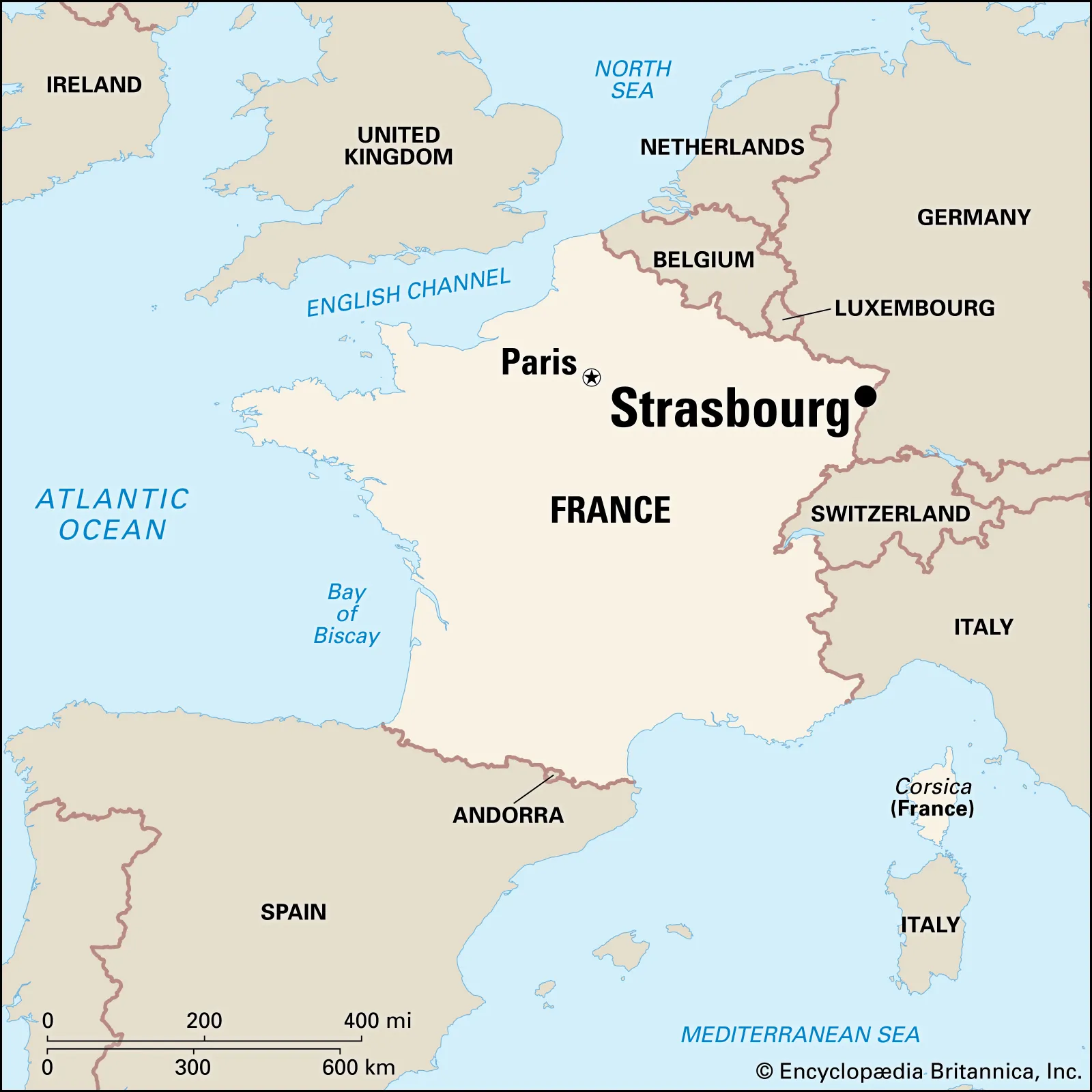
Strasbourg is a city in eastern France, the capital of the Bas-Rhin department and the Grand Est region. It is located approximately 2.5 miles (4 km) west of the Rhine River on the Franco-German frontier. The Ill River traverses the city, dividing and surrounding the Grand Île, where the old town and most famous buildings stand. Strasbourg has a regional airport 9 miles (15 km) southwest of the city. Besides being the chief city of Alsace, Strasbourg is home to many European institutions, including the European Parliament, the Council of Europe, and the European Court of Human Rights.
2 Britannica SourcesThis answer is created from Britannica articles using AI. AI can make mistakes, so verify using Britannica articles. -
What country is Strasbourg a part of?
Strasbourg is a city in eastern France. It serves as the capital of the Bas-Rhin département, in the Grand Est région. Situated approximately 2.5 miles (4 km) west of the Rhine River, Strasbourg lies on the Franco-German frontier. The city has a rich and complex history, having been seized by Louis XIV of France in 1681 and later captured and annexed by the Germans in the Franco-German War (1870–71). After World War I, Strasbourg reverted to France. Today, Strasbourg is a major business, commercial, and cultural center and is the seat of several European institutions, including the European Parliament.
1 Britannica SourceThis answer is created from Britannica articles using AI. AI can make mistakes, so verify using Britannica articles. -
What is Strasbourg known for?
Strasbourg, France, is known for its rich history and international significance. Originally a Celtic village and later a Roman garrison town, it became a free city within the Holy Roman Empire. Today, Strasbourg plays a major role as a business, commercial, and cultural center and is the seat of several European institutions, including the European Parliament, the Council of Europe, and the European Court of Human Rights. Its Grand Île, with famous buildings, was designated a UNESCO World Heritage site in 1988.
2 Britannica SourcesThis answer is created from Britannica articles using AI. AI can make mistakes, so verify using Britannica articles. -
Why is Strasbourg important in Europe?
Strasbourg holds significant importance in Europe due to its rich history and status as a major business, commercial, and cultural center. It was originally a Celtic village, then a Roman garrison town. Strasbourg is the seat of several European institutions, including the European Parliament, the Council of Europe, and the European Court of Human Rights. Its historical significance includes the Serment de Strasbourg, an important Old French document, and its role as a free city within the Holy Roman Empire. The city's Grande Île is a UNESCO World Heritage site.
1 Britannica SourceThis answer is created from Britannica articles using AI. AI can make mistakes, so verify using Britannica articles. -
What famous buildings or landmarks can be found in Strasbourg?
Located on the Grand Île, Strasbourg boasts a rich collection of famous buildings and landmarks. The Cathedral of Notre-Dame, built from red Vosges sandstone, showcases a blend of architectural styles and a 15th-century spire reaching 455 feet. The Château des Rohan, once an episcopal palace from the 18th century, now houses three museums. The La Petite France district has well-preserved old streets, wooden houses, and picturesque canals.
Strasbourg is also home to European institutions like the European Parliament, the Council of Europe, and the European Court of Human Rights.
1 Britannica SourceThis answer is created from Britannica articles using AI. AI can make mistakes, so verify using Britannica articles. -
How has Strasbourg's history been influenced by its location near the border of France and Germany?
Strasbourg's history has been significantly influenced by its location on the border between France and Germany. The city was originally a Celtic village and later a Roman garrison town. In 842, a significant alliance was formed there between Charles II and Louis II. Strasbourg has changed hands between France and Germany several times throughout history. Louis XIV of France seized the city in 1681, and Germany captured it in the Franco-German War of 1870–71. The city reverted to France after World War I but was occupied by Germany again during World War II. Major industrial development in Strasbourg was delayed until the 1950s because of its border location. Today, Strasbourg plays a major role as a business, commercial, and cultural center and is the seat of several European institutions.
3 Britannica SourcesThis answer is created from Britannica articles using AI. AI can make mistakes, so verify using Britannica articles.

Strasbourg, city, capital of Bas-Rhin département, Grand Est région, eastern France. It lies 2.5 miles (4 km) west of the Rhine River on the Franco-German frontier.
History
The city was originally a Celtic village, and under the Romans it became a garrison town called Argentoratum. It was captured in the 5th century by the Franks, who called it Strateburgum, from which the present name is derived. In 842 Charles II (the Bald), king of the West Franks, and Louis II (the German), king of the East Franks, took an oath of alliance there, the Serment de Strasbourg, a text of which is the oldest written document in Old French. After a struggle for power between its citizens and the bishops in the Middle Ages, Strasbourg became a free city within the Holy Roman Empire.

Strasbourg’s population was mainly Protestant after the Reformation but cautiously avoided the religious conflicts of the Thirty Years’ War (1618–48). In 1681 Louis XIV of France seized the city in peacetime and obtained ratification for his arbitrary action by the Treaty of Rijswijk (1697). The town retained its privileges until the French Revolution (1787–99). In 1792 Claude-Joseph Rouget de Lisle, a French poet, musician, and soldier, composed in Strasbourg the anthem of the Rhine Army, since known as “La Marseillaise.” In the Franco-German War (1870–71) the Germans captured Strasbourg after a 50-day siege and annexed it. The city reverted to France after World War I. It was occupied by Germany again (1940–44) during World War II. The city gained international status with the opening there in 1979 of the European Parliament.

The contemporary city
The city of Strasbourg is traversed by the Ill River, which divides and surrounds the Grand Île (Big Island) on which the old town and most of the city’s famous buildings are situated. The island was designated a UNESCO World Heritage site in 1988. Strasbourg’s 11th–15th-century Cathedral of Notre-Dame, damaged in 1870 and again in World War II, has been carefully restored. Built of red Vosges sandstone, it is a harmonious edifice despite the variety of its architectural styles. It has an asymmetrical facade (mainly 13th century) with fine sculptured portals and only one tower, which has a tall (455 feet [139 metres]) and graceful 15th-century spire. Some of the cathedral’s sculptures, together with vestiges from other old French churches, are exhibited in the Maison de l’Oeuvre Notre-Dame, next to the cathedral. The 18th-century Château des Rohan, a former episcopal palace, houses three museums. The La Petite district of the city has several well-preserved old streets with wooden houses, as well as some picturesque canals.
Tanning, milling, metalworking, and brewing industries have long existed in the city, but major industrial development did not begin until the 1950s because of the city’s border location. Strasbourg’s present-day economic activities include food processing, mechanical and electrical engineering, and the manufacture of pharmaceuticals, electronics, and plastics. There is also a large automobile assembly plant in the city’s industrial port zone. The port itself is one of the largest on the Rhine and handles shipments of petroleum, agricultural products, and building materials.
Strasbourg plays a major role as a business, commercial, and cultural centre. Besides its traditional role as the chief city of Alsace, Strasbourg is also the seat of a number of European institutions and bodies including the European Parliament, the Council of Europe, and the European Court of Human Rights. The city has several universities (among them the prestigious National School of Administration [ENA] for civil service and international cooperation). The city centre, with walking paths and tram cars, has also become a popular tourist destination. A regional airport lies 9 miles (15 km) southwest of the city. Pop. (1999) 264,115; (2014 est.) 276,170.