


Vilnius Cathedral
| Cathedral Basilica of St. Stanislaus and St. Ladislaus | |
|---|---|
Vilniaus Šv. Stanislovo ir Šv. Vladislovo arkikatedra bazilika (in Lithuanian) | |
 | |
 Click on the map for a fullscreen view | |
| 54°41′09″N 25°17′16″E / 54.68583°N 25.28778°E | |
| Location | Vilnius |
| Country | Lithuania |
| Denomination | Catholic |
| Tradition | Roman Rite |
| Website | www |
| History | |
| Status | Cathedral-Basilica |
| Founder(s) | Legendary: Mindaugas Historical: Jogaila Current building: Ignacy Jakub Massalski |
| Dedication | St Stanislaus and St Ladislaus |
| Consecrated | 1783 |
| Architecture | |
Functional status | Active |
| Architect | Laurynas Gucevičius |
Architectural type | Church |
| Style | Gothic, Baroque, Neoclassical |
| Groundbreaking | Original: 1251 Current: 1779 |
| Completed | 1783 |
| Specifications | |
| Materials | plastered masonry |
| Administration | |
| Archdiocese | Roman Catholic Archdiocese of Vilnius |
Official name | Vilnius Old Town |
| Type | Cultural |
| Criteria | Cultural: (ii), (iv) |
| Designated | 1994 |
| Reference no. | 541 |
UNESCO region | Europe |
Vilnius Cathedral, formally the Cathedral Basilica of St. Stanislaus and St. Ladislaus, is the Roman Catholic cathedral of the Archdiocese of Vilnius and a minor basilica in Vilnius, Lithuania.
Located on Cathedral Square in the historic centre of the city, it is one of the country's most important religious and architectural monuments. Its present Neoclassical appearance largely results from the reconstruction designed by Laurynas Gucevičius in the late eighteenth century.
Historically, the cathedral served as the site of the inauguration of the Grand Dukes of Lithuania, during which Gediminas' Cap was placed on the ruler's head. In modern Lithuania, a Mass at the cathedral forms part of the ceremonies following the inauguration of the President of Lithuania.
History
[edit]_to_the_Vilnius_Cathedral,_issued_on_17_February_1387_in_Vilnius,_Lithuania.jpg)

The origins of Christian and pre-Christian structures on the site are disputed. A long historiographical tradition, dating back to the 15th-century historian Jan Długosz, associated an earlier church beneath the present cathedral with King Mindaugas and suggested that it was subsequently adapted for pagan worship.[1]
More recent archaeological and historical studies have questioned this interpretation, with some scholars dating the earliest masonry beneath the cathedral to the early fourteenth century and rejecting its identification as Mindaugas's cathedral.[1] The first securely documented cathedral was founded on the initiative of Jogaila following the Christianization of Lithuania in 1387 and was consecrated in 1388.[2]
After the cathedral was destroyed by fire in 1419, Vytautas had a substantially larger Gothic hall church built in its place. The Gothic core of Vytautas's cathedral, including much of its walls and pillars, survives within the present building. The third cathedral had three naves and four circular towers at its corners, and was similar to cathedral in Frombork. In 1522, the cathedral was renovated, and a bell tower was built on top of the Lower Castle defensive tower. Following a major fire in 1530, the cathedral was reconstructed from 1534 under the direction of Italian architects Bernardinus de Gianotis and Giovanni Cini. Further chapels and crypts were added, and by the completion of the works in the mid-sixteenth century the cathedral had acquired Renaissance architectural features.[3]
The elevations of the Grand Dukes of Lithuania took place in the cathedral.[4] Inside its crypts and catacombs are buried many famous people from Lithuanian and Polish history including Vytautas (1430), his wife Anna (1418), his brother Sigismund (1440), his cousin Švitrigaila (1452), Saint Casimir (1484), Alexander Jagiellon (1506), and two wives of Sigismund II Augustus: Elisabeth of Austria (1545) and Barbara Radziwiłł (1551). The heart of Władysław IV Vasa was buried there upon his death, although the rest of his body is buried at the Wawel Cathedral in Kraków.[3]
In 1529 Sigismund II Augustus was elevated as Grand Duke of Lithuania in the cathedral, it was the last such ceremony. On 29 May 1580, during a ceremony in Vilnius Cathedral, Merkelis Giedraitis, Bishop of Samogitia, presented Stephen Báthory with a ceremonial sword and a pearl-encrusted hat sent and blessed by Pope Gregory XIII. The ceremony was regarded by some contemporaries and has been interpreted by historians as a symbolic substitute for the separate inauguration of a Grand Duke of Lithuania that had ceased after the Union of Lublin.[5][6]
After yet another fire in 1610, the cathedral was rebuilt again, and the two front towers were added. The cathedral was damaged again in 1655 when Vilnius fell to Russian troops in the Russo-Polish War of 1654–1667. It was renovated and redecorated several more times.

Between 1623 and 1636, at the initiative of Sigismund III Vasa and later completed by his son Wladyslaw IV Vasa, the Baroque style Chapel of Saint Casimir by royal architect Costante Tencalla was built of Swedish sandstone. Its interior was reconstructed in 1691–1692 and decorated with frescoes by Michelangelo Palloni, the altar and stuccowork by Pietro Perti. This chapel contains sculpted statues of Jagiellon kings and an epitaph with Wladyslaw IV Vasa's heart. More than anything in the Cathedral this chapel symbolizes the glory of Polish-Lithuanian union and common history.

In 1769 the southern tower, built during the reconstruction of 1666 collapsed, destroying the vaults of the neighbouring chapel and killing 6 people. After the damage, Bishop of Vilnius Ignacy Jakub Massalski ordered the reconstruction of the cathedral. Reconstruction in the Neoclassical style began in the early 1780s under Laurynas Gucevičius and was completed in 1801 by Michał Szulc. The church acquired a strict quadrangular shape common to local public buildings. The main facade was adorned with sculptures of the Four Evangelists by Italian sculptor Tommaso Righi. Some scholars point to the architectural resemblance of the cathedral to the works of Andrea Palladio or see the influence of Gucevičius's tutor Claude Nicolas Ledoux.[7] The influence of Palladian architecture is evident in side facades of the building. The lack of 'purity' of the Classical architecture, due to incorporation of Baroque style sculptures and other elements, was later criticized by academical architects, notably Karol Podczaszyński.
.jpg)
Between 1786 and 1792 three sculptures by Karol Jelski were placed on roof of the Cathedral - Saint Casimir on the south side, Saint Stanislaus on the north, and Saint Helena in the centre. These sculptures were removed in 1950 and restored (sculptor Stanislovas Kuzma) in 1997.[8][clarification needed]
During the Soviet occupation, the cathedral was converted into a warehouse. Masses were celebrated again starting in 1988, although the cathedral was still officially called The Gallery of Images at that time. In 1989, its status as a cathedral was restored. In January that year, the remains of Albertas Goštautas were discovered in the cathedral wall.[9]
In 2002 work officially began to rebuild the Royal Palace of Lithuania behind the cathedral. The newly erected palace building considerably altered the context of the cathedral.
The cathedral and the belfry were renovated and the façades repainted during the 2006–2008 renovation. It was the first renovation since the restoration of Lithuania's independence in 1990.
In 2018, the cathedral's tympanum and several of its plinths were repaired. In 2022, the roof was renovated after part of it was blown off by strong winds. In 2023, the roof lantern above St Casimir's Chapel and the sacristy were repaired.[10]
Architecture
[edit]Inside, there are more than forty works of art dating from the 16th through 19th centuries, including frescoes and paintings of various sizes. Excavations uncovered earlier masonry and floor levels beneath the cathedral; their dating and interpretation, including proposed associations with Mindaugas and a pre-Christian sanctuary, remain disputed. In addition, the remains of the cathedral built in 1387 were also located. A fresco dating from the end of the 14th century, the oldest known fresco in Lithuania, was found on the wall of one of the cathedral's underground chapels.
Gallery
[edit]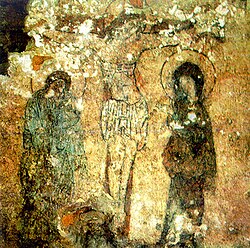 The fresco in the Vilnius Cathedral, dating to the Christianization of Lithuania
 Façade of Vilnius Cathedral in an 1847 drawing
 The Bell Tower
 Litas coin to commemorate Vilnius Cathedral
 Side view of Vilnius Cathedral
 Façade view of the Vilnius Cathedral at night
 Statue of apostle Mark
 Statue of apostle Matthew
 Statue of apostle Luke
 Statue of Moses
 Cartouche on the wall of St. Casimir's Chapel in Vilnius. West wall of Vilnius Cathedral
 Bas-relief of Vilnius Cathedral

_(cropped).jpg)
.jpg)


Notes
[edit]References
[edit]
- 1 2 Baronas, Darius (2012). "Perkūno šventykla Vilniuje". lmka.lt (in Lithuanian). Retrieved 6 October 2026.
- ↑ "Vilniaus katedra ir varpinė". Visuotinė lietuvių enciklopedija (in Lithuanian). Archived from the original on 2 December 2024. Retrieved 3 December 2024.
- 1 2 "Vilniaus arkikatedra. Pirmosios katedros". www.katedra.lt. Retrieved 6 October 2026.
- ↑ Gudavičius, Edvardas. "Gedimino kepurė". Visuotinė lietuvių enciklopedija (in Lithuanian). Archived from the original on 23 March 2023. Retrieved 19 March 2023.
- ↑ Ragauskienė, Raimonda; Ragauskas, Aivas; Bulla, Noémi Erzsébet (2018). Tolimos bet artimos: Lietuvos ir Vengrijos istoriniai ryšiai (PDF) (in Lithuanian). Vilnius. p. 67. Retrieved 6 November 2023.
{{cite book}}: CS1 maint: location missing publisher (link) - ↑ Bues, Almut (2005). "POLITINĖ CEREMONIALO PASKIRTIS ELEKCINĖJE MONARCHIJOJE: LENKIJA-LIETUVA XVI-XVIII A." (PDF). Lietuvos Istorijos Metraštis (in Lithuanian). Lithuanian Institute of History: 9. Archived (PDF) from the original on 6 November 2023. Retrieved 6 November 2023.
- ↑ Archived 27 February 2008 at the Wayback Machine
- ↑ "Vilniaus arkikatedra". Ldmuziejus.mch.mii.lt. 27 March 2006. Archived from the original on 7 January 2007. Retrieved 7 January 2012.
- ↑ Jankauskas, Rimantas. "LDK istorija: Vilniaus vaivados ir LDK kanclerio Alberto Goštauto kūno antropologinis tyrimas". 15min.lt (in Lithuanian). Archived from the original on 12 September 2021. Retrieved 12 September 2021.
- ↑ Narkunas, Vilius (25 May 2024). "Vilnius Cathedral needs renovation, but who should pay?". LRT. Archived from the original on 27 May 2024. Retrieved 27 May 2024.
 | History |  | |
|---|---|---|---|
| Elderships | |||
| Government | |||
| Transport | |||
| Education | |||
| Landmarks | |||
| International | |
|---|---|
| National | |
| Geographic | |
| Other | |

- Roman Catholic churches completed in 1783
- 18th-century Roman Catholic church buildings in Lithuania
- Roman Catholic cathedrals in Lithuania
- Basilica churches in Lithuania
- Rebuilt buildings and structures in Lithuania
- Roman Catholic church buildings in Vilnius
- Burial sites of the Gediminids
- Burial sites of the Jagiellonian dynasty
- Burial sites of the House of Radziwiłł
- Burial sites of the House of Vasa
- Objects listed in Lithuanian Registry of Cultural Property
- Neoclassical church buildings in Lithuania
- Landmarks in Vilnius
- Vilnius Old Town