


Timeline of Vilnius
The following is a timeline of the history of the city of Vilnius, Lithuania.
Grand Duchy of Lithuania
[edit]| History of Lithuania |
|---|
 |
| Chronology |
 Lithuania portal Lithuania portal |
14th century
[edit]- 1323
- 1330 – Coat of arms of Vilnius granted.
- 1345 – Russian Orthodox Church of St. Paraskeva built.[2]
- 1348 – Russian Orthodox Cathedral of the Theotokos built.
- 1387
- Magdeburg rights granted.
- Roman Catholic Church of Saint Nicholas built.
- 1397 – Cathedral School active (approximate date).
15th century
[edit]- 1409 – Gediminas' Tower built.
- 1413 – City becomes capital of the newly formed Vilnius Voivodeship by the Union of Horodło.
- 1426 – Roman Catholic Church of St. Johns built.[2]
- 1469 – Roman Catholic Church of St. Francis and St. Bernardino founded.[2]
16th century
[edit]- 1500 – Roman Catholic Church of St. Anne consecrated.
- 1501 – First mentions of Armenians in the city.[3]
- 1522
- City walls and Gate of Dawn built.
- Francysk Skaryna sets up printing press.
- 1555 – Evangelical Lutheran Church built on Vokiečių Street.[2]
- 1557 – Roman Catholic Vilnius Cathedral rebuilt.
- 1560 – Russian Orthodox Church of St. Paraskeva rebuilt.
- 1570 – Jesuit library established.
- 1572 – Synagogue built.
- 1579 – Alma Academia et Universitas Vilnensis Societatis Iesu founded.
- 1588 – Plague.[1]
- 1597 – Monastery of the Holy Ghost founded.[2]
_(34065617).jpg)
17th century
[edit]- 1610 – Fire.[1]
- 1626 – Roman Catholic Church of St. Theresa founded.[2]
- 1630 – Roman Catholic Church of All Saints built.
- 1633 – Great Synagogue built.
- 1644 – Biblioteca Sapehana willed to Vilnius University.[4]
- 1653 – Radvila Palace built.
- 1655 – July: Battle of Vilnius; Russian occupation begins, lasting until 1661.[1]
- 1656 – Tsardom of Muscovy declares that it annexed the city mid-war.[1]
- 1658 – Battle of Verkiai.
- 1661 – Vilnius liberated from Muscovite occupation.
- 1697 – Sapieha Palace built.
18th century
[edit]- 1701 – Roman Catholic Church of St. Peter and St. Paul built.
- 1702 – Swedish occupation.[1]
- 1710 – Plague.
- 1739 – Green Bridge constructed.
- 1749 – Roman Catholic Sanctuary of the Divine Mercy built.
1770s and 1780s
[edit]1790s
[edit]Long 19th century
[edit]- 1795
- City occupied by the Russian Empire. It is designated as the capital of Vilna Governorate.
- Russian Orthodox Church of St. Paraskeva rebuilt.
- 1799
- Town Hall rebuilt.
- Romm publishing house relocates to Vilnius.
- 1801
- Rasos Cemetery consecrated.
- Royal Palace demolished.
- 1809 – Antakalnis Cemetery established.
- 1810 – Bernardine Cemetery established.
- 1812
- Napoleon enters the city, marking the beginning of the brief French period in Lithuania.[7]
- 1 July: Vilnian National Guard founded in Vilnius.
- 3 July: 18th Lithuanian Infantry Regiment founded in Vilnius.[8]
- 5 July: 3rd Light Cavalry Lancers Regiment of the Imperial Guard (Lithuanian) founded in Vilnius.[9]
- 22 September: 21st Lithuanian Mounted Rifle Regiment founded in Vilnius.[10]
1820s
[edit]- 1823 – Pop.: 20,900.[11]
- 1825 – Tuskulėnai Manor built.
- 1828 – Jewish cemetery established in Užupis (approximate date).
1830s and 1840s
[edit]- 1831 – Uprising of 1831 across Lithuania, but Vilnius is not liberated due to the defeat of the rebels at the battle of Paneriai on June 19.[1]
- 1832 – University closed.[1]
- 1834 – Presidential Palace renovated.
- 1836 – St. George Avenue (now Gediminas Avenue) laid out.
- 1845 – Theatre opens.[2]
1850s
[edit]- 1852 – Central Archive of Early Register Books established.[12]
- 1855 – Museum of Antiquities established.
- 1856 – Public library established.[13]
1860s
[edit]- 1861 – Demonstration against Russian Empire.
- 1863 – Uprising against Russian Empire.
- 1866 – Orthodox Church of St. Nicholas reconsecrated.
- 1867 – Pretchistenski Cathedral rebuilt.[2]
1880s–1890s
[edit]- 1881 – Pop.: 89,560.[14]
- 1883 – Pop.: 93,760.[1]
- 1897 – General Jewish Labour Bund founded in Vilnius.[15]
- 1898 – Russian Orthodox Church of St. Alexander Nevsky and District Court built.[2]
1900s
[edit]- 1900 – Pop.: 162,633.[1]
- 1901 – Kaziukas Fair relocates to Lūkiškės Square.
- 1903 – Power Plant, Choral Synagogue and the Russian Orthodox Church of Our Lady of the Sign built.
- 1904 – Lukiškės Prison built.
- 1905 – December: Great Seimas of Vilnius held.
- 1906
- Society of Friends of Science organized.
- Vileišis Palace built.
- 1907 – Lithuanian Art Society founded.[16]
1910s
[edit]- 1911 – Catholic Church of St. Casimir, Naujoji Vilnia built.
- 1913
- Russian Orthodox Church of St. Constantine and St. Michael built.
- Pop.: 204,290.[17]
World Wars and occupations
[edit]- 1915
- 19 September: German occupation begins.[18]
- City becomes capital of Lithuania District.
- 1916 – Vilna Troupe active.
- 1918
- 16 February: Lithuania declares independence from German Empire.
- Museum of History and Ethnography established.

Interwar
[edit]- 1919
- April: Vilna offensive by Polish army.
- Central Library of Lithuania organized.[19]
- Jabłkowski Brothers department store opens.
- 1920 – October 9: Vilnius occupied by Polish (so-called Central Lithuanian) troops during the Żeligowski's Mutiny.
- 1925
- Darius Stadium opens.
- Elektrit Radiotechnical Society, Roman Catholic Metropolitan Archdiocese of Vilnius, and Yiddish Scientific Institute established.
- 6 May: School massacre.
- 1926 – City becomes capital of Wilno Voivodeship.
- 1928 – Northern Trade Fair begins.
- 1931 – Pop.: 195,000.
- 1933
- City Museum established.
- Śmigły Wilno soccer team formed.
World War II
[edit]- 1939
- 18–19 September: Battle of Vilnius (1939) between the Poles and the invading Soviets at the start of World War II.
- Soviet occupation of Vilnius.
- 28 October: Vilnius returned to Lithuania as part of the terms of the Soviet–Lithuanian Mutual Assistance Treaty.
- Vilnius Pedagogical Institute established.
- 1940
- City becomes capital of Lithuanian Soviet Socialist Republic.
- Vilnius State Theatre established.
- 1941
- June: Germans occupation begins.
- July: Ponary massacre begins.[20]
- 5 July: Dulag transit camp for prisoners of war deployed in the city.[21]
- August: Dulag transit camp for prisoners of war relocated to Lida.[21]
- August: Subcamp of the Stalag 336 POW camp established by the Germans.[22]
- 9 September: Subcamp of Stalag 336 converted into the Stalag 344 POW camp.[22]
- December: Wehrmacht military prison established.[23]
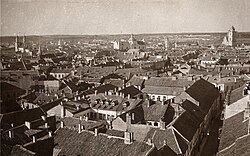
Old Town in 1944
- 1942 – Fareynikte Partizaner Organizatsye formed in Vilna Jewish Ghetto.
- 1943 – HKP 562 forced labor camp set up by Germans.

- 1944
- Wehrmacht military prison relocated to Tarnów.[23]
- 6–15 July: Operation Ostra Brama; Soviet occupation begins.
- Airport begins operating.
Soviet occupation
[edit]- 1945 – Music School founded.
- 1946 – Russian Drama Theatre re-established.[24]
1950s
[edit]- 1950 – Žalgiris Stadium opens.
- 1951 – Vilnius Heat Plant commissioned.
- 1955 – Šeškinė village becomes part of the city.
- 1956
- Trolleybuses begin operating.
- Vilnius Gediminas Technical University established.
1960s
[edit]- 1963
- National Library of Lithuania relocates to Vilnius.[19]
- Polish Theater founded.
- 1964 – Statyba basketball team formed.
- 1965
- Žirmūnai Bridge constructed.
- Vingis Park renovated.
- Pop.: 293,000.[25]
- 1967 – Technika (publisher) established.
- 1968 – Ratilio ensemble formed.
1970s
[edit]- 1971 – Palace of Concerts and Sports opens.
- 1972 – Valakampiai Bridge constructed.
- 1974
- Lithuanian National Opera and Ballet Theatre built.
- Evangelical Cemetery demolished.
- 1979 – Pop.: 503,000.[26]
1980s
[edit]- 1980 – Seimas Palace and Vilnius TV Tower built.
- 1983 – Vilnius Combined Heat and Power Plant commissioned.
- 1985 – Pop.: 544,000.[27]
- 1987 – Vilnius Jazz Festival begins.
- 1989 – Jewish State Museum established.
Independent Lithuania
[edit]- 1990
- 11 March: Lithuania declares independence from USSR.
- Vilnius Lyceum and Vilniaus lietuvių namai (school) established.
- 1991 – January: City besieged by Soviet forces.
- 1992
- Genocide and Resistance Research Centre of Lithuania[28] and Verkiai Regional Park established.
- Museum of Genocide Victims opens.
- 1994 – General Jonas Žemaitis Military Academy of Lithuania established.
- 1995 – Alis Vidūnas becomes mayor.
- 1997
- 1 April: Užupis neighborhood declares itself an independent republic.
- Rolandas Paksas becomes mayor.
- Kalnai Park established.
- 1999
- Vilnius Book Fair begins.[citation needed]
- Juozas Imbrasas becomes mayor.
- 2000
- House of the Signatories museum opens.
- Artūras Zuokas becomes mayor.
21st century
[edit]- 2001 – Sportima Arena opens.
- 2002
- Vilnius Ice Palace opens.
- Energy and Technology Museum established.
- 2003
- Mindaugas Bridge opens.
- 750th anniversary of the coronation of Mindaugas.
- FK Vėtra relocates to Vilnius.
- 2004
- Siemens Arena and Vetra Stadium open.
- European Humanities University relocates to Vilnius.
- Europa Tower built.
- Mykolas Romeris University and Vilnius Academy of Business Law established.
- Vilnius Marathon begins.
- 2005 – Lietuvos rytas Arena opens.
- 2006 – May: City hosts regional democracy conference.
- 2007
- Juozas Imbrasas becomes mayor again.
- Jonas Mekas Visual Arts Center opens.
- 2008
- February: City hosts NATO meeting.
- Vilnius Airport railway station opens.
- Gariūnai Market pavilion built.
- 2009
- Palace of the Grand Dukes of Lithuania rebuilt.
- City designated a European Capital of Culture.
- 2011
- Vilniaus viešasis transportas (bus company) established.
- Pop.: 554,060.
- Artūras Zuokas becomes mayor again.[29]
- 2015 – Remigijus Šimašius becomes mayor.
- 2025
- 2023
- July: City hosts NATO summit.
- 2026
- Pop.: 617,984 (city proper) and 747,864 (urban area)
See also
[edit]References
[edit]- 1 2 3 4 5 6 7 8 9 10 11 Britannica 1910.
- 1 2 3 4 5 6 7 8 9 Baedeker 1910.
- ↑ Stopka, Krzysztof (2000). Ormianie w Polsce dawnej i dzisiejszej (in Polish). Kraków: Księgarnia Akademicka. p. 120. ISBN 83-7188-325-0.
- ↑ Marcia J. Bates, ed. (2010), Encyclopedia of Library and Information Sciences, Boca Raton, Florida: CRC Press, ISBN 978-0-8493-9712-7
- 1 2 3 4 5 6 7 Gembarzewski 1925, p. 34.
- ↑ Gembarzewski 1925, p. 35.
- ↑ E. J. Harrison (1922), "Topographical Outline", Lithuania, past and present, London: Unwin
- ↑ Gembarzewski 1925, p. 57.
- ↑ Gembarzewski 1925, p. 52.
- ↑ Gembarzewski 1925, p. 64.
- ↑ Morse 1823.
- ↑ Grimsted 1979.
- ↑ "Leading Libraries of the World: Russia and Finland". American Library Annual. New York: R.R. Bowker Co. 1916. pp. 477–478.
Vilna
- ↑ Hunter, Brian; Paxton, John; Steinberg, S. H.; Epstein, Mortimer; Renwick, Isaac Parker Anderson; Keltie, John Scott; Martin, Frederick (1885). "Russia". Statesman's Year-Book. London: Macmillan and Co. hdl:2027/nyp.33433081590469.
- ↑ James C. Docherty; Peter Lamb (2006). "Chronology". Historical Dictionary of Socialism (2nd ed.). Scarecrow Press. ISBN 978-0-8108-6477-1.
- ↑ Chris Michaelides, ed. (2007). "Chronology of the European Avant Garde, 1900─1937". Breaking the Rules: The Printed Face of the European Avant Garde 1900–1937. Online Exhibitions. British Library.
- ↑ "Russia: Principal Towns: European Russia". Statesman's Year-Book. London: Macmillan and Co. 1921. hdl:2027/njp.32101072368440.
- ↑ Stephen Pope; Elizabeth-Anne Wheal (1995). "Select Chronology". Dictionary of the First World War. Macmillan. p. 523+. ISBN 978-0-85052-979-1.
- 1 2 "History". Martynas Mazvydas National Library of Lithuania. Retrieved 3 December 2012.
- ↑ "Vilnius". Encyclopedia of Jews in Eastern Europe. New York: Yivo Institute for Jewish Research. Retrieved 30 April 2015.
- 1 2 Megargee, Geoffrey P.; Overmans, Rüdiger; Vogt, Wolfgang (2022). The United States Holocaust Memorial Museum Encyclopedia of Camps and Ghettos 1933–1945. Volume IV. Indiana University Press, United States Holocaust Memorial Museum. p. 92. ISBN 978-0-253-06089-1.
- 1 2 Megargee, Geoffrey P.; Overmans, Rüdiger; Vogt, Wolfgang (2022). The United States Holocaust Memorial Museum Encyclopedia of Camps and Ghettos 1933–1945. Volume IV. Indiana University Press, United States Holocaust Memorial Museum. p. 332. ISBN 978-0-253-06089-1.
- 1 2 Megargee, Geoffrey P.; Overmans, Rüdiger; Vogt, Wolfgang (2022). The United States Holocaust Memorial Museum Encyclopedia of Camps and Ghettos 1933–1945. Volume IV. Indiana University Press, United States Holocaust Memorial Museum. pp. 646–647. ISBN 978-0-253-06089-1.
- ↑ "About Us". Old Theatre of Vilnius. Retrieved 6 May 2011.
- ↑ "Population of capital cities and cities of 100,000 and more inhabitants". Demographic Yearbook 1965. New York: Statistical Office of the United Nations. 1966.
- ↑ Henry W. Morton and Robert C. Stuart, ed. (1984). The Contemporary Soviet City. New York: M.E. Sharpe. p. 4. ISBN 978-0-87332-248-5.
- ↑ United Nations Department of Economic and Social Affairs, Statistical Office (1987). "Population of capital cities and cities of 100,000 and more inhabitants". 1985 Demographic Yearbook. New York. pp. 247–289.
{{cite book}}: CS1 maint: location missing publisher (link) - ↑ "Genocide and Resistance Research Centre of Lithuania". Retrieved 3 December 2012.
- ↑ "Mayor". Vilniu City. Retrieved 13 May 2013.
This article incorporates information from the Lithuanian Wikipedia, Polish Wikipedia, and Russian Wikipedia.
Bibliography
[edit]- Jedidiah Morse; Richard C. Morse (1823), "Wilna", A New Universal Gazetteer (4th ed.), New Haven: S. Converse
- "Wilna", Jewish Encyclopedia, vol. 12, New York, 1907, hdl:2027/osu.32435029752839
{{citation}}: CS1 maint: location missing publisher (link) - . Encyclopædia Britannica. Vol. 28 (11th ed.). 1910. pp. 88–89.
- "Vilna", Russia with Teheran, Port Arthur, and Peking, Leipzig: Karl Baedeker, 1914, OCLC 1328163
- William Henry Beable (1919), "Vilna", Russian Gazetteer and Guide, London: Russian Outlook
- Patricia Kennedy Grimsted (1979). "The Archival Legacy of the Grand Duchy of Lithuania: The Fate of Early Historical Archives in Vilnius". Slavonic and East European Review. 57.
- Weeks, T. R. (2015). Vilnius between Nations, 1795–2000. Northern Illinois University Press.
- Gembarzewski, Bronisław (1925). Rodowody pułków polskich i oddziałów równorzędnych od r. 1717 do r. 1831. Warszawa: Towarzystwo Wiedzy Wojskowej.
External links
[edit]
Wikimedia Commons has media related to Vilnius.
 | History |  | |
|---|---|---|---|
| Elderships | |||
| Government | |||
| Transport | |||
| Education | |||
| Landmarks | |||
Years in Lithuania (1918–present) | ||
|---|---|---|
| ||