tralac maintains a collection of regional and national trade-related resources including copies of the texts and annexes of regional and bilateral trade agreements, copies of various regional protocols, memoranda of understanding and tariff offers, and copies of national legislation and trade-related policy documents. These resources can be accessed below by regional bloc (use the maps to navigate to each regional resources page) and by country.
We also monitor some of Africa’s key international trading relationships, including the BRICS countries (Brazil, Russia, India, China and South Africa) which are soon to be expanded; and the European Union’s Economic Partnership Agreements (EPAs), among others. tralac also undertakes periodic trade data analyses as well as preparing factsheets on current trade-related topics relevant to trade in Africa.
We are grateful to our donors – BMZ/GIZ, IDRC and Sida – for their support to be able to maintain this resource collection.
Please note that registration to the tralac website is required to download resource documents. Registration is free of charge and for monitoring purposes only.
Protection of Personal Information
tralac adheres to the highest standards of ethical practices in all its operations to ensure the protection of your personal information. All personal information collected is used only for internal reporting purposes. See tralac’s privacy policy.
Regional blocs


In January 2012, the 18th AU Assembly endorsed a comprehensive framework towards the attainment of developmental regionalism in the continent, through its decision to establish an African Continental Free Trade Area (AfCFTA). The main objectives of the AfCFTA are to create a single continental market for goods and services, with free movement of business persons and investments.
Once implemented, the AfCFTA will cover a market of more than 1.2 billion people with a combined GDP of more than US$3.4 trillion. It will be governed by five operational instruments, i.e. the Rules of Origin; the online negotiating forum; the monitoring and elimination of non-tariff barriers; a digital payments system and the African Trade Observatory.
To date, the consolidated text of the AfCFTA Agreement has been signed by 54 of the 55 AU member states. Only Eritrea’s signature is outstanding. As at September 2023, 47 of the 54 signatories (85.2%) have deposited their instruments of AfCFTA ratification with the AUC Chairperson. On 7 October 2022, the AfCFTA Secretariat launched the AfCFTA Guided Trade Initiative in Accra, marking the commencement of trade under the Agreement.

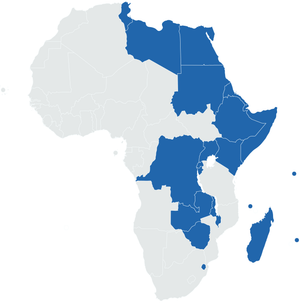
The Treaty Establishing the Common Market for Eastern and Southern Africa entered into force on 8 December 1994, replacing the Preferential Trade Area for Eastern and Southern Africa which was established in 1981. COMESA’s vision is to “endeavour to achieve sustainable economic and social progress in all Member States through increased co-operation and integration in all fields of development particularly in trade, customs and monetary affairs, transport, communication and information, technology, industry and energy, gender, agriculture, environment and natural resources”.
The aims and objectives of the Common Market, as stated in Article 3 of the Treaty, include, to attain sustainable growth and development of the Member States by promoting a more balanced and harmonious development of its production and marketing structures. COMESA launched a Free Trade Area on 31 October 2000. As of 2026, 16 of 21 COMESA Member States are fully implementing the FTA: Burundi, Comoros, Djibouti, Egypt, Kenya, Libya, Madagascar, Malawi, Mauritius, Rwanda, Seychelles, Sudan, Tunisia, Uganda, Zambia, and Zimbabwe. Five Member States are yet to join: the Democratic Republic of the Congo, Ethiopia, Eswatini and Somalia. In June 2009, a Customs Union was established, although this is yet to become fully operational.


The Treaty for Establishment of the East African Community was signed on 30 November 1999 and entered into force on 7 July 2000 following its ratification by the original 3 Partner States – Kenya, Uganda and Tanzania. Since then, five countries have joined the EAC, bringing the total EAC membership to eight (8): Burundi, Democratic Republic of the Congo, Rwanda, Somalia and South Sudan. The EAC’s vision is creating a prosperous, competitive, secure, stable and politically united East Africa. The objectives of the Community are to develop policies and programmes aimed at spearheading the regional economic, social and political integration agenda and widening and deepening cooperation among the Partner States.
The EAC’s objectives are to be attained through four stages of integration: a Customs Union (CU), Common Market, Monetary Union, and Political Federation. The CU was successfully launched in 2005 with the aim to liberalise intra-regional trade, promote production efficiency, attract investment, and encourage economic development and industrial diversification. The EAC has a common external tariff (CET) which is placed on goods entering the EAC market. However, its implementation remains uneven. Although the EAC Common Market was established in 2010, it is not yet fully operational.


The Economic Community of West African States (ECOWAS) Treaty was signed by the Heads of State and Government of 15 West African countries on 28 May 1975 in Lagos, Nigeria. The Revised Treaty of ECOWAS was signed in July 1993. The “main aims of ECOWAS are to promote cooperation and integration, leading to the establishment of an economic union in West Africa in order to raise the living standards of its peoples, and to maintain and enhance economic stability, foster relations among Member States and contribute to the progress and development of the African Continent.” ECOWAS is one of the eight regional economic communities (RECs) identified by the African Union.
ECOWAS envisages stages of integration. The establishment of a Common Market is the first integration milestone. This is to be achieved through a Free Trade Area (liberalisation of tariffs on trade in goods), a Customs Union with a common external tariff (CET), and a common trade policy vis-a-vis third countries and free movement of persons, goods, services, and capital. Although the FTA has been achieved and CET is in place, the CU and Common Market have yet to be fully realised.
The current Member States of ECOWAS are Benin, Cabo Verde, Côte d’Ivoire, The Gambia, Ghana, Guinea, Guinea Bissau, Liberia, Nigeria, Sierra Leone, Senegal and Togo. On 29 January 2025, three Sahel States led by military regimes – Mali, Burkina Faso and Niger – formally withdrew from ECOWAS in the form of a confederation known as the Alliance for Sahel States (AES).


The Southern African Customs Union (SACU) was established in 1910 between Botswana, Lesotho, Eswatini (formerly Swaziland) and South Africa. It is the oldest Customs Union in existence. The SACU Agreement was renegotiated in 1969 when Namibia gained independence from South Africa, who subsequently became the fifth member. The Agreement was again renegotiated in 2002 (and amended in April 2013), recognising that the SACU Agreement concluded in 1969 no longer adequately catered for the needs of a customs union in the 21st century.
Among the key objectives of SACU, as contained in Article 2 of the SACU Agreement 2002, are to facilitate the cross-border movement of goods between the territories of the Member States; create effective, transparent and democratic institutions which will ensure equitable trade benefits to Member States; promote the integration of Member States into the global economy through enhanced trade and investment; and facilitate the equitable sharing of revenue arising from customs, excise and additional duties levied by Member States, among others.
A key feature of SACU is the application of a single tariff regime − the Common External Tariff (CET). This means that the five Member States form a Common Customs Area, and all customs, excise and additional duties collected shall be paid into the Common Revenue Pool.


The Southern African Development Community (SADC) was established on 17 August 1992 with the adoption of the SADC Treaty, redefining the existing Southern African Development Coordinating Conference which was established in 1980. The SADC Treaty was amended in 2011 and again 2014. According to this amendment, the main objectives of SADC are to, inter alia: “promote sustainable and equitable economic growth and socio-economic development that will ensure poverty alleviation with the ultimate objective of its eradication, enhance the standard and quality of life of the people of Southern Africa and support the socially disadvantaged through regional integration”.
The SADC Regional Indicative Strategic Development Plan (RISDP 2020-2030) and SADC Vision 2050 are two strategic plans which seek to further deepen Southern Africa regional integration and foster development. These encompass three interrelated pillars: Industrial Development and Market Integration; Infrastructure Development in support of Regional Integration; and Social and Human Capital Development.
A Free Trade Area was established in 2008. The 16 SADC Member States are: Angola, Botswana, the Union of Comoros, Democratic Republic of the Congo, Eswatini, Lesotho, Madagascar, Malawi, Mauritius, Mozambique, Namibia, Seychelles, South Africa, United Republic of Tanzania, Zambia, and Zimbabwe.

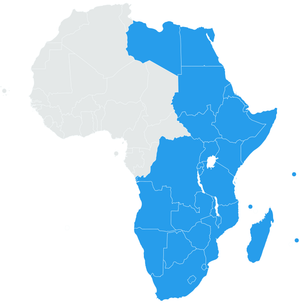
The member states of COMESA, EAC and SADC agreed in October 2008 to negotiate a Tripartite Free Trade Area (TFTA) with the aim of bringing together, in one common market, countries in the three regional economic blocs recognised by the African Union. The TFTA Agreement shall adopt a development integration approach which comprises of a) Trade in goods; b) Trade in services; and c) Other trade-related matters. More specifically, the objectives are to progressively liberalise trade in goods and services, promote industrial development, facilitate movement of business persons, support the strengthening of infrastructure, promote competitiveness, build the capacity of micro, small and medium scale enterprises, and contribute to the deepening of integration in the Tripartite Member States. There are currently 29 Member States in the TFTA, many of which overlap with other regional economic communities.
The TFTA was officially launched in Sharm El Sheikh, Egypt on 10 June 2015 where Heads of State and Government had met to conclude outstanding Phase I negotiations on rules of origin, trade remedies, and tariff offers. However, due to a number of challenges faced in the process of integration, the commencement of Phase II negotiations – covering trade in services and other trade related matters – has been delayed. The Agreement entered into force on 20 July 2024, 30 days after having received 14 ratifications by Member States, in accordance with Article 39 (3) of the TFTA Agreement.


With a view to accelerating the process of economic and political integration in the continent, the Constitutive Act of the African Union was adopted in 2000 at the Lomé Summit and entered into force in 2001. The vision for the AU is to support the empowerment of African states in the global economy while addressing the multifaceted social, economic and political problems facing the continent amidst increasing globalisation.
With the adoption of the Treaty Establishing the African Economic Community in 1991 (the ‘Abuja Treaty’), the AU is working towards the establishment of a single African Common Market through six successive stages, using the Regional Economic Communities (RECs) as building blocks. Agenda 2063 was formally adopted in January 2015 as a strategic framework for the socioeconomic transformation of the continent over the next 50 years. It encapsulates not only Africa’s aspirations for the future but also identifies key Flagship Programmes which can boost Africa’s economic growth and development and lead to the rapid transformation of the continent. The AU currently consists of 55 member states.

The challenges of the evolving international trade landscape and global economy, and how trade policy in the 21st century can be used to promote the effective integration and upgrading of developing countries, have meant that the nature of Africa’s trading relationships has been undergoing significant shifts.
While trade with its traditional trading partners, particularly the European Union and the United States, has been declining, trade ties with emerging economies and global players, notably the BRICS (Brazil, Russia, India, China and South Africa), has been steadily increasing.
The negotiation of Economic Partnership Agreements (EPAs) with the EU, the United Kingdom’s exit from the EU (Brexit), and multilateral trade developments at the World Trade Organisation (WTO) also have implications for Africa’s trade. Click on the map below to find out more.

The African continent consists of 55 member states with a combined GDP projected to reach $29 trillion by 2050. Africa’s economic growth is primarily being driven by a youthful and rapidly urbanising population, a growing middle class, the boom in digital services, soaring global demand for critical minerals and natural resources (including oil, natural gas, diamonds, gold, rare earth minerals, lithium, cobalt, nickel and copper), as well as increased regional trade and integration into the global economy.
Africa has a multiplicity of overlapping regional trade arrangements (RTAs). It is home to approximately 30 different RTAs, all of which are at varying stages of integration and implementation. Although African leaders recognise that RTAs have enormous potential to foster regional integration and development on the continent, the low rate of their implementation has left this potential largely unmet.
Africa’s regional trade arrangements are largely championed by eight regional economic communities (RECs) which the African Union recognises as pillars of its continental integration: COMESA, EAC, SADC, ECCAS, ECOWAS, IGAD, AMU, and CEN-SAD. Click on the maps alongside to find out more.
International trading relationships
The nature of Africa’s trading relationships has been undergoing significant shifts. While trade with its traditional international trading partners, particularly the European Union and the United States, has been declining, trade ties with emerging economies and global players, notably the BRICS (Brazil, Russia, India, China and South Africa), has been steadily increasing. The negotiation of Economic Partnership Agreements (EPAs) with the EU, the United Kingdom’s exit from the EU (Brexit), and multilateral trade developments at the World Trade Organisation (WTO) also have implications for Africa’s trade.
Trade data analysis and factsheets
tralac has compiled a selection of web resources related to regional, continental, and global trade and integration, including data and statistics platforms and analysis tools, major trade-related publications, and organisations involved in trade-related development in Africa.
External Resources
tralac has compiled a selection of web resources related to regional, continental, and global trade and integration, including data and statistics platforms and analysis tools, major trade-related publications, and organisations involved in trade-related development in Africa.