Educational resources
Our educational resources are made up of offerings for both students and teachers. They include animated games, videos and easy to use Nobel Prize lessons.
© Nobel Prize Outreach. Photo: Benoît Derrier
Explore the Nobel Prize lessons – an educational resource about the Nobel Prize laureates and their groundbreaking work. The lessons are developed to make it easy for teachers to introduce the students to the prize-awarded achievements and their benefit to humankind.
The Nobel Prize lessons 2026 have now been published – find them all here.
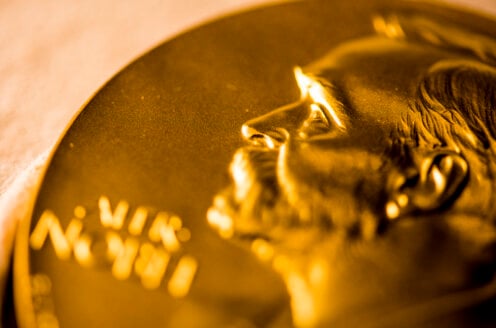
Take our one-minute crash courses and find out how these discoveries and achievements have changed our world. The 2026 one-minute crash courses will be published here in November.

Do you know how magnetism really works?
If every electron and proton has an invisible, magnetic field, then why isn’t everything magnetic? And how does magnetism really work? Explore what we know – and don’t know – about the physics of magnetism. Read more
Did you know our brains create mental maps of the spaces around us? Dig into the neuroscience behind your inner navigation system and how you can improve your wayfinding skills.

Nobel Prize in Physiology or Medicine 1930
What happens if you get a blood transfusion with the wrong blood type? Play a game where you save patients’ lives and learn about human blood types and blood typing.

What happens when a cell dies inside the body and how does the body know when to make new cells? As Cell Division Supervisor inside the cell nucleus, your job in this game is to control cell division to make sure each stage of the cell cycle occurs in the correct order.

In this game, your mission as a camp commander is to run a prisoner of war camp without violating any human rights. You must follow the humanitarian standards outlined in the Third Geneva Convention.

In this game you are to assist during an MRI investigation and afterwards sort some images. You can earn five magnets out of five if you are good at memory games and know the differences between MRI, X-ray and CAT images!

In this game you can train a dog to drool on command! It’s all about conditioned learning.

This fast-paced game relies on a keen knowledge of food containing vitamin B1 and good keyboard skills to save lives. You have one minute to feed chickens suffering from beriberi with the correct food to stop them from dying.

Chiral molecules can be used to control or speed up different chemical reactions. In this little game you are to decide which objects are chiral and which ones are not!

This new course will equip students with the tools scientists use to make sense of the world around them. By learning to evaluate evidence and solve problems in the face of uncertainty, young people will be ready to navigate the complex challenges of the century, and feel empowered to make better decisions.

© Nobel Prize Outreach Ill. Christina Heitmann
Perspectives on life
Ever wondered how Nobel Prize laureates think about the world? Watch the video series where laureates share their challenges and how the lessons they learnt can help us navigate our own lives.

Step into the shoes of a Nobel Peace Prize laureate and learn about the legacy of Alfred Nobel in this immersive learning experience from the Nobel Peace Center. All Minecraft players can now journey alongside Desmond Tutu, United Nations High Commissioner for Refugees, Jody Williams and Carl von Ossietzky to bring their vision of a more democratic, peaceful world to life.

Nobel Prize in Physics 1901
X-rays were discovered in 1895 by Wilhelm Conrad Röntgen, who received the first Nobel Prize in Physics in 1901. Several important discoveries have been made using X-rays.

Can you match the right physics laureate with the right discovery? Have a try!

Can you match the right chemistry laureate with the right discovery? Have a try!

Can you match the right medicine laureate with the right discovery? Have a try!

Can you match the right book title with the right Nobel Prize awarded author? Have a try!

Can you match the right peace laureate with the right accomplishment? Have a try!

Can you match the right research field to the right laureate? Have a try!
