


Union asks NDP to keep Saudi armoured vehicles deal ‘under wraps,’ fearing ‘significant’ job losses
Mulcair questioned Harper on London, Ont.’s General Dynamics Land Systems Canada's $15-billion deal to supply armoured vehicles to Saudi Arabia
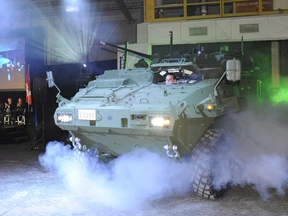
A London, Ontario industrial giant has been thrust into a federal election scrap between party leaders, and its workers — fearing their jobs could be jeopardized — aren’t happy about it.

In a federal leaders’ debate, when the NDP’s Tom Mulcair questioned Conservative Leader Stephen Harper on General Dynamics Land Systems Canada’s (GDLS) $15-billion deal to supply armoured vehicles to Saudi Arabia, it drew fire from Unifor, the union that represents workers at the London plant.
“We have contacted the NDP about this issue,” said Fergo Berto, Unifor area director for London, adding that Unifor national president Jerry Dias spoke recently to Mulcair.

If GDLS lost the contract, it would not only mean “significant” job losses in London, he said, but he’s worried it would also hurt the plant’s ability to land future work.
“We asked the NDP to not make this an issue, that it be kept under wraps. There are a lot of issues out there to be talking about,” said Berto, adding Dias spoke to Mulcair over the weekend, after the debate last week.
There are more than 2,000 workers at GDLS Canada and more than 500 are Unifor workers.
During the debate, Bloc Quebecois Leader Gilles Duceppe and Mulcair challenged Harper on military sales to Saudi Arabia.
Mulcair said after the debate government must question the human rights record of Saudi Arabia and that his government would look at the human rights record of any country in which it intended to sign an agreement on arms.

Harper defended the deal, saying many of Canada’s allies were also after that contract. He also said Saudi Arabia is an ally in the fight against ISIS, and the deal is crucial to workers here and to the area’s economy.
Irene Mathyssen, NDP candidate and MP in the last Parliament in London-Fanshawe, said she has since spoken to Mulcair and GDLS officials. She said the contract wouldn’t be cancelled under an NDP win, but the party wanted “more transparency” from the federal government.
“It’s a signed deal. We recognize the impact this will have for General Dynamics,” Mathyssen said. “The issue is the Conservatives are so secretive they don’t tell anyone what they are up to. We have to do due diligence and investigate.”
The GDLS deal wasn’t raised during the most recent debate Monday. Mulcair and GDLS Canada couldn’t be reached for comment Tuesday.
The Saudi contract, spread over 14 years, is to supply armoured vehicles to Saudi Arabia, which has a record of suppressing its citizens, including imprisoning those who speak out.
When Harper was challenged about the deal, he said it would “not be right to punish workers in a factory in London for this. It doesn’t make sense.”
David Perry, senior analyst with the Canadian Defence and Foreign Affairs Institute in Ottawa, defended the secrecy around arms deals, saying it’s often demanded by the customer, and not the fault of government or the industry.
If Canada wants to compete globally in the military supply sector, it shouldn’t make a habit of questioning this deal, he added.
“To have this discussed after will be a concern to (the Saudis). It is not secrecy, but the terms of the contract,” Perry said.
It’s also a question of whether Canada wants to be a global player in trade, he added.
“If we’re going to have a domestic industry that is economically viable, we need a foreign policy pragmatic enough to support it. We just can’t sell to our closest allies. We need to broaden the market.”
Our website is the place for the latest breaking news, exclusive scoops, longreads and provocative commentary. Please bookmark nationalpost.com and sign up for our politics newsletter, First Reading, here.
- Advertisement 1Story continues below



- Advertisement 2Story continues below





Postmedia is committed to maintaining a lively but civil forum for discussion. Please keep comments relevant and respectful. Comments may take up to an hour to appear on the site. You will receive an email if there is a reply to your comment, an update to a thread you follow or if a user you follow comments. Visit our Community Guidelines for more information.