


Third wave of autocratization
| Third wave of autocratization | |||
|---|---|---|---|
| Part of waves of democracy c. 2000s – present | |||
| |||
 | |||
| Location | Worldwide | ||
| Key events |
| ||

| Part of the Politics series |
| Democracy |
|---|
 Politics portal Politics portal |
The third wave of autocratization is the ongoing 21st-century phenomenon whereby countries around the globe are drifting away from liberal democracy towards authoritarianism. The war on terror, the Great Recession, and the COVID-19 pandemic were some of the most significant events that exacerbated autocratization. Since the 2010s, more countries have been autocratizing than democratizing.[1]
Unlike previous waves of autocratization, the third wave has resulted in significant autocratization in healthy liberal democracies. Modern autocrats have relied less on military coups to consolidate power and more on being legitimately elected to positions of power and eroding separation of powers from within.
Waves of autocracy contrast with waves of democracy, with the third wave of autocratization being preceded by the third wave of democratization, which began in 1974. Although experts disagree on which year marked the beginning of the third wave of autocratization (and the corresponding end to the third wave of democratization), most agree it began during the war on terror or Great Recession.
Autocratization has ignited international pro-democracy movements such as the Arab Spring and the Gen Z protests. Autocratization has also led to developments in protest tactics against police riot control methods, as well as the popularization of new pro-democracy symbols like the three-finger salute and Straw Hats' Jolly Roger.
Timeline
[edit]Modern democratic backsliding, rather than occurring through military coups (the norm during the Cold War era), has more frequently occurred through the election of personalist leaders or parties who subsequently dismantle democratic institutions.[2] New democracies that were weakly established during the third wave of democratization have been especially vulnerable to democratic backsliding.[3][4]
War on terror (2001–2021)
[edit]Following the September 11 attacks and subsequent war on terror, democratic backsliding ensued.[5] The war on terror is a global military campaign initiated by the United States in response to the September 11 attacks in 2001. A global conflict spanning multiple wars, some researchers and political scientists have argued that it replaced the Cold War.[6][7]
In 2003, political scientists and theorists believed that the third wave had crested and would soon begin to ebb, just as its predecessors did in the first and second waves.[8]

While support for the "war on terror" was high among the American public during its initial years, it had become deeply unpopular by the late 2000s.[9][10] Controversy over the war has focused on its morality, casualties, and continuity, with critics questioning government measures that infringed civil liberties and human rights.[11] Critics have notably described the Patriot Act as "Orwellian" due to its substantial expansion of the federal government's surveillance powers.[12][13] Controversial practices of coalition forces have been condemned, including drone warfare, surveillance, torture, extraordinary rendition, and various war crimes.[14][15][16] The participating governments have been criticized for implementing authoritarian measures, repressing minorities,[17][18] fomenting Islamophobia globally,[19] and causing negative impacts to health and environment.[20][21][22] Security analysts assert that there is no military solution to the conflict, pointing out that terrorism is not an identifiable enemy, and have emphasized the importance of negotiations and political solutions to resolve the underlying roots of the crises.[23]
Great Recession (2010s)
[edit]

Some scholars argue the third wave of autocratization began in the 2010s after the Great Recession, when the number of liberal democracies was at an all-time high.[25][26] From 2010 to 2020, the V-Dem Institute reported a global decline in liberal democracy.[27]
COVID-19 (2019–2022)
[edit]

The COVID-19 pandemic has been used as a pretext for autocratization, largely due to the heavy practical and logistical disruption the virus and subsequent lockdown restrictions have caused.[28][29][30][31] Across the world, national governments found themselves with no other choice but to suspend, cancel, or postpone numerous democratic elections at both national and subnational governmental levels.[32]
The 2020 Freedom House report also highlighted a variety of responses relating to government mishandling of the pandemic against the best interests of its citizens, such as denial of the existence of COVID-19 in Turkmenistan and Nicaragua, and the promotion of unsafe or unproven treatments in Brazil and Tanzania.[31] The Freedom in the World score dropped by 45 points in 2020, marking the most significant decline in the prior fifteen years.[29] According to Ingo Keilitz, both authoritarian leaders and surveillance capitalists used the pandemic to "make massive shifts and reprogramming of our sensibilities about privacy and civil liberties that may not be reversible." Keilitz saw this as a threat to judicial independence.[33] The Pandemic Backsliding Index created by V-Dem measured authoritarian and illiberal practices between March and December 2020 for 144 countries, and found 80% of all countries engaged in authoritarian practices such as emergency measures without time limit, disproportionate limitations on the role of legislatures, and government disinformation campaigns.[34] Dr. Abouzzohour at Harvard University said that from 2020 to 2022, COVID-19 "undoubtedly contributed to the deterioration of political freedom" globally. She claimed "heightened repression, militarization, and restrictions" following from the pandemic contributed.[29]
This is due to factors that have been weakened such as "checks against abuses of power, protection of vulnerable groups, transparency and anti-corruption, free media and expression, and credible elections."[31] As governments were entrusted with unprecedented powers to protect public health, even the strongest democracies "failed to guard themselves against abuse of power," said an op-ed on Newsweek.[35] This is because emergency powers grant governments the ability to '"make regulations without an act of parliament"[36] These powers are typically intended to take "rapid action"[36] and combat instability. Emergency powers have been used by some governments to extend state power.[37] This arguably occurred in Moscow, where tens of thousands of cameras with facial-recognition features were supposedly installed to track contagion, however, these systems risk remaining in place after the pandemic.[37] According to a 2020 Brookings Institution report, "the challenges posed by the need for mass surveillance suggest that the resilience of democratic regimes cannot be taken for granted." The same study highlighted foreign disinformation surrounding COVID-19 as a threat to democracy, stating that the pandemic presented an opportunity for malign actors to "multiply the production of fake news, conspiracy theories, and manipulated information", it further stated that "Russia and China exploited the chaos induced by COVID-19 to promote their geopolitical interests and continue to destabilise western democracies."[37]
An article on the journal Democratic Theory comments that a side effect of COVID-19 will be a "long-term effect on established democracies around the world."[38] Part of this long-term effect includes the increasing prevalence of democratic backsliding; while proportional responses to a global pandemic are necessary, excessive measures under abusive enforcement have raised concerns that democracy, in nations where it is already unstable, is declining worldwide.[39]
After the National Assembly of Hungary passed legislation allowing Viktor Orbán to rule by decree, the Washington Post declared the pandemic had "killed its first democracy."[40] During the Hong Kong protests in 2020, police used newly-passed pandemic laws banning groups of more than four to disperse protesters.[41][42]
Post-COVID (2022–present)
[edit]
In the 2020s, democratic backsliding has increasingly been observed not only in newer or weakly institutionalized democracies, but also in long-established democratic systems.[44]
According to the V-Dem Institute's Democracy Report 2026, nearly a quarter of the world's countries were undergoing autocratization in 2025, including several in Europe and North America. The report also highlights growing concerns about declines in democratic quality and increasing pressures on media and journalists worldwide.[44]
Russia under Vladimir Putin has repeatedly engaged in election interference and disinformation campaigns aimed at damaging opponents of far-right populist factions, including in three US elections to support Donald Trump (2016, 2020, 2024)[45][46][47] and in German elections to support the AfD, or Alternative for Germany (2025).[48][49][50][51][52]
Concepts
[edit]Autocratic legalism
[edit]Autocratic legalism is a form of weaponized legalism and politicization of the law.[53] Political scientist Javier Corrales first defined the term in the context of democratic backsliding in the 21st century. It was later expanded upon by sociologist Kim Lane Scheppele. The term describes the use of legal methods that are used by autocrats to weaken the checks and balances in liberal constitutional democracies, effectively transforming them from democratic systems into autocracies and hybrid regimes.[54]
Right-wing populism
[edit].JPG)
Right-wing populism, also called right populism and national populism,[56][57][58] is a political ideology that combines right-wing politics with populist rhetoric and themes. Its rhetoric employs anti-elitist sentiments, opposition to the Establishment, and speaking to or for the common people. Recurring themes of this political ideology include neo-nationalism, social conservatism, economic nationalism, and fiscal conservatism.[59] Frequently, they aim to defend a national culture, identity, and economy against perceived attacks by outsiders.[60]
Some right-wing populist parties and movements have associations with elements of authoritarianism,[61][62] while some far-right populists draw comparisons to fascism.[63] Right-wing populism in the Western world is sometimes associated with ideologies such as anti-environmentalism,[64] anti-globalisation,[65][66][67] nativism,[65][68][69] and protectionism.[70] In Europe, the term is often used to describe groups, politicians and political parties generally known for their opposition to immigration,[65][71] and for Euroscepticism.[72] Some right-wing populists may support expanding the welfare state, but only for those they deem fit to receive it;[73] this concept has been referred to as "welfare chauvinism".[74][75][76][77][78] Since the Great Recession,[79][80][81] European right-wing populist movements began to grow in popularity,[82][83] in large part due to increasing opposition to immigration from the Middle East and Africa, rising Euroscepticism and discontent with the economic policies of the European Union.[84] Some forms of right-wing populism may also go into libertarian themes, with federalism, anti-central bank, pro-sound money and the non-aggression principle being key themes in the libertarian spectre of right-wing populism, with Ron Paul and some parts of the Tea Party movement being a notable example of this.[citation needed]
Scholars use terminology inconsistently, sometimes referring to right-wing populism as "radical right"[85] or other terms such as new nationalism.[86] Pippa Norris noted that "standard reference works use alternate typologies and diverse labels categorising parties as 'far' or 'extreme' right, 'New Right', 'anti-immigrant' or 'neo-fascist', 'anti-establishment', 'national populist', 'protest', 'ethnic', 'authoritarian', 'anti-government', 'anti-party', 'ultranationalist', 'right-libertarian' and so on".[87][needs update] The term authoritarian populism can be used to describe right-wing populism,[88] although it is also used to refer to left-wing political movements.[89][90]
Policing
[edit]Kettling
[edit]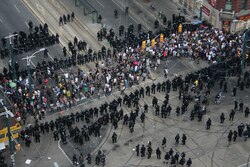
Kettling (also known as containment or corralling)[91] is a police tactic for controlling large crowds during demonstrations or protests. It involves the formation of large cordons of police officers who then move to contain a crowd within a limited area. Protesters either leave through an exit controlled by the police, leave through an uncontrolled gap in the cordons, or are contained, prevented from leaving, and arrested.
The tactic has proved controversial, in part because it has resulted in the detention of ordinary bystanders as well as protesters.[92] In March 2012, kettling was ruled lawful by the European Court of Human Rights following a legal challenge.[93]
Militarization
[edit]_Enforcement_and_Removal_Operations_(ERO)_in_Los_Angeles,_California,_June_12,_2025_-_76.jpg)
The militarization of police (sometimes referred to as the paramilitarization of police in some media) is the use of military equipment and tactics by law enforcement officers.[94] This includes the use of armored personnel carriers (APCs), assault rifles, submachine guns, flashbang grenades,[95] sniper rifles, and SWAT (special weapons and tactics) teams.[96][97] The militarization of law enforcement is also associated with intelligence agency–style information gathering aimed at the public and political activists[98][99] and with a more aggressive style of law enforcement.[100][101] Criminal justice professor Peter Kraska has defined militarization of police as "the process whereby civilian police increasingly draw from, and pattern themselves around, the tenets of militarism and the military model".[102]
Predictive policing
[edit]Predictive policing is the usage of mathematics, predictive analytics, and other analytical techniques in law enforcement to identify potential criminal activity.[103][104][105]
A report published by the RAND Corporation identified four general categories predictive policing methods fall into: methods for predicting crimes, methods for predicting offenders, methods for predicting perpetrators' identities, and methods for predicting victims of crime.[106] Predictive policing has received significant scrutiny throughout the 2010s and 2020s, especially relating to concerns of the practice disproportionately affecting communities of color due to selection bias.
Protest policing
[edit].jpg)
Protest policing or public order policing is part of a state’s response to political dissent and social movements. Police maintenance of public order during protest is an essential component of liberal democracy, with military response to protest being more common under authoritarian regimes.[107]
Australasian, European, and North American democratic states have all experienced increased surveillance of protest movements and more militarized protest policing since 1995 and through the first decades of the 21st century.[108][109]
Criminalization of dissent is legislation or law enforcement that penalizes political dissent. It may also be accomplished through media that controls public discourse to delegitimize critics of the state. Study of protest criminalization places protest policing in a broader framework of criminology and sociology of law.[108]
Academic study of protest policing has identified several protest policing strategies.[108][110][109]
Escalating force is a legalistic and repressive approach toward protest.
Negotiated management is a communication-based approach emphasizing negotiation with protestors.
Strategic incapacitation is a policing strategy that emphasizes less lethal weapons like tasers or tear gas; kettling; no-protest zones; and surveillance or information campaigns to manage protests.
Militarized protest policing sees protest as a threat, negotiates incoherently, and uses indiscriminate surveillance and coercive strategies to suppress protest. It is associated with the “strategic incapacitation” approach to protest policing.[108][110][109]
Police response to the global justice movement in liberal democracies during the early decades of the 21st century as well as various environmental movements around the world have prompted several studies about criminalization of protest that place protest policing in a broader framework of criminology and sociology.[108]
Dissent is criminalized through a variety of processes. These include the making of new laws or increasing penalties for existing laws; control of discourse about protest to delegitimize dissent and frame it as a security problem or “terrorism”;[108] and impunity for officials that violate human rights or refuse to investigate abuses against political dissidents.[111]
Criminalization of dissent is often most severe in authoritarian countries, resulting in cruel punishments or even killings of protestors. However, both authoritarian and democratic states have restricted the right to protest; and criminalization of dissent has been “firmly entrenched” in liberal democracies since their origin.[108]
Criminalization of dissent may also take the form of intimidation, disappearances, or violence against human rights defenders or political dissidents. It may also occur as a discursive battle that frames defense of human rights or the environment as a threat to national security.[111] “Thus, a main component of criminalization is legitimizing the repression of the peaceful and democratic conduct of community members, transforming them into public enemies and accusing them of illegitimate violence, delinquency, terrorism, etc.”[111]
Riot police
[edit]Riot police are police who are organized, deployed, trained or equipped to confront crowds, protests or riots.
Riot police may be regular police officers who act in the role of riot police in particular situations, or they may be separate units organized within or in parallel to regular police forces. Riot police are used in a variety of different situations and purposes. They may be employed to control riots as their name suggests, to disperse or control crowds, to maintain public order or discourage criminality, or to protect people or property. The militarization of modern police has brought militaristic riot gear and new technologies that allow for their duties to expand above normal police duties.[112]
Riot police often use special equipment called riot gear to help protect themselves and for offensive use in riot control. Riot gear typically includes personal armor, batons, tactical shield, riot shields, and riot helmets. Many riot police teams also deploy specialized non-lethal weapons, such as: baton rounds, sponge grenade, pepper spray, tear gas, riot guns, rubber bullets, stun grenades, water cannons, and Long Range Acoustic Devices.[113]
Other tactics
[edit]Disinformation attack
[edit]
Disinformation attacks are strategic deception campaigns[114] involving media manipulation and internet manipulation,[115] to disseminate misleading information,[116] aiming to confuse, paralyze, and polarize an audience.[117] Disinformation can be considered an attack when it involves orchestrated and coordinated efforts[118] to build an adversarial narrative campaign that weaponizes multiple rhetorical strategies and forms of knowing—including not only falsehoods but also truths, half-truths, and value-laden judgments—to exploit and amplify identity-driven controversies.[119] Disinformation attacks use media manipulation to target broadcast media like state-sponsored TV channels and radios.[120][121] Due to the increasing use of internet manipulation on social media,[115] they can be considered a cyber threat.[122][123] Digital tools such as bots, algorithms, and AI technology, along with human agents including influencers, spread and amplify disinformation to micro-target populations on online platforms like Instagram, Twitter, Google, Facebook, and YouTube.[124][119]
According to a 2018 report by the European Commission,[125] disinformation attacks can pose threats to democratic governance, by diminishing the legitimacy of the integrity of electoral processes. Disinformation attacks are used by and against governments, corporations, scientists, journalists, activists, and other private individuals.[126][127][128][129] These attacks are commonly employed to reshape attitudes and beliefs, drive a particular agenda, or elicit certain actions from a target audience. Tactics include circulating incorrect or misleading information, creating uncertainty, and undermining the legitimacy of official information sources.[130][131][132]
Mass surveillance
[edit]
Mass surveillance is the intricate surveillance of an entire or a substantial fraction of a population in order to monitor that group of citizens.[133] The surveillance is often done via the use of technologies that collect data on a large mass of individuals.[134][135]
Mass surveillance has often been cited by intelligence agencies – for example, the American National Security Agency (NSA) – as necessary to fight terrorism,[136] and to prevent crime and social unrest.
At the same time, mass surveillance has equally often been criticized for violating privacy rights, limiting civil and political rights and freedoms, and being illegal under some legal or constitutional systems.[137] Another criticism is that increasing mass surveillance could potentially lead to the development of a surveillance state, an electronic police state, or a totalitarian state wherein civil liberties are infringed or political dissent is undermined by COINTELPRO-like programs.[138] Mass surveillance is considered a global issue,[139][140][141][142] and a 2020 Brookings Institution report warned "the challenges posed by the need for mass surveillance suggest that the resilience of democratic regimes cannot be taken for granted."[143]
Global mass surveillance
[edit]
Global mass surveillance can be defined as the mass surveillance of entire populations across national borders.[144]
Its existence was not widely acknowledged by governments and the mainstream media until the global surveillance disclosures by Edward Snowden triggered a debate about the right to privacy in the Digital Age.[145][146] One such debate is the balance which governments must acknowledge between the pursuit of national security and counter-terrorism over a right to privacy. Although, to quote H. Akın Ünver, "Even when conducted for national security and counterterrorism purposes, the scale and detail of mass citizen data collected, leads to rightfully pessimistic observations about individual freedoms and privacy".[147]
Pro-democracy movements
[edit]Third-wave countries, including Portugal, Spain, South Korea, and Taiwan became fully consolidated democracies rather than backsliding. As of 2020, they even had stronger democracies than many counterparts with a much longer history as democratic countries.[148]
Arab Spring (2010–2012)
[edit]
The Arab Spring (Arabic: الربيع العربي, romanized: ar-rabīʻ al-ʻarabī) was a series of pro-democracy anti-government protests, uprisings, and armed rebellions that spread across much of the Arab world in the early 2010s. It began in Tunisia in response to the death of Mohamed Bouazizi by self-immolation.[149][150][151] From Tunisia, the protests initially spread to five other countries: Libya, Egypt, Yemen, Syria and Bahrain. The rulers deposed include: Zine El Abidine Ben Ali of Tunisia, Muammar Gaddafi of Libya, and Hosni Mubarak of Egypt, all in 2011; and Ali Abdullah Saleh of Yemen in 2012.[a] Major uprisings and social violence occurred, including riots, civil wars, or insurgencies. Sustained street demonstrations took place in Morocco, Iraq, Algeria, Lebanon, Jordan, Kuwait, Oman and Sudan. Minor protests took place in Djibouti, Mauritania, Palestine, Saudi Arabia and the Western Sahara.[152] A major slogan of the demonstrators in the Arab world is ash-shaʻb yurīd isqāṭ an-niẓām! (Arabic: الشعب يريد إسقاط النظام, lit. 'the people want to bring down the regime').[153]
The wave of initial revolutions and protests faded by mid- to late 2012, as many Arab Spring demonstrations were met with violent responses from authorities,[154][155][156] pro-government militias, counterdemonstrators, and militaries. These attacks were answered with violence from protesters in some cases.[157][158][159] Multiple large-scale conflicts followed: the Syrian civil war;[160][161] the rise of ISIS,[162] insurgency in Iraq and the following civil war;[163] the Egyptian Crisis, election and removal from office of Mohamed Morsi, and subsequent unrest and insurgency;[164] the Libyan crisis;[165] and the Yemeni crisis and subsequent civil war.[166] Regimes that lacked major oil wealth and hereditary succession arrangements were more likely to undergo regime change.[167]
A power struggle continued after the immediate response to the Arab Spring. While leadership changed and regimes were held accountable, power vacuums opened across the Arab world. Ultimately, it resulted in a contentious battle between a consolidation of power by religious elites and the growing support for democracy in many Muslim-majority states.[168] The early hopes that these popular movements would end corruption, increase political participation, and bring about greater economic equity quickly collapsed in the wake of the counter-revolutionary moves by foreign state actors in Yemen,[169] the regional and international military interventions in Bahrain and Yemen, and the destructive civil wars in Syria, Iraq, Libya, and Yemen.[170] Some referred to the succeeding and still ongoing conflicts as the Arab Winter.[160][161][163][164][166]
A new wave of protests began in 2018 which led to the resignation of prime ministers Haider al-Abadi of Iraq in 2018 and Saad Hariri of Lebanon in 2020, and the overthrow of presidents Omar al-Bashir of Sudan and Abdelaziz Bouteflika of Algeria in 2019. Sometimes called the "Second Arab Spring", these events showed how the conditions that started the Arab Spring have not faded and political movements against authoritarianism and exploitation remain ongoing.[171] Continued protest movements in Algeria, Sudan, Iraq, Lebanon, Egypt, and Syria have been seen as a continuation of the Arab Spring.[172][173]
As of 2025, multiple conflicts are still continuing, which some have considered as originating from the Arab Spring. A major shift in the Syrian civil war occurred in December 2024, when a rebel offensive led to the fall of the Assad regime after over a decade of warfare. In Libya, a major civil war concluded, with foreign powers intervening.[174][175] In Yemen, a civil war continues to affect the country.[176]
Gen Z protests (2019–present)
[edit].jpg)

The Gen Z protests are a series of youth-led protests and riots that have occurred in some parts of the world during the 2020s. The protests in Bangladesh in 2024 are widely cited as the first successful Gen Z revolution,[177][178][179][180] inspiring other Gen Z-led protests, including Nepal, Indonesia, Philippines, Timor-Leste, Maldives, Mongolia, Madagascar, Morocco, Serbia, India, Albania, South Korea, Taiwan, and Japan[181][182][183][184][185][186][187] as well as in other parts of the world. The protests began in Asia, although by 2025 the protests had spread to other continents. To date, the earliest known use of the term was in an opinion piece by French market research company Ipsos published on 8 December 2019, referring to the Fridays for Future and Hong Kong 2019 protests,[188][189] which have generally been considered the beginning of the movement.[190][191]
Although the causes of the protests are different in each country, they have generally been in response to inequality, declining standards of living, corruption, democratic backsliding and authoritarianism. As the first true digital-native generation, social media has been a common tool for activism and coordination and is widely believed by non-members of the generation to have caused these protests. An ML–generated study by Bloomberg Economics in late 2025, assessing 22 million data points on the dynamics surrounding Gen Z protests, found a correlation between social media penetration and a low average age, on the one hand, and increased social discontent over issues such as socio-economic inequality, unemployment, and corruption, on the other.[192]
Some protests, like Bangladesh's 2024 July Uprising and Nepal, have resulted in the overthrow of national governments. As a result, many deaths have occurred from the overthrows. In particular, it saw the emergence of the world's first Gen Z political party, National Citizen Party and Rastriya Swatantra Party,[193] whose candidates became the world's first Gen Z leaders elected as members of parliament of a government.[194][195][196]
Milk Tea Alliance (2020–present)
[edit]The Milk Tea Alliance is a democracy and human rights movement consisting of netizens from Hong Kong, Taiwan, Thailand, and Myanmar (Burma).[197][198][199] It originally started as an internet meme, created in response to the increased presence of Chinese nationalist commentators on social media[200][201] and has evolved into a dynamic multinational protest movement against authoritarianism and advocating democracy in different parts of Asia.
Pro-democracy symbols
[edit]Three-finger salute
[edit]
The three-finger salute is a hand gesture made by raising the index, middle and ring fingers, while holding the thumb to the little finger, and raising the hand with the palm facing out in a salute. The gesture was popularized in the 2010s after its use in The Hunger Games as a symbol of revolution. The gesture has been adopted by protesters, particularly for pro-democracy protest movements in Southeast Asia, mainly in Thailand and Myanmar, as well as in other countries, including Hong Kong.
Straw Hats' Jolly Roger
[edit]
The Straw Hats' Jolly Roger (Japanese: 麦わらの一味の海賊旗, Hepburn: Mugiwara no Ichimi no Kaizokuki; lit. Straw Hat Crew's Jolly Roger), also known as the Straw Hats' Skull and Crossbones, is a pirate flag predominantly featured in the Japanese One Piece manga and its anime franchise, wherein it is used to identify the protagonist Straw Hats, a pirate crew who often fight for liberation of oppressed peoples. The fictional Jolly Roger is of a cartoonish skull with two crossbones and a straw hat similar to the one worn by Monkey D. Luffy.
The Straw Hats' Jolly Roger is a symbol for several global youth-led protest movements. In the August 2025 Indonesian protests, people began using the flag instead of the national flag as a form of protest against the government, and the practice spread to other countries. Notably, the flag saw widespread use during protests in Nepal and Madagascar which overthrew their respective governments. The flag has also seen use in protests in other countries across Africa, the Americas, and Eurasia.
Protest tactics
[edit]Black bloc and PPE
[edit]

A black bloc (sometimes black block) is a tactic used by protesters who wear similar clothing including ski masks, scarves, sunglasses, and personal protective equipment including goggles, gas masks, motorcycle helmets with padding, or other face-concealing and face-protecting items that are usually, but not necessarily, black.[202][203][204] The clothing is used to conceal wearers' identities from both the police and politically opposing organizations by making it difficult to distinguish between participants. It is also used to protect their faces and eyes from pepper spray, which is used by police during in some protests or civil unrest. The tactic also allows the group to appear as one large unified mass.[205] Black bloc participants are often associated with anarchism. A variant of this type of protest is the Padded bloc, where following the Tute Bianche movement protesters wear padded clothing to protect against the police.
The tactic was developed in the 1980s in the European autonomist movement's protests against squatter evictions, nuclear power, and restrictions on abortion, as well as other influences.[202] Black blocs gained broader media attention outside Europe during the 1999 Seattle WTO protests, when a black bloc damaged property of Gap, Starbucks, Old Navy, and other multinational retail locations in downtown Seattle.[202][206]
Hong Kong protest innovations
[edit]
.jpg)
The Umbrella Movement (Chinese: 雨傘運動) was a political movement that emerged during the 2014 Hong Kong protests.[207][208][209] Its name arose from the use of umbrellas as defense against police pepper spray to disperse the crowd during the protests, sparked by the decision of the Standing Committee of the National People's Congress (NPCSC) of the People's Republic of China of 31 August 2014 that prescribed a selective pre-screening of candidates for the 2017 election of Hong Kong's chief executive.[210][211]
The sophistication, novelty and diversity of tactics and methods used by protests in the 2019–2020 Hong Kong protests have been noted by many scholars and news outlets around the world. They range from new principles of autonomy and decentralisation, incorporating different methods of demonstration, economic and social protest, and most notably new technological methods for organising and ensuring the security of protesters. Many of these tactics have been used or were inspired by previous protests. The sheer scale, complexity, and variety of tactics used have become a case study for mass protests around the world.
In 2019, Hong Kong protesters invented a way of using traffic cones to dispose tear gas when riot police are attempting to disperse a crowd. The method works by placing a traffic cone over the gas canister to trap the gas inside the cone and then by dousing the canister with water through an opening in the top of the cone.[212][213][214] The method has been used at protests around the world, including in Chile and the United States, after videos on social media spread of the method being used during the Hong Kong protests.
Countries
[edit]Bangladesh
[edit]
China
[edit]
Germany
[edit]Hong Kong
[edit].jpg)

Iran
[edit]- Iran protests
Italy
[edit]Philippines
[edit]
Russia
[edit]
South Korea
[edit]Syria
[edit]Thailand
[edit]Turkey
[edit]United Kingdom
[edit]United States
[edit]| Part of a series on |
| Authoritarianism during the Trump presidencies |
|---|
| Part of the third wave of autocratization |


- Government attacks on journalists during the Trump presidencies
- Antifa (United States)
- Democratic backsliding in the United States
- George Floyd protests
- Project 2025
- Project Esther
- Snowden disclosures
- Trump and fascism
- Political activities of Elon Musk
- Occupy Wall Street
- Operation Metro Surge
- War on drugs
- Flock Safety
- Palantir
- No Kings protests
- NYPD Strategic Response Group
- Trumpism
- June 2025 Los Angeles protests against mass deportation
- 2026 Delaney Hall hunger strike and protests
- ICE and New York City during the second Trump presidency
See also
[edit]- V-Dem Democracy Indices
- Waves of democracy
- Anti-fascism
- Surveillance capitalism
- Neo-nationalism
- White identity politics
- Censorship
- Fascism
- Neo-fascism
- Broligarchy
- Far-right
- Totalitarianism
- Guy Fawkes mask
- Unmanned aerial vehicles in law enforcement
- Long-range acoustic device
- Democratic backsliding
- Inverted totalitarianism
- Origins of global surveillance
- Political impact of the COVID-19 pandemic
- Police response to Gaza war protests at universities
References
[edit]- 1 2 Boese, Vanessa A.; Lindberg, Staffan I.; Lührmann, Anna (18 August 2021). "Waves of autocratization and democratization: a rejoinder". Democratization. 28 (6): 1202–1210. doi:10.1080/13510347.2021.1923006. ISSN 1351-0347.
- ↑ Frantz, Erica; Kendall-Taylor, Andrea; Kendall-Taylor, Senior Fellow and Director of the Transatlantic Security Program Andrea; Wright, Joe (2024). The Origins of Elected Strongmen: How Personalist Parties Destroy Democracy from Within. Oxford University Press. ISBN 978-0-19-888807-9.
- ↑ Rocha Menocal, Alina; Fritz, Verena; Rakner, Lise (June 2008). "Hybrid regimes and the challenges of deepening and sustaining democracy in developing countries1". South African Journal of International Affairs. 15 (1): 29–40. doi:10.1080/10220460802217934. ISSN 1022-0461. S2CID 55589140. Archived from the original on 21 January 2020.
- ↑ Bermeo, Nancy (January 2016). "On Democratic Backsliding" (PDF). Journal of Democracy. 27 (1): 5–19. doi:10.1353/jod.2016.0012. ISSN 1086-3214. S2CID 155798358. Archived (PDF) from the original on 29 March 2021. Retrieved 26 April 2019.
- ↑ Little AT, Meng A. Measuring Democratic Backsliding. PS: Political Science & Politics. 2024;57(2):149–161. doi:10.1017/S104909652300063X
- ↑ Buzan, Barry (November 2006). "Will the 'Global War on Terrorism' Be the New Cold War?". International Affairs. 82 (6): 1101–18. doi:10.1111/j.1468-2346.2006.00590.x. ISSN 0020-5850. JSTOR 4122087. Archived from the original on 9 November 2024. Retrieved 16 June 2024.
- ↑ Tunander, Ola (May 2004). "War on Terror and Transformation of World Order". Peace Research Institute Oslo (PRIO). Archived from the original on 16 June 2024. Retrieved 16 June 2024.
- ↑ Zagorski, Paul W. (2003). "Democratic Breakdown in Paraguay and Venezuela: The Shape of Things to Come for Latin America?". Armed Forces & Society. 30 (1): 87–116. doi:10.1177/0095327X0303000104. S2CID 145056898.
- ↑ Ackerman, Spencer (27 March 2012). "Afghanistan War Is Now More Unpopular Than Iraq War". Wired. Archived from the original on 19 October 2015.
- ↑ Doherty, Carroll; Kiley, Jocelyn (14 March 2023). "A Look Back at How Fear and False Beliefs Bolstered U.S. Public Support for War in Iraq". Pew Research Center. Archived from the original on 31 March 2023.
- ↑ "FBI Tried to Cover Patriot Act Abuses With Flawed, Retroactive Subpoenas, Audit Finds". Wired. ISSN 1059-1028. Archived from the original on 30 May 2023. Retrieved 11 September 2021.
- ↑ Liptak, Adam (2011-09-07). "Civil Liberties Today". The New York Times. ISSN 0362-4331. Archived from the original on 2 August 2024. Retrieved 2024-08-02.
- ↑ Eddington, Patrick G. (21 October 2021). "The PATRIOT Act Has Threatened Freedom for 20 Years". Cato Institute. Archived from the original on 2 August 2024. Retrieved 2024-08-02.
- ↑ Ball, James (22 May 2013). "US rendition: every suspected flight mapped". The Guardian. Retrieved 11 September 2021.
- ↑ "CIA photographed detainees naked before sending them to be tortured". The Guardian. 28 March 2016. Retrieved 11 September 2021.
- ↑ "Drone Warfare". The Bureau of Investigative Journalism (en-GB). Archived from the original on 24 November 2021. Retrieved 11 September 2021.
- ↑ "9/11 Legacies │ Assimilation or Islamophobia?: Uyghurs and China's Counter–Terrorist Discourse after 2001". 911legacies.com. Retrieved 11 September 2021.
- ↑ "9/11 Legacies │ US Pressure for Democratization and Political Opportunity Structures in Egypt since 9/11". 911legacies.com. Archived from the original on 10 September 2021. Retrieved 11 September 2021.
- ↑ Abbas, Tahir (24 September 2021). "Reflection: the "war on terror", Islamophobia and radicalisation twenty years on". Critical Studies on Terrorism. 14 (4): 402–04. doi:10.1080/17539153.2021.1980182. hdl:1887/3618299. S2CID 244221750.
- ↑ "Birth Defects and the Toxic Legacy of War in Iraq". MERIP. 22 September 2020. Archived from the original on 11 September 2021. Retrieved 11 September 2021.
- ↑ "Airborne Hazards and Burn Pit Exposures". US Department of Veterans Affairs, Veterans Health Administration. Archived from the original on 13 May 2020. Retrieved 11 September 2021.
- ↑ Lutfi, Ameem; Schwartz, Kevin L. (8 September 2021). "20 years later, the legacies of 9/11 and the war on terror have just begun". The Hill. Archived from the original on 11 September 2021. Retrieved 11 September 2021.
- ↑ Richissin, Todd (2 September 2004). "'War on terror' difficult to define". The Baltimore Sun. Archived from the original on 14 January 2009. Retrieved 28 January 2009.
- ↑ Nazifa Alizada, Rowan Cole, Lisa Gastaldi, Sandra Grahn, Sebastian Hellmeier, Palina Kolvani, Jean Lachapelle, Anna Lührmann, Seraphine F. Maerz, Shreeya Pillai, and Staffan I. Lindberg. 2021. Autocratization Turns Viral. Democracy Report 2021. University of Gothenburg: V-Dem Institute. https://www.v-dem.net/media/filer_public/74/8c/748c68ad-f224-4cd7-87f9-8794add5c60f/dr_2021_updated.pdf.
- ↑ Maerz, Seraphine F.; Lührmann, Anna; Hellmeier, Sebastian; Grahn, Sandra; Lindberg, Staffan I. (18 May 2020). "State of the world 2019: autocratization surges – resistance grows". Democratization. 27 (6): 909–927. doi:10.1080/13510347.2020.1758670. ISSN 1351-0347.
- ↑ Boese, Vanessa A.; Lundstedt, Martin; Morrison, Kelly; Sato, Yuko; Lindberg, Staffan I. (2022). "State of the world 2021: autocratization changing its nature?". Democratization. 29 (6): 983–1013. doi:10.1080/13510347.2022.2069751. ISSN 1351-0347. S2CID 249031421.
- ↑ Dwyer, Brandon (May 1, 2022). "Trends in Autocratization and their Impact on Pandemic Response". Capstone, The UNC Asheville Journal of Undergraduate Scholarship. 35 (1). University of North Carolina Asheville. Retrieved September 11, 2026.
- ↑ Puerta Riera, Maria (August 25, 2020). Autocratization and democratic backsliding during the COVID-19 pandemic in Nicaragua and Venezuela. ECPR General Conference. European Consortium for Political Research. Retrieved September 11, 2026.
- 1 2 3 Abouzzohour, Yasmina (June 2022). "The Amplification of Authoritarianism in the Age of COVID-19". Project on Middle East Political Science. Elliott School of International Affairs, George Washington University. Retrieved September 11, 2026.
- ↑ Lewkowicz, Jacek; Woźniak, Michał; Wrzesiński, Michał (2022). "COVID-19 and erosion of democracy". Economic Modelling. 106 105682. doi:10.1016/j.econmod.2021.105682. PMC 8571542. PMID 34776576.
- 1 2 3 "Democracy under Lockdown". Freedom House. Retrieved 14 January 2022.
- ↑ "Global overview of COVID-19: Impact on elections | International IDEA". www.idea.int. Retrieved 27 January 2021.
- ↑ Keilitz, Ingo (10 August 2020). "Illiberalism Enabled by the Coronavirus Pandemic: An Existential Threat to Judicial Independence". International Journal for Court Administration. 11 (2) 2. doi:10.36745/ijca.339. S2CID 225514092.
- ↑ Kneuer, Marianne; Wurster, Stefan (March 29, 2023). "Democratic health in the corona pandemic. The corona pandemic as a trigger or amplifier of democratic erosion or autocratization?". Zeitschrift für Vergleichende Politikwissenschaft. 16 (4): 615–634. doi:10.1007/s12286-023-00558-8. PMC 10052220. Retrieved September 11, 2026.
- ↑ Nguyen, Le Dong Hai (13 May 2022). "Is authoritarianism the new normal for Asia?". Newsweek. Retrieved 31 May 2022.
- 1 2 Nice, Alex; Hogarth, Raphael; Marshall, Joe; Haddon, Catherine; Lily, Alice (22 March 2021). "Government emergency powers and coronavirus". Institute for Government. Retrieved 1 January 2023.
- 1 2 3 Belin, Célia; De Maio, Giovanna. "DEMOCRACY AFTER CORONAVIRUS: FIVE CHALLENGES FOR THE 2020s" (PDF). Brookings. Brookings Institution. Retrieved 10 January 2023.
- ↑ Rapeli, Lauri; Saikkonen, Inga (1 December 2020). "How Will the COVID-19 Pandemic Affect Democracy?". Democratic Theory. 7 (2): 25–32. doi:10.3167/dt.2020.070204. ISSN 2332-8894. S2CID 224918228.
- ↑ Edgell, Amanda B.; Lachapelle, Jean; Lührmann, Anna; Maerz, Seraphine F. (1 September 2021). "Pandemic backsliding: Violations of democratic standards during Covid-19". Social Science & Medicine. 285 114244. doi:10.1016/j.socscimed.2021.114244. ISSN 0277-9536. PMC 8417367. PMID 34399291.
- ↑ "COVID-19 Brief: Impact on Democracy Around the World". U.S. Global Leadership Coalition. U.S. Global Leadership Coalition. December 2021. Retrieved September 11, 2026.
- ↑ Hui, Mary (1 April 2020). "Hong Kong police are using coronavirus restrictions to clamp down on protesters". Quartz. Archived from the original on 2020-04-18. Retrieved 19 April 2020.
- ↑ "Hong Kong police break up pro-democracy singing protest at mall". Reuters. 26 April 2020. Archived from the original on 2020-04-26. Retrieved 27 April 2020.
- ↑ Staff, MPR News (2026-01-13). "Woman dragged by ICE agents into unmarked car, private data being used to intimidate observers". MPR News. Retrieved 2026-02-25.
- 1 2 V-Dem Institute. Democracy Report 2026 (Report). University of Gothenburg.
- ↑ Myers, Steven Lee and Barnes, Julian E. (July 10, 2024). "U.S. and Allies Take Aim at Covert Russian Information Campaign". The New York Times.
- ↑ Swenson, Ali (2024-09-17). "Russia goes all-out with covert disinformation aimed at Harris, Microsoft report says". AP News. Retrieved 2026-07-23.
- ↑ "Russia's new punching bag: Kamala Harris". POLITICO. 2024-07-23. Retrieved 2026-07-23.
- ↑ Sam Schechner; Thomas Grove; Warren P. Strobel; Aruna Viswanatha; Gordon Lubold (25 October 2024). "Exclusive: Elon Musk's Secret Conversations With Vladimir Putin". WSJ. Archived from the original on 20 February 2025. Retrieved 21 February 2025.
- ↑ "Verfassungsschutz warnt vor Einflussnahme auf Bundestagswahl" [Federal Office for the Protection of the Constitution warns against influencing the Bundestag election]. Tagesschau (in German). Archived from the original on 29 November 2024. Retrieved 20 December 2024.
- ↑ "Influence operation exposed: How Russia meddles in Germany's election campaign". EDMO. Archived from the original on 4 February 2025. Retrieved 4 February 2025.
- ↑ Thust, Sarah (23 January 2025). "Einflussoperation enttarnt: Russland greift in deutschen Wahlkampf ein" [Influence operation exposed: Russia intervenes in German election campaign]. Correctiv (in German). Archived from the original on 23 January 2025. Retrieved 4 February 2025.
- ↑ Evan Williams (November 4, 2025). The Rise of Germany's New Right. YouTube. FRONTLINE PBS. Retrieved September 11, 2026.
- ↑ Howard, Robert M.; Randazzo, Kirk A.; Reid, Rebecca Ann (Eds.). (2023). Research Handbook on Law and Political Systems. Edward Elgar Publishing. pp. 8, 174, 185. ISBN 9781800378339. OCLC 1800378335.*Popova, Maria (12 April 2019). "The Rise of Weaponised Legalism". The European Consortium For Political Research. Retrieved August 5, 2025.
- ↑ Marantz, Andrew (June 12, 2023). "Minority Rules". The New Yorker. 99 (16): 46–55. Retrieved July 21, 2025.
- ↑ Mudde, Cas; Kaltwasser, Cristóbal Rovira (2017). Populism: A Very Short Introduction. Oxford: Oxford University Press. pp. 34–35. ISBN 978-0-19-023487-4.
- ↑ Berman, Sheri (11 May 2021). "The Causes of Populism in the West". Annual Review of Political Science. 24 (1): 71–88. doi:10.1146/annurev-polisci-041719-102503.
- ↑ Camus, Jean-Yves; Lebourg, Nicolas (20 March 2017). Far-Right Politics in Europe. Harvard University Press. pp. 12–13. ISBN 978-0-674-97153-0.
- ↑ Eatwell, Roger; Goodwin, Matthew (25 October 2018). National Populism: The Revolt Against Liberal Democracy. Penguin UK. pp. 1–2. ISBN 978-0-241-31201-8.
- ↑ Zembylas, Michalinos. Affect and the Rise of Right-Wing Populism.
- ↑ Akkerman, Agnes (2003) "Populism and Democracy: Challenge or Pathology?" Acta Politica n.38, pp.147–159
- ↑ Weyland, Kurt (July 2013). "Latin America's Authoritarian Drift". Journal of Democracy. 24 (3): 18–32. doi:10.1353/jod.2013.0045. S2CID 154433853.
- ↑ Norris, Pippa; Inglehart, Ronald (2018). Cultural backlash: Trump, Brexit, and the rise of authoritarian-populism. New York, NY: Cambridge University Press. p. 14. ISBN 978-1-108-42607-7.
- ↑ Eatwell, Roger (2017-10-26), "Populism and Fascism", in Kaltwasser, Cristóbal Rovira; Taggart, Paul; Espejo, Paulina Ochoa; Ostiguy, Pierre (eds.), The Oxford Handbook of Populism, Oxford University Press, pp. 363–383, doi:10.1093/oxfordhb/9780198803560.013.14, ISBN 978-0-19-880356-0,
whilst populism and fascism differ notably ideologically, in practice the latter has borrowed aspects of populist discourse and style, and populism can degenerate into leader-oriented authoritarian and exclusionary politics.
- ↑ Bierbach, Mara (26 February 2019). "Climate protection: Where do the EU's right-wing populists stand?". Deutsche Welle. Retrieved 5 June 2019.
- 1 2 3 Kallis, Aristotle (2018). "Part I: Ideology and Discourse – The Radical Right and Islamophobia". In Rydgren, Jens (ed.). The Oxford Handbook of the Radical Right. Oxford and New York City: Oxford University Press. pp. 42–60. doi:10.1093/oxfordhb/9780190274559.013.3. ISBN 978-0-19-027455-9. LCCN 2017025436.
- ↑ North, Bonnie. "The Rise of Right-Wing Nationalist Political Parties in Europe". Retrieved 24 March 2017.
- ↑ Rodrik, Dani (5 August 2021). "Why Does Globalization Fuel Populism? Economics, Culture, and the Rise of Right-Wing Populism". Annual Review of Economics. 13: 133–170. doi:10.1146/annurev-economics-070220-032416.
- ↑ "Fear of Diversity Made People More Likely to Vote Trump". The Nation. ISSN 0027-8378. Archived from the original on 24 March 2017. Retrieved 24 March 2017.
- ↑ "The political lexicon of a billionaire populist". Washington Post. Retrieved 24 March 2017.
- ↑ "The End of Reaganism". POLITICO Magazine. Retrieved 24 March 2017.
- ↑ Sharpe, Matthew. "The metapolitical long game of the European New Right". The Conversation. Retrieved 24 March 2017.
- ↑ Buruma, Ian (10 March 2017). "How the Dutch Stopped Being Decent and Dull". The New York Times. ISSN 0362-4331. Retrieved 24 March 2017.
- ↑ Busemeyer, Marius R.; Rathgeb, Philip; Sahm, Alexander H. J. (2 March 2021). "Authoritarian values and the welfare state: the social policy preferences of radical right voters" (PDF). West European Politics. 45: 77–101. doi:10.1080/01402382.2021.1886497. hdl:20.500.11820/a79cc9ce-a4c6-499a-80a3-14089958f74f. ISSN 0140-2382. S2CID 233843313.
- ↑ Busemeyer, Marius R.; Rathgeb, Philip; Sahm, Alexander H. J. (2022). "Authoritarian values and the welfare state: the social policy preferences of radical right voters" (PDF). West European Politics. 45 (1): 77–101. doi:10.1080/01402382.2021.1886497. hdl:20.500.11820/a79cc9ce-a4c6-499a-80a3-14089958f74f. S2CID 233843313.
- ↑ Enggist, Matthias; Pinggera, Michael (2022). "Radical right parties and their welfare state stances – not so blurry after all?". West European Politics. 45 (1): 102–128. doi:10.1080/01402382.2021.1902115. PMC 8489900. PMID 34621097.
- ↑ Edsall, Thomas (16 December 2014). "The Rise of 'Welfare Chauvinism'". The New York Times. Retrieved 4 January 2015.
- ↑ Rippon, Haydn (4 May 2012). "The European far right: actually right? Or left? Or something altogether different?". The Conversation. Retrieved 4 January 2015.
- ↑ Matlack, Carol (20 November 2013). "The Far-Left Economics of France's Far Right". Bloomberg.com. Archived from the original on 21 November 2013. Retrieved 4 January 2015.
- ↑ Judis, John B. (5 October 2016). The Populist Explosion: How the Great Recession Transformed American and European Politics. Columbia Global Reports. ISBN 978-0-9971264-4-0.
- ↑ Cooper, Ryan (15 March 2017). "The Great Recession clearly gave rise to right-wing populism". The Week. Retrieved 20 November 2017.
- ↑ Sarmadi, Dario (20 October 2015). "Far-right parties always gain support after financial crises, report finds". EURACTIV. Retrieved 20 November 2017.
- ↑ "The map which shows how Ukip support is growing in every constituency but two". The Independent. 15 May 2015. Retrieved 24 March 2017.
- ↑ Hunt, Alex (21 November 2014). "UKIP: The story of the UK Independence Party's rise". BBC News. Retrieved 24 March 2017.
- ↑ Lowe, Josh; Matthews, Owen; McAllester, Matt (23 November 2016). "Why Europe's populist revolt is spreading". Newsweek. Retrieved 24 March 2017.
- ↑ Kaplan & Weinberg 1998, pp. 10–11.
- ↑ "From 'Brexit' To Trump, Nationalist Movements Gain Momentum Around World". NPR. Retrieved 24 March 2017.
- ↑ Norris 2005, p. 44.
- ↑ AKGEMCİ, Esra (2022). "Authoritarian Populism as a Response to Crisis: The Case of Brazil". Uluslararası İlişkiler / International Relations. 19 (74). Uluslararası İlişkiler Konseyi İktisadi İşletmesi: 37–51. doi:10.33458/uidergisi.1113367. ISSN 1304-7310. JSTOR 27130875.
One could argue that authoritarian populism can also be combined with left-wing social policy. Still, I assert that the phenomenon was born to address specific conditions in which far-right leaders appealed to the "people" with populist attitudes to promote authoritarian measures. A leftist leader can also be both authoritarian and populist, but the term authoritarian populism, which Stuart Hall coined, can be applied as a distinctive version of far-right populism.
- ↑ "Authoritarian Populism Index 2024" (PDF). Timbro. 2024. p. 12. Retrieved 2024-10-24.
- ↑ Corrales, Javier (2024-08-19). "Why Populism is the Sugar, Salt, and Fat of Our Politics. . . with Variations: A Reflection". American Behavioral Scientist. 68 (13). SAGE Publications: 1804–1814. doi:10.1177/00027642241268275. ISSN 0002-7642.
For comparable arguments for left-wing authoritarian populism, see Corrales (2011, 2018),. Carrión (2021), Cleary and Öztürk (2022).
- ↑ Davenport, Justin (3 April 2009). "Police defend 'corralling' thousands of protesters for eight hours in City". Evening Standard. Retrieved 2009-04-20.
{{cite news}}: CS1 maint: deprecated archival service (link) - ↑ Joyce, Julian (16 April 2009). "Police 'kettle' tactic feels the heat". BBC News. Archived from the original on 19 April 2009. Retrieved 18 April 2009.
- ↑ "European court says 'kettling' tactics in 2001 lawful". BBC News. 15 March 2012. Archived from the original on 15 March 2012. Retrieved 15 March 2012.
- ↑ "Militarization of Police In the United States". Charles Koch Institute. July 17, 2018. Archived from the original on 2020-04-22. Retrieved 2020-05-17.
- ↑ Texas Rangers, Department of Public Safety, Branch Davidian Evidence Archived January 7, 2009, at the Wayback Machine, Investigative Report No. 1, September 1999; Investigative Report No. 2, January 2000 (PDFs available at Texas Rangers website). The Rangers found that the FBI used grenade launchers to fire two 40 mm M651 grenades. The Army considers the M651 a pyrotechnic device and it is known to cause fires. The Army Tech Manual for the M651 warns that it can penetrate 3/4" plywood at 200 meters and "projectile may explode upon target impact". During inventory of the Waco evidence the Texas Rangers also found flashbang grenades.
- ↑ James Joyner (June 15, 2011). "Militarization of Police". Outside the Beltway. Archived from the original on December 21, 2015. Retrieved November 12, 2015.
- ↑ Paul D. Shinkman (August 14, 2014). "Ferguson and the Militarization of Police". U.S. News & World Report. Archived from the original on September 6, 2017. Retrieved September 5, 2017.
- ↑ Michael German (December 18, 2014). "Why Police Spying On Americans Is Everyone's Problem". Defense One. Archived from the original on January 23, 2015. Retrieved January 20, 2015.
- ↑ Josh Peterson (March 25, 2014). "State lawmakers push to rein in police spying". Fox News Channel. Archived from the original on March 17, 2015. Retrieved January 20, 2015.
- ↑ Ryan Van Velzer (June 24, 2014). "ACLU: Free military weapons making Arizona police more aggressive". The Arizona Republic.
- ↑ Jodie Gummow (August 29, 2013). "11 over-the-top U.S. police raids that victimized innocents". Salon. Archived from the original on January 20, 2015. Retrieved January 20, 2015.
- ↑ GLENN GREENWALD (August 14, 2014). "THE MILITARIZATION OF U.S. POLICE: FINALLY DRAGGED INTO THE LIGHT BY THE HORRORS OF FERGUSON". The Intercept. Archived from the original on January 11, 2015. Retrieved January 17, 2015.
- ↑ Rienks R. (2015). "Predictive Policing: Taking a chance for a safer future".
- ↑ Meijer, Albert; Wessels, Martijn (2019). "Predictive Policing: Review of Benefits and Drawbacks". International Journal of Public Administration. 42 (12): 1031–1039. doi:10.1080/01900692.2019.1575664.
- ↑ Mugari, Ishmael; Obioha, Emeka E. (2021). "Predictive Policing and Crime Control in The United States of America and Europe: Trends in a Decade of Research and the Future of Predictive Policing". Social Sciences. 10 (6): 234. doi:10.3390/socsci10060234.
- ↑ Perry, Walter L.; McInnis, Brian; Price, Carter C.; Smith, Susan; Hollywood, John S. (25 September 2013), The Role of Crime Forecasting in Law Enforcement Operations
- ↑ Porta, Donatella Della; Reiter, Herbert Reiter. Policing Protest: The Control of Mass Demonstrations in Western Democracies. U of Minnesota Press. ISBN 978-1-4529-0333-0.
- 1 2 3 4 5 6 7 Selmini, Rossella; Di Ronco, Anna (November 2023). "The Criminalization of Dissent and Protest". Crime and Justice. 52: 197–231. doi:10.1086/727553. hdl:11585/958859. ISSN 0192-3234.
- 1 2 3 Wood, Lesley J. (2014). Crisis and control: the militarization of protest policing. Toronto: Between the Lines. ISBN 978-0-7453-3388-5.
- 1 2 Ullrich, Peter (2017-02-28). "Review of Wood's Crisis and Control—The Militarization of Protest Policing". Surveillance & Society. 15 (1): 184–186. doi:10.24908/ss.v15i1.6557. ISSN 1477-7487.
- 1 2 3 Doran, Marie-Christine (2017-09-01). "The Hidden Face of Violence in Latin America: Assessing the Criminalization of Protest in Comparative Perspective". Latin American Perspectives. 44 (5): 183–206. doi:10.1177/0094582X17719258. ISSN 0094-582X.
- ↑ Lawson, Edward (2019). "TRENDS: Police Militarization and the Use of Lethal Force". Political Research Quarterly. 72 (1): 177–189. doi:10.1177/1065912918784209. ISSN 1065-9129. JSTOR 45276899.
- ↑ Bettel, Florian (2021). "POLICING THE CRISIS: A History of Riot Control Technology". Icon. 26 (1): 90–111. ISSN 1361-8113. JSTOR 27082030.
- ↑ Bennett, W Lance; Livingston, Steven (April 2018). "The disinformation order: Disruptive communication and the decline of democratic institutions". European Journal of Communication. 33 (2): 122–139. doi:10.1177/0267323118760317. ISSN 0267-3231. S2CID 149557690.
- 1 2 Diaz Ruiz, Carlos (30 October 2023). "Disinformation on digital media platforms: A market-shaping approach". New Media & Society. 27 (4): 2188–2211. doi:10.1177/14614448231207644. ISSN 1461-4448. S2CID 264816011.
- ↑ Wardle, Claire (1 April 2023). "Misunderstanding Misinformation". Issues in Science and Technology. 29 (3): 38–40. doi:10.58875/ZAUD1691. S2CID 257999777.
- ↑ Fallis, Don (2015). "What Is Disinformation?". Library Trends. 63 (3): 401–426. doi:10.1353/lib.2015.0014. hdl:2142/89818. ISSN 1559-0682. S2CID 13178809.
- ↑ Diaz Ruiz, Carlos (2025-03-14). "The Polysemy of Disinformation: Definitions, Meanings, and Contradictions in Disinformation Research". Market-Oriented Disinformation Research: Digital Advertising, Disinformation and Fake News on Social Media (1 ed.). London: Routledge. p. 29. doi:10.4324/9781003506676-2. ISBN 978-1-003-50667-6.
- 1 2 Diaz Ruiz, Carlos; Nilsson, Tomas (2023). "Disinformation and Echo Chambers: How Disinformation Circulates on Social Media Through Identity-Driven Controversies". Journal of Public Policy & Marketing. 42 (1): 18–35. doi:10.1177/07439156221103852. S2CID 248934562.
- ↑ Ajir, Media; Vailliant, Bethany (2018). "Russian Information Warfare: Implications for Deterrence Theory". Strategic Studies Quarterly. 12 (3): 70–89. ISSN 1936-1815. JSTOR 26481910.
- ↑ McKay, Gillian (22 June 2022). "Disinformation and Democratic Transition: A Kenyan Case Study". Stimson Center.
- ↑ Caramancion, Kevin Matthe (March 2020). "An Exploration of Disinformation as a Cybersecurity Threat". 2020 3rd International Conference on Information and Computer Technologies (ICICT). pp. 440–444. doi:10.1109/ICICT50521.2020.00076. ISBN 978-1-7281-7283-5. S2CID 218651389.
- ↑ Downes, Cathy (2018). "Strategic Blind–Spots on Cyber Threats, Vectors and Campaigns". The Cyber Defense Review. 3 (1): 79–104. ISSN 2474-2120. JSTOR 26427378.
- ↑ Katyal, Sonia K. (2019). "Artificial Intelligence, Advertising, and Disinformation". Advertising & Society Quarterly. 20 (4). doi:10.1353/asr.2019.0026. ISSN 2475-1790. S2CID 213397212.
- ↑ "Communication - Tackling online disinformation: a European approach". European Commission. 2018-04-26. Retrieved 2023-11-15.
- ↑ Upton, Philip; Kashifuddin, Mir; Joyce, Sean; Nocera, Joseph. "Disinformation attacks have arrived in the corporate sector. Are you ready?". PwC. Archived from the original on 16 July 2021. Retrieved 6 December 2022.
- ↑ Pertwee, Ed; Simas, Clarissa; Larson, Heidi J. (March 2022). "An epidemic of uncertainty: rumors, conspiracy theories and vaccine hesitancy". Nature Medicine. 28 (3): 456–459. doi:10.1038/s41591-022-01728-z. ISSN 1546-170X. PMID 35273403. S2CID 247385552.
- ↑ Gundersen, Torbjørn; Alinejad, Donya; Branch, T.Y.; Duffy, Bobby; Hewlett, Kirstie; Holst, Cathrine; Owens, Susan; Panizza, Folco; Tellmann, Silje Maria; van Dijck, José; Baghramian, Maria (17 October 2022). "A New Dark Age? Truth, Trust, and Environmental Science". Annual Review of Environment and Resources. 47 (1): 5–29. doi:10.1146/annurev-environ-120920-015909. hdl:10852/99734. S2CID 250659393.
- ↑ Nyst, Carly; Monaco, Nick (2018). STATE-SPONSORED TROLLING How Governments Are Deploying Disinformation as Part of Broader Digital Harassment Campaigns (PDF). Palo Alto, CA: Institute for the Future. Retrieved 21 January 2023.
- ↑ Collado, Zaldy C.; Basco, Angelica Joyce M.; Sison, Albin A. (2020-06-26). "Falling victims to online disinformation among young Filipino people: Is human mind to blame?". Cognition, Brain, Behavior. 24 (2): 75–91. doi:10.24193/cbb.2020.24.05. S2CID 225786653.
- ↑ Frederick, Kara (2019). "Counterterrorism Lessons for the Digital Disinformation Fight". The New War of Ideas: Counterterrorism Lessons for the Digital Disinformation Fight. Center for a New American Security. JSTOR resrep20399.
- ↑ Hornsey, Matthew J.; Lewandowsky, Stephan (November 2022). "A toolkit for understanding and addressing climate scepticism". Nature Human Behaviour. 6 (11): 1454–1464. doi:10.1038/s41562-022-01463-y. hdl:1983/c3db005a-d941-42f1-a8e9-59296c66ec9b. ISSN 2397-3374. PMC 7615336. PMID 36385174. S2CID 253577142.
- ↑ "Mass Surveillance". Privacy International. Retrieved 20 April 2017.
- ↑ Stahl, Titus (2016). "Indiscriminate mass surveillance and the public sphere". Ethics and Information Technology. 18: 33–39. doi:10.1007/s10676-016-9392-2. hdl:11370/d7d6fb33-4d37-4332-8a53-2c421468a55f.
- ↑ "Mass Surveillance | Privacy International".
- ↑ "About The National Security Agency". U.S. Intelligence Community careers Expand agency career sites header. March 25, 2025. Archived from the original on 26 March 2025. Retrieved March 25, 2025.
- ↑ Watt, Eliza (2017-09-02). "'The right to privacy and the future of mass surveillance'". The International Journal of Human Rights. 21 (7): 773–799. doi:10.1080/13642987.2017.1298091. ISSN 1364-2987. S2CID 148928418.
- ↑ Giroux, Henry A. (2015). "Totalitarian Paranoia in the Post-Orwellian Surveillance State". Cultural Studies. 29 (2): 108–140. doi:10.1080/09502386.2014.917118. S2CID 143580193.
- ↑ Kuehn, Kathleen (9 December 2016). The Post-Snowden Era: Mass Surveillance and Privacy in New Zealand. Bridget Williams Books. ISBN 9780908321087. Retrieved 8 January 2017.
- ↑ "Snowden: Mass Surveillance Needs Global Solution". Retrieved 8 January 2017.
- ↑ Lyon, David (19 October 2015). Surveillance After Snowden. John Wiley & Sons. ISBN 9780745690889. Retrieved 8 January 2017.
- ↑ "Towards a world without mass surveillance" (PDF). Retrieved 8 January 2017.
- ↑ Belin, Célia; De Maio, Giovanna. "DEMOCRACY AFTER CORONAVIRUS: FIVE CHALLENGES FOR THE 2020s" (PDF). Brookings. Brookings Institution. Retrieved 10 January 2023.
- ↑ Webb, Maureen (2007). Illusions of Security: Global Surveillance and Democracy in the Post-9/11 World (1st ed.). San Francisco: City Lights Books. ISBN 978-0872864764.
- ↑ Zevenbergen, Bendert (3 December 2013). "Adventures in digital surveillance". European View. 12 (2): 223–233. doi:10.1007/s12290-013-0287-x.
Snowden used the press to inform the world that a global surveillance state may be being built. This led to the beginning of a global political debate on digital communications surveillance.
- ↑ Ranger, Steve (24 March 2015). "The undercover war on your internet secrets: How online surveillance cracked our trust in the web". TechRepublic. Archived from the original on 12 June 2016. Retrieved 12 June 2016.
- ↑ Ünver, H. Akın (2018). Politics of Digital Surveillance, National Security and Privacy (Report). Centre for Economics and Foreign Policy Studies.
- ↑ "Democracy Index 2020".
- ↑ "Peddler's martyrdom launched Tunisia's revolution". Reuters. 19 January 2011. Archived from the original on 6 January 2023. Retrieved 13 September 2024.
- ↑ "Uprisings in the region and ignored indicators". Payvand. Archived from the original on 25 April 2013. Retrieved 23 February 2011.
- ↑ "What is the Arab Spring, and how did it start?". Al Jazeera. Retrieved 2025-06-21.
- ↑ Ruthven, Malise (23 June 2016). "How to Understand ISIS". New York Review of Books. 63 (11). Archived from the original on 7 August 2016. Retrieved 12 June 2016.
- ↑ Abulof, Uriel (10 March 2011). "What Is the Arab Third Estate?". The Huffington Post. Archived from the original on 7 June 2011. Retrieved 1 May 2011.
- ↑ "Many wounded as Moroccan police beat protestors". Reuters UK. 23 May 2011. Archived from the original on 10 January 2012. Retrieved 12 June 2011.
- ↑ "Syria's crackdown". The Irish Times. 31 May 2011. Archived from the original on 26 October 2011. Retrieved 12 June 2011.
- ↑ "Bahrain troops lay siege to protesters' camp". CBS News. 16 March 2011. Archived from the original on 19 March 2011. Retrieved 12 June 2011.
- ↑ "Syria clampdown on protests mirrors Egypt's as thugs join attacks". Ahram Online. 19 April 2011. Archived from the original on 22 February 2012. Retrieved 12 June 2011.
- ↑ Almasmari, Hakim (16 March 2011). "Yemeni government supporters attack protesters, injuring hundreds". The Washington Post. Sanaa. Archived from the original on 5 March 2012. Retrieved 12 June 2011.
- ↑ Parks, Cara (24 February 2011). "Libya Protests: Gaddafi Militia Opens Fire on demonstrators". The Huffington Post. Archived from the original on 1 March 2011. Retrieved 12 June 2011.
- 1 2 Karber, Phil (18 June 2012). Fear and Faith in Paradise. Rowman & Littlefield Publishers. ISBN 978-1-4422-1479-8. Archived from the original on 28 February 2017. Retrieved 23 October 2014.
- 1 2 "Arab Winter". America. 28 December 2012. Archived from the original on 26 October 2014. Retrieved 23 October 2014.
- ↑ Al-Marashi, Ibrahim (2017), "Iraq and the Arab Spring: From Protests to the Rise of ISIS", The Arab Spring (2 ed.), Routledge, pp. 147–164, doi:10.4324/9780429494581-8, ISBN 978-0-429-49458-1, archived from the original on 6 August 2023, retrieved 2023-08-06
- 1 2 "Analysis: Arab Winter is coming to Baghdad". The Jerusalem Post. Archived from the original on 24 October 2014. Retrieved 23 October 2014.
- 1 2 "Egypt and Tunisia's new 'Arab winter'". Euro news. 8 February 2013. Archived from the original on 22 October 2014. Retrieved 23 October 2014.
- ↑ Black, Ian (2011-02-17). "Libya cracks down on protesters after violent clashes in Benghazi". The Guardian. ISSN 0261-3077. Retrieved 2025-02-12.
- 1 2 "Yemen's Arab winter". Middle East Eye. Archived from the original on 24 October 2014. Retrieved 23 October 2014.
- ↑ "Tracking the "Arab Spring": Why the Modest Harvest?". Journal of Democracy. Archived from the original on 7 January 2020. Retrieved 2019-10-27.
- ↑ Hoyle, Justin A. "A Matter of Framing: Explaining The Failure of Post-Islamist Social Movements in the Arab Spring." DOMES: Digest of Middle East Studies 25.2 (2016): 186–209. Academic Search Complete. Web. 18 November 2016.
- ↑ Filkins, Dexter (2 April 2018). "A Saudi Prince's Quest to Remake the Middle East". The New Yorker. Archived from the original on 9 August 2018. Retrieved 9 May 2018.
- ↑ Hassan, Islam; Dyer, Paul (2017). "The State of Middle Eastern Youth". The Muslim World. 107 (1): 3–12. doi:10.1111/muwo.12175. ISSN 0027-4909. Archived from the original on 3 April 2017. Retrieved 6 February 2017.
- ↑ "The Long Arab Spring". jacobinmag.com. Archived from the original on 10 February 2020. Retrieved 2019-09-17.
- ↑ "From Lebanon to Iraq, the Arab Spring never ended, it just gets bigger". Middle East Eye. Archived from the original on 13 September 2024. Retrieved 28 August 2020.
- ↑ "Are we seeing a new Arab Spring?". TRT World. Archived from the original on 29 October 2019. Retrieved 29 October 2019.
- ↑ Libya has a chance at peace but Russia and the US are in the way Haftar seems to be on his way out, while Turkey risks creating a new Afghanistan on Europe's southern flank Archived 10 June 2020 at the Wayback Machine, by Ahmed Aboudouh, June 9, 2020. Russia's ally, General Khalifa Haftar, commander of the self-proclaimed National Libyan Army, has lost his 14-month military campaign to capture the capital Tripoli. His rivals in the Government of National Accord (GNA) forces, backed by -extremist militias, managed to chase his troops deep into the east of the country.
- ↑ Danger of 'miscalculation' as global powers scramble for position in Libya. Fighting moves from west to centre and south of country, as Egypt advances towards border, and Tripoli ignores truce calls. Borzou Daragahi, Oliver Carroll. June 8, 2020 Archived 10 June 2020 at the Wayback Machine.
- ↑ Yemen's Government demands UN action regards Houthi violation of deal Archived 13 September 2024 at the Wayback Machine, Yemen's government has demanded UN action against Iran-backed Houthi militants for violating the Hodeidah deal, state news agency Saba New reported. Yemen's Economic Council – a state advisory body composed of cabinet members – said the militants looted the central bank in Hodeidah city and were delaying the distribution of fuel and food arriving at the Hodeidah port. The looted funds were meant to pay salaries of public workers, who had not been paid for months according to the report. This money would now "feed the militia's pointless war," the council said. On Wednesday, Yemen's Information Minister Muammar Al-Eryani said Houthis are looting and extorting the private healthcare sector.
- ↑ "How Bangladesh's students carried out world's first Gen Z revolution". The Independent. 7 August 2024. Archived from the original on 4 November 2025.
- ↑ Regan, Helen (6 August 2024). "Bangladesh's 'Gen Z revolution' toppled a veteran leader. Why did they hit the streets and what happens now?". CNN. Archived from the original on 6 August 2024.
- ↑ Paul, Ruma; Das, Krishna N.; Das, Krishna N. (6 August 2024). "Who is Nahid Islam, student leader of campaign to oust PM Sheikh Hasina?". Reuters. Archived from the original on 6 August 2024.
- ↑ Chowdhury, Shamim. "An ode to Bangladesh's students and the first Gen-Z revolution". The New Arab. Archived from the original on 23 August 2024.
- ↑ Singh, Anand (11 September 2025). "Is this the Asian Spring? Are there parallels with the Arab Spring?". India Today. Archived from the original on 11 September 2025. Retrieved 19 September 2025.
- ↑ "Opinion | From Arab Spring to Asian uprisings". kathmandupost.com. Archived from the original on 19 September 2025. Retrieved 19 September 2025.
- ↑ Sufian, Abu (15 August 2024). "Arab Spring Effect In South Asia: After Sri Lanka And Bangladesh, Where Next? – OpEd". Eurasia Review. Archived from the original on 2 October 2025. Retrieved 19 September 2025.
- ↑ "Opinion | A Leaderless and Connected Gen Z Is Taking Over in Asia". 19 September 2025. Archived from the original on 19 September 2025. Retrieved 19 September 2025.
- ↑ Sharma, Yashraj. "Nepal, Bangladesh, Sri Lanka: Is South Asia fertile for Gen Z revolutions?". Al Jazeera. Archived from the original on 16 September 2025. Retrieved 21 September 2025.
- ↑ Salve, Priyanka; Murali, Raksha (23 July 2026). "Gen Z protests led by India's 'Cockroach party' are testing Modi's leadership". CNBC. Archived from the original on 23 July 2026. Retrieved 23 July 2026.
- ↑ Kaushal, Shruti (23 July 2026). "'Modi ji, please break up with us': Gen Z's protest playbook maybe unserious, its impact is not". The Indian Express. Archived from the original on 23 July 2026. Retrieved 23 July 2026.
- ↑ "Ok, Boomer!". Ipsos. 8 December 2019. Archived from the original on 29 April 2025. Retrieved 1 November 2025.
- ↑ "'OK boomer' is dividing generations. What does it mean?". NBC News. 7 November 2019. Archived from the original on 8 November 2019. Retrieved 1 November 2025.
- ↑ Fong, Clara (November 20, 2025). "How Global Gen Z Protests Have Shocked and Transformed Governments". Council on Foreign Relations. Council on Foreign Relations. Archived from the original on 12 September 2026. Retrieved September 11, 2026.
- ↑ Zheng, Bingyu (November 2024). "Patterns of "Gen Z" Protests in Contemporary Asia". Bridgewater Review. 42 (1). Bridgewater State University: 11–14. Retrieved September 11, 2026.
- ↑ "Gen-Z Revolts Against 'Dystopian Future' as Protests Sweep the Globe". Bloomberg.com. Archived from the original on 2025-12-27. Retrieved 2026-03-31.
- ↑ "Bangladesh students launch new party to shake up politics". Deutsche Welle. 28 February 2025. Archived from the original on 28 February 2025. Retrieved 28 February 2025.
- ↑ Das, Krishna N.; Agarwala, Tora (9 February 2026). "Bangladesh votes in world's first Gen Z-inspired election". Reuters.
- ↑ Chowdhury, Zia; Paul, Ruma; N. Das, Krishna. "After Gen Z uprising, Bangladesh vote shows limits of youth power". Reuters.
- ↑ Beech, Hannah (2026-04-19). "How Gen Z Protests Have Fared Around the World". The New York Times. ISSN 0362-4331. Retrieved 2026-04-20.
- ↑ Tanakasempipat, Patpicha. "Young Thais join 'Milk Tea Alliance' in online backlash that angers Beijing". mobile.reuters.com. Reuters. Archived from the original on 23 August 2020. Retrieved 18 April 2020.
- ↑ Bunyavejchewin, Poowin. "Will the 'Milk Tea War' Have a Lasting Impact on China-Thailand Relations?". thediplomat.com. The Diplomat. Archived from the original on 3 May 2020. Retrieved 4 May 2020.
- ↑ "#MilkTeaAlliance has a new target brewing: Myanmar's military". South China Morning Post. 4 February 2021. Archived from the original on 23 February 2021. Retrieved 5 February 2021.
- ↑ McDevitt, Dan. "'In Milk Tea We Trust': How a Thai-Chinese Meme War Led to a New (Online) Pan-Asia Alliance". thediplomat.com. The Diplomat. Archived from the original on 18 April 2020. Retrieved 18 April 2020.
- ↑ Lau, Jessie (15 May 2020). "Why the Taiwanese are thinking more about their identity". www.newstatesman.com. New Statesman. Archived from the original on 21 May 2020. Retrieved 15 May 2020.
- 1 2 3 Autonomia and the Origin of the Black Bloc. Retrieved 7 November 2008.
- ↑ Carlson, Kathryn Blaze (14 June 2010). "The Black Bloc: A look at the anarchists who could be the biggest G20 security threat". National Post.
- ↑ "The Hunger Strike at Delaney Hall" (Podcast). What Next | Daily News and Analysis. Slate. June 3, 2026. Retrieved July 15, 2026 – via Acast.
- ↑ "Fashion Tips for the Brave". CrimethInc. Archived from the original on 21 January 2017. Retrieved 26 August 2013.
- ↑ Lennard, Natasha (22 January 2017). "Neo-Nazi Richard Spencer Punched--You Can Thank the Black Bloc". National Post.
- ↑ Phillips, Keri (28 October 2014). "Tracing the history of Hong Kong's umbrella movement". ABC Radio National. Australian Broadcasting Corporation. Retrieved 29 November 2014.
- ↑ Tattersall, Amanda (2019). "An in depth look at the Hong Kong democracy movement". Commons Social Change Library. Retrieved 2022-07-01.
- ↑ Lau, Emily (2018). "Umbrella Movement Reflections". Commons Social Change Library. Retrieved 2022-07-01.
- ↑ "Beijing rejects full Hong Kong democracy". Deutsche Welle. 31 August 2014. Retrieved 31 August 2014.
- ↑ Meixler, Eli (17 January 2018). "Joshua Wong, Hong Kong's Most Prominent Pro-Democracy Activist, Has Been Jailed Again". Time. Retrieved 11 June 2018.
- ↑ Hume, Tim; Owen, Tess (June 3, 2020). "Traffic Cones, Leaf Blowers, and Other Brilliant Tactics U.S. Protesters Are Taking From Hong Kong's Playbook". Vice. Retrieved July 1, 2026.
- ↑ Diss, Kathryn (August 6, 2019). "Hong Kong protesters get creative with traffic cones and lasers as demonstrations escalate". ABC News. Australian Broadcasting Corporation. Retrieved July 1, 2026.
- ↑ Gutierrez G., Sandra (November 19, 2019). "What to do if you're exposed to tear gas". Popular Science. Retrieved July 1, 2026.
- ↑ Other leaders who were targeted by the initial wave of protests but were deposed after its conclusion were Omar al-Bashir of Sudan and Abdelaziz Bouteflika of Algeria in 2019, and Bashar al-Assad of Syria in 2024. al-Bashir was deposed in a military coup d'état during the Sudanese revolution, Bouteflika resigned during the Hirak protests against his presidential candidacy for a fifth term, and Assad was removed from office by an opposition-led offensive after 13 years of civil war.
{{efn}} templates on this page, but the references will not show without a {{reflist|group=lower-alpha}} template or {{notelist}} template (see the help page).