As noted above, most of the steps that we advocate here have been proposed before, in one form or another. Yet there is a very palpable discrepancy between the intuitive plausibility of these steps in the service of Good Science, and the relative reluctance with which they are being adopted in many places. Some of this may be attributable to a mere lack of information on the side of potential adopters, whereas some may be attributable to the inherent inertia of a system as big and complex as academic psychology. Structures and processes tend to be perceived as unchangeable the longer they have existed unchanged, and often responsibilities are diffuse and communication pathways are inefficient.
However, we assume that some of this reluctance is attributable to the fact that many of these steps are in conflict with vested interests on the side of people and institutions who
profit from the status quo, and from a social dilemma structure (
Dawes, 1980;
Nosek & Bar-Anan, 2012): Becoming an author on large numbers of rather weak research articles is not only relatively easy, but also a promising way toward earning all sorts of rewards under the current incentive structure (e.g., jobs, money). “Scientists” who are inclined to behave accordingly will be motivated to keep it that way, and to fight, or at least not support, any attempt at improving scientific rigor. Research institutions interested in improving their standings in rankings will be motivated to reward those same people for doing just that. Moreover, the primary interest of commercial scientific publishers is not to maximize scientific quality, but revenue (
Aspesi et al., 2019). Hence, the collectively rational solution (“getting it right”) is not yet sufficiently aligned with incentives for individual researchers (e.g., “getting it published”), resulting in a dilemma structure that entails potentially detrimental effects for scientists that adhere to higher standards (
Nosek et al., 2012).
The result is, lamentably, a vast and badly organized research literature incorporating far too many contributions of questionable value. Knowledge development progresses more slowly than it could, and large amounts of public resources are being wasted. This needs to change, and we are optimistic that it will. Our express purpose here is to accelerate this development. In the remainder of this paper, we will outline our vision of how good (i.e., efficient, transparent, and cumulative) science in personality psychology and beyond may become more of the rule rather than the exception.
Changes in Reward Mechanisms
Academia has much to offer to researchers in terms of rewards. These may be roughly grouped into two clusters, intrinsic ones and extrinsic ones: As for intrinsic rewards, a career in science may provide a person with an opportunity to spend a major part of their life investigating issues that, optimally, are intriguing, exciting, and relevant to society. Such work may be intellectually challenging - which some of us perceive as an attractive quality in itself – and sometimes very rewarding, when hard work finally pays off and an important problem appears to have been solved, or at least brought closer to a solution. Given the complexity of the phenomena of interest, it has now become virtually impossible to do all of this by oneself, so psychological research is — by necessity — becoming more and more collaborative in nature, as well. This in turn may entail constant interactions and stimulating exchanges with other gifted, ambitious, and inspiring people who are interested in the same or similar issues as oneself. What a privilege that is! For these reasons alone, many young idealistic people aspire to a career in academic psychology.
In addition, there are very substantial rewards involved of a more extrinsic nature: An unmatched level of job security once tenure has been attained, often coupled with relatively good salaries and an equally unmatched amount of freedom to decide what one wants to work on, how, and with whom. Academic leadership positions such as professorships may also entail quite a bit of power and prestige, both of which may be more appealing to certain personality types than to others.
So, there are many good reasons why a person may want to work in (e.g., psychological) science. A major problem, however, lies in what one has to do in order to
attain a permanent position in academia. As the number of those jobs is limited, it is inevitable that evaluation criteria have to come into play. We think that the way in which research productivity has been evaluated in the past – and still is being evaluated in many places – is at the core of many of the problems that the research literature in psychology has been shown to have. Most importantly, the sheer
number of peer-reviewed publications (co-)authored and the
number of citations to those publications (both of which contribute to the now infamous
h-index;
Hirsch, 2005) are often given a lot of weight when ranking scientists in terms of their potential and/or achievement (
Abele-Brehm & Bühner, 2016;
Anderson et al., 2007;
Chapman et al., 2019;
Fong & Wilhite, 2017). Doing so is both practical and convenient, as these numbers may easily be obtained from a database such as Web of Science, Scopus, or Google Scholar. Unfortunately, the
validity of both of these presumptive measures of scientific merit is unsatisfactory.
Indubitably, good scientific work may lead to impressive publication and citation numbers. The problem is that these numbers are too strongly contaminated with influences that are unrelated, or even in direct opposition, to basic principles of Good Science like the ones we laid out above. For example, the number of papers that is needed to elucidate the degree of (non-)overlap between different personality constructs and/or measures, as well as the number of papers introducing “new” personality constructs or measures will increase the
less consensus and conceptual clarity there is in a field as to what the relevant dimensions are, and how they should be named (see our Step 2) and measured (see our Step 3). Therefore, personality researchers tend to “reinvent the wheel” again and again (
Phaf, 2020). This may happen for self-serving reasons, because they just want their
own names to be attached to some important topic. It may also happen by accident, because they are simply unable to locate the relevant contributions in the avalanche of publications that already exist, and/or cannot invest the necessary time and energy to thoroughly check for redundancy between their own and previous research. The much-needed antidote to this state of affairs would be a concerted effort to streamline the field (e.g., in terms of constructs and measurement practices), but this would be very hard work and not be sufficiently rewarded at present. We argue that this needs to change.
Often, co-authorships do not so much reflect a person's sizeable scientific contributions, but rather their having power over others, being embedded in a large collaborator network, having access to some kind of research technology or infrastructure, or simply being paid (back) a favor (
Anderson et al., 2007;
Fong & Wilhite, 2017;
Ioannidis, 2008;
Kwok, 2005;
Reisig et al., 2020). Mechanisms such as these will not increase the number of publications in a
field, but the number of publications attributed to an individual, which may reap great rewards for that person. In the earlier stages of an academic career, such a reward may consist in (e.g.) being awarded tenure. In the later stages, a person's mere number of co-authorships may even directly translate into personal financial gain (e.g., as a bonus payment from the institution at which he or she is employed).
At present, citation counts are equally questionable measures of scientific merit (
Fong & Wilhite, 2017;
Thorne, 1977). Obviously, if scientific work is not recognized (cited) at all, it cannot contribute to knowledge development, and there are many examples of scientific papers that get cited a lot for all the right reasons. However, large citation counts may also be the result of an intellectually undemanding treatment of sexy topics. Simple and superficial papers may be read and cited much more readily than difficult and detailed ones. Recently,
Serra-Garcia and Gneezy (2021) presented evidence showing that citation rates actually predict the
non-replicability of findings, and tentatively explained this with the trade-off between scientific rigor and “interestingness” faced by editorial teams.
In personality and clinical psychology, devising a measure that is then used by many people almost guarantees high citation numbers. But many of the most popular measures in these fields have actually been developed in a rather “quick and dirty” fashion and are not backed by a lot of conceptual and/or empirical work (e.g., regarding possible redundancy with other measures). Furthermore, the chance to devise an authoritative measure (e.g., of some official diagnostic category) that has good chances of being regularly cited often hinges upon one's networking history more than anything else.
Citation counts may also reflect voluntary or coerced efforts to please (potential) reviewers and/or journal editors, personal favors, and the workings of several different types of feedback loops (e.g., papers getting cited just because they were cited before) in which, again, papers get cited more just because they were cited before (
Fong & Wilhite, 2017;
Teplitskiy et al., 2020). At the same time, there is surprisingly little empirical evidence that citation counts do reflect what most researchers consider to be good
quality of research (
Aksnes et al., 2019;
Dougherty & Horne, 2019).
In our view, the problems discussed above reflect an interaction between the current incentive structure (rewarding high publication and citation numbers, largely irrespective of content) and the willingness of individual researchers to take “the path of least resistance”. For example, the number of co-authorships attributed to an author is very easily inflated, at virtually no cost to the people inflating it (
Borkenau, 2012), and at very little risk of ever being “caught” or even sanctioned for doing so.
Kwok (2005) outlines a strategy that has proven highly successful in securing co-authorships despite close-to-zero involvement with the actual research, while at the same time making it almost impossible to prove that these co-authorships are undeserved. These unfortunate facts put younger researchers in particular in a very difficult situation, as they may come to ask themselves whether doing
good research instead of just “playing the game” will actually
harm their own career prospects (cf.
Dawes, 1980;
Nosek et al., 2012).
An Explicit Scheme for Rewarding Quality in Personality Science
We assume that the disproportionate role played by the mere
numbers of publications and citations in research evaluation have contributed substantially to the apparent lack of cohesion and integrity that seems to permeate parts of the research literature (not only) in psychology. In our view, this problem needs to be addressed. There has been no shortage of public declarations that, somehow, “quality” needs to play a more prominent role than mere quantity in assessments of academic merit and potential. But calls for greater scientific ambition and rigor will remain ineffective as long as the incentive structure in academia, definitely rewarding quantity more than anything else, continues to stand in the way of change (
Chapman et al., 2019). Many — especially young, non-tenured — academics report being faced with the dilemma that the practices that will help them the most in their personal career (or to even have such a career) do not align with those that would be required to help ensure robust scientific progress (
Abele-Brehm & Bühner, 2016). Therefore, the incentive structure itself needs to change.
We will not say much about citations, as that is a topic of its own and research illuminating the proper and improper ways in which papers are (not) being cited seems to have just begun. We do embrace the view that citation is, in principle, a valid way of acknowledging the quality and relevance of a scientific contribution. However, there also is a lot of room for improvement in that regard. For example, one may add qualifiers to citations, telling the reader why a given paper is being cited in a particular context.
In the remainder of the present paper, we will focus only on
publications, however. Researchers must be rewarded not for publishing
a lot, but for conducting and publishing
good research. Fortunately, the question of what good research is does not lie completely in the eye of the beholder. There are some standards in this regard that seem to be widely acceptable (see above), even though their implementation is lacking so far. We suggest explicitly weighting the research that a person is involved in by its adherence to such standards.
Table 1 shows a tentative reward matrix for published papers that might be used to this effect. The underlying mechanism is basically a multi-attributive utility analysis, in which reward points reflect the respective weight of each attribute. A similar approach has recently been suggested (
Dougherty et al., 2019) but remained at the level of person ratings and used only two holistic attributes (i.e., Transparency & Reproducibility efforts; Quality and Scope of Publications;
https://osf.io/gp5qt/), whereas we suggest a more detailed rating system for single papers.
The idea to take some measure of quality into account when assessing research productivity is not new, of course. Sometimes, the impact factor of the journal in which an article has appeared is used for that purpose. However, this practice has long been denounced for a number of valid reasons (e.g., in the San Francisco Declaration on Research Assessment;
https://sfdora.org/read;
The PLoS Medicine Editors, 2006). For example, even if one does accept the number of citations to a paper as a measure of that paper's scientific merit, the number of citations attracted by papers in the same journal varies dramatically, making the impact factor an extremely imprecise measure of the (likely) impact of individual contributions. Also, given the potential rewards associated with publishing in “high impact” journals, authors may actually be willing to cut a few more corners in order to “make it” into one of those journals, even at the cost of possibly endangering the integrity of their research (
Brembs et al., 2013;
Dougherty & Horne, 2019). We therefore argue in favor of assessing the quality of individual papers directly, by explicitly weighting them with their Good Science merits, and to pay much less attention to the journals in which they were published.
The column named “Reward Points” in
Table 1 contains our suggestions as to how much
additional value a paper with a given desirable property should be assigned. Under the current incentive structure, ignoring impact factors, any paper that is published in a peer-reviewed journal would receive one point (see first data row of the table). The other rewards listed in
Table 1 are supposed to go
on top of that, to explicitly acknowledge the greater value of papers that have certain desirable properties. For example, a paper that “includes an algebraic or formal-logic formulation of the theory being tested, and how it relates to measured variables” (6a) should not receive just one point, but (1.0 + 2.0 =) three points (e.g., in an evaluation of an applicant's publication record). Notably, these rewards are also meant to be
additive. The more desirable properties a paper has, the more it should count. For example, a paper that not only meets our criterion 6a, but also has been submitted as a registered report (7b) should receive (1.0 + 2.0 + 2.0 =) five points. Sometimes, paper properties are not independent of one another. For example, data can be made openly available (10a) without being documented in FAIR format (10b), but the reverse is not true. In such cases, the reward values in
Table 1 are also supposed to
combine, in order to avoid hierarchies among individual entries: Authors should be rewarded for making their data publicly available (+ 0.5) and additionally for using FAIR format in doing so (+ 1.0), resulting in an overall value of (1.0 + 0.5 + 1.0 =) 2.5 points for a paper that has no other desirable properties apart from this one.
For example: Burt spends three years working with a group of colleagues from multiple other labs to establish consensus among them as to how their favorite construct shall be measured in the future (3a). The consensus paper documenting the outcome of that massive undertaking will count as (1.0 + 5.0 =) six points in the CVs of each of its authors. Furthermore, any future paper actually using those agreed-on measurement practices (3b) will count as (1.0 + 0.5 =) one-and-a-half points in the CVs of each of that paper's authors. Another example: Lisa submits a registered report (7b) about a study she plans that includes a well justified sample size calculation (9a) resulting in an expected Alpha (type I error rate) of .01 and a Beta (type II error rate) of .10 (9b) based on a realistic expected effect size estimate. The paper gets an in principle-acceptance. Then Lisa conducts her study, and reports her findings strictly distinguishing between confirmatory and exploratory analyses (7a). In response to a request by an anonymous reviewer, Lisa also conducts an additional study, attempting to replicate the same effect with even greater statistical power (8). When Lisa's performance as an assistant professor is evaluated by her tenure committee, that paper receives (1.0 + 2.0 + 0.5 + 2.0 + 1.0 + 1.0 =) 7.5 points. Note that this reward value is independent of whether Lisa's replication attempt succeeded or not, as long as it is published as a part of the paper.
The use of an explicit reward scheme like this (e.g., in making hiring decisions) may have a number of desirable effects: First, it would help establish transparency (for applicants and committee members alike) as to what evaluation criteria will be used in regard to scientific quality, and thus also improve on fairness and - probably - inter-rater agreement. Second, it would make it less likely that committee members, despite being initially committed to prioritizing quality, switch back to mainly quantitative assessment later in the process. Third, it may make visible a potential discrepancy between the evaluation criteria that should be applied in the service of acquiring robust scientific knowledge, and the criteria that typically are being applied in research evaluations (e.g., in university rankings). This in turn could become the starting point for an important discussion.
Especially to readers who have little experience yet with the Good Science practices listed in
Table 1, some of the reward values we suggest may seem a bit outrageous at first. By meeting a number of these criteria, a single paper may easily acquire ten times the value of an “ordinary paper” not meeting those criteria. However, we think that the values we propose here may actually be deemed relatively
modest. They represent our consensual, but still preliminary view of what would be fair, based on our own practical experience as researchers. Doing Good Science
is much more demanding, which is why researchers so often shy away from it, which in turn is why it is so necessary to reward it more. Still, these are just our suggestions. If an institution wishes to adopt our basic premise and reward the Good Science practices that we advocate here, but just not as much as we propose (or even more!) or in a different way, it is very easy to change these reward values, either individually, or by multiplying all of them with the same number (other than 1). At present, most academic institutions effectively use a factor value of zero for that multiplication. An assessment in terms of fewer, more holistic attributes (cf.
Dougherty et al., 2019) would also be viable, as long as it still aligns with the same broad ideas of what Good Science is about (see below).
It may also be argued that such a system of weighting each of the individual papers that a researcher has published with a long list of potential scientific merits is too complicated to be practical. We are not that skeptical. For example, applicants for positions in academia will probably not mind compiling such a list for themselves. Once they have it, it can be sent to any potential employer, and be amended any time with additional, more recent publications. We assume that most applicants who have been made aware that their quality-weighted list of publications may be subjected to checks by the hiring committee at any time will prefer to stick to the truth in what they report. To ease the burden on applicants or candidates and to draw the focus of assessment even more on the most important contributions in terms of content (instead of quantity), one may ask them for an assessment of their (e.g., five) most important publications only.
It may also be argued that the criteria listed in
Table 1 are too “technical” in nature, and that we neglect the importance of originality, innovation and relevance in good research. This is inevitably so because originality and innovation, although definitely important, are much harder to assess in a sufficiently objective manner (
Starbuck, 2005). Anyone who has ever received – or was involved in providing – “split reviews” may probably attest to that. Thus, the criteria we propose should be viewed as relatively broad, abstract indicators whose presence will make it more likely for research to lead to credible, incremental knowledge growth. In line with many previous calls for reform (see above), we are convinced that these criteria will already go a long way in improving the overall quality of our research. Any desirable qualities of research that go
beyond these (e.g., originality and relevance) will still have to be assessed by journal reviewers or hiring/tenure committees, in much the same way that they are already being assessed at present. If the goal is to combine criteria for methodological quality (like ours)
and originality/innovation/relevance in a single score, the latter could also be rated on a global scale by reviewers and then multiplied with the former.
Finally, it should be noted that there are some qualitative differences between the consensus-building criteria (1a, 2a, 3a, 4a, and 5a) and all of the other criteria listed in
Table 1. Whereas the latter may basically appear in any combination in any empirical paper, it is most likely that a paper may only be characterized by
one of the former. The reason is, simply, that consensus-building is such an enormous task. At present, only very few papers in our field present any systematic attempts at consensus-building at all, and each of these covers only one of the five domains we introduced above. Therefore, it should be clear that no paper will ever be able to score high on all of our criteria at once. Rather, most papers will either present a new consensus (5 points) or be empirical in nature and then incorporate about a handful of desirable properties that such papers may have.
Of course, one typical risk of all static reward systems is that people might try to outsmart them. We assume that the reward system we propose here is much harder to outsmart than one in which authors only need to somehow acquire as many authorships as possible. However, one will still have to remain wary as to whether authors - through their work - are true to the
spirit of such a system, or whether they are just trying to somehow maximize reward points. Additional measures such as requesting explicit research philosophy statements and/or annotated CVs (
Dougherty et al., 2019) might be used to reduce the likelihood that such attempts go unnoticed.
Multidimensional Rating vs. Total Score
Up to here, we treated our proposed rating scheme as being largely unidimensional: The more points a paper gains overall, the better. In many instances, however, it may be useful to engage in more detailed analyses: For example, the 24 desirable paper properties listed in
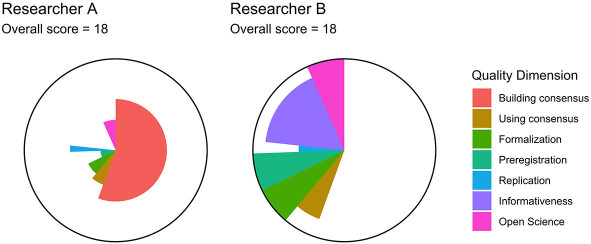
Table 1 may be clustered into 7 broad categories: Building consensus (1a, 2a, 3a, 4a, and 5a), Using consensus (1b, 2b, 3b, 4b, and 5b), Formalization (6a, 6b), Preregistration (7a, 7b), Replication (8), Informativeness (9a–9d), and Open Science (10a–10e). Aggregating across a researcher's (e.g., most recent) publications and then visualizing scores in these seven categories separately may be helpful for various purposes: For example, it may be used to identify
areas of possible improvement in that researcher's habitual research practices (e.g., Peter never cared much about replication so far, but he should). When combined with an annotated CV (
Dougherty et al., 2019), such an analysis may also be used to make transparent certain unavoidable
impediments to implementing desirable research practices that are owed to a particular researcher's field of study. For example, if Trudy studies patients with very rare conditions, that will make it much harder for her to obtain large samples, or to run many replications. Still, Trudy could aim for robustness of her research in other areas, such as pre-registration.
Such a more differentiated analysis of individual researchers’ Good Science profiles is also well in line with a “compensatory” philosophy in which not everyone can be equally good at everything. For example, researchers who invest the great effort that consensus-building requires will almost by necessity have less time and energy available to invest into empirical studies, and thus be unable to obtain many points on criteria related to such studies. Both types of Good Science should be rewarded, however. This is showcased by the two profiles displayed in
Figure 1. Both of the two hypothetical researchers (A and B) whose profiles are displayed here attain the same overall score (18), but by different means. Needless to say, such analyses may also be conducted at even higher levels of aggregation (e.g., whole departments).
Top-Down vs. Bottom-Up Implementation
Organizational change is rarely easy. When asking who would be responsible for implementing the changes we propose here, several possible agents come to mind. Individual researchers may do a lot to improve the quality of their own research all by themselves. For example, they may pre-register their research designs and analysis plans, and make their materials, data, and code publicly available. They may also start co-ordinating better with other researchers in terms of terminology and measurement practices, possibly resulting in some sort of preliminary, local consensus among them. This is the bottom-up or “grass roots” approach to change, and we are happy to see more and more personality scientists go down that road already, even against the current incentive structure.
However,
institutions need to embrace these new evaluation practices as well (cf.
Dougherty et al., 2019). For example, every psychology department has the responsibility to determine how much weight it will assign to indicators of research quality in making decisions as to who gets a job interview, an award, a bonus, or tenure. The current paper contains a concrete proposal for how a better incentive structure might look like. If Good Science indicators play too little of a role in making these decisions, it is the responsibility of the people within a department to demand and ensure changes to the current incentive structure. Notably, the bulk of this responsibility falls on the
senior department members (
Chapman et al., 2019), because they have the greatest power to actually change the rules. To facilitate an increased use of quality-weighting, it may also be helpful to rethink and improve rewards for committee work.
It is not unheard of, however, that people within a department pass the responsibility for implementing the necessary changes on to the people at the next higher level (i.e., their university leadership) who then externalize that responsibility completely (e.g., to the institutions compiling university rankings, whose evaluation criteria “we will never be able to change”). Also, there is undeniably a multi-level social dilemma involved here (
Nosek & Bar-Anan, 2012) in that individuals and institutions who actually dare to move away from behaviors that accord with the current incentive structure will necessarily be disadvantaged for some time, as long as this incentive structure persists.
Given this social dilemma, some relatively technical counter-measures such as “critical mass building” have been proposed (
Nosek & Bar-Anan, 2012). Under this approach, more and more researchers would commit to different behavioral standards, but but these commitments would only become effective once a sufficiently large number of their colleagues has done so, as well. Despite being theoretically sound, however, we are fairly skeptical that such an approach will ever be actually be implemented. The much more promising approach would be for individual researchers to change their ways and starting doing their research differently, explicitly accepting the disadvantages that this will earn them under the current incentive structure, in the service of better science. Again, the main responsibility for promoting change this way lies with tenured faculty because for them it
does take courage to do so (e.g., go against the expectations of their institution's leadership), but it will
not cost them their careers and/or livelihoods.
In addition, it would certainly be very helpful if academic societies also endorsed the idea of explicitly rewarding people for engaging in Good Science practices. In our case (personality psychology), this would concern societies such as ARP, EAPA, EAPP, DGPs-DPPD, ISSID and/or SPSP. Furthermore, substantial enforcement power also lies with academic journals and funding agencies, whose policies should also reflect Good Science principles as much as possible.