Super Smash Bros. Ultimate isn’t content being merely a “big” video game. Nintendo’s latest mascot-fighter sequel seems determined to wallop you over the head with its enormity, even after establishing itself as an oversized package.
It’s not enough that the game ships with dozens of gaming-nostalgia icons. The big-name Nintendo mascots (Mario, Link, Pikachu), the more obscure company wild cards (Ice Climbers, ROB, “Dark” Pit), and the beloved third-party guests (Solid Snake, Sonic the Hedgehog, Final Fantasy VII‘s Cloud) are all back from older Smash games, fulfilling the development team’s “every fighter ever” promise. They’re joined by a cast of very welcome (and masterfully designed) newcomers, bringing the fighter selection up to 74.
But, wait, there’s more: you’ll fight across 103 battle arenas and bust out dozens of the game’s items, assist trophies, and Pokemon helpers. If you were to shuffle the game’s variables before every basic versus match, you’d likely need years to see the same battle appear twice. It’s a lot—and that’s not even counting the value of the seam-busting soundtrack.
Yet someone at the combined development teams of Sora Ltd and Bandai-Namco couldn’t leave well enough alone. They were determined to deliver even more by way of a ridiculous combatant count: more than 1,200 classic characters. To be fair, this comes by way of a gimmick—a new single-player “Spirits” mode. Luckily for fans, the way Smash Ultimate achieves this ludicrous count is quite interesting, and occasionally fascinating.
Spirits isn’t executed perfectly, and the single-player mode leaves a noticeable crater in the rest of the package—at least, if you come to Smash Ultimate expecting certain elements from earlier in the series to return. (After nearly 20 years of Smash games, that’s likely.) But there’s a reason Smash Ultimate can get away with its bonkers, thousand-fight conceit, especially during that mode’s pacing fumbles.
The basic fact is, we could spend this entire review just talking about how refined, measured, and satisfying it is to pick up controllers and get into a four-player beatdown with friends. Smash Ultimate‘s basic foundation is good. Top-of-the-year good. Why-we-love-video-games good. And, thank goodness, the game’s obsession with being capital-B Big doesn’t get in the way of that fact.
I have been reviewing Smash games for a long, long time…
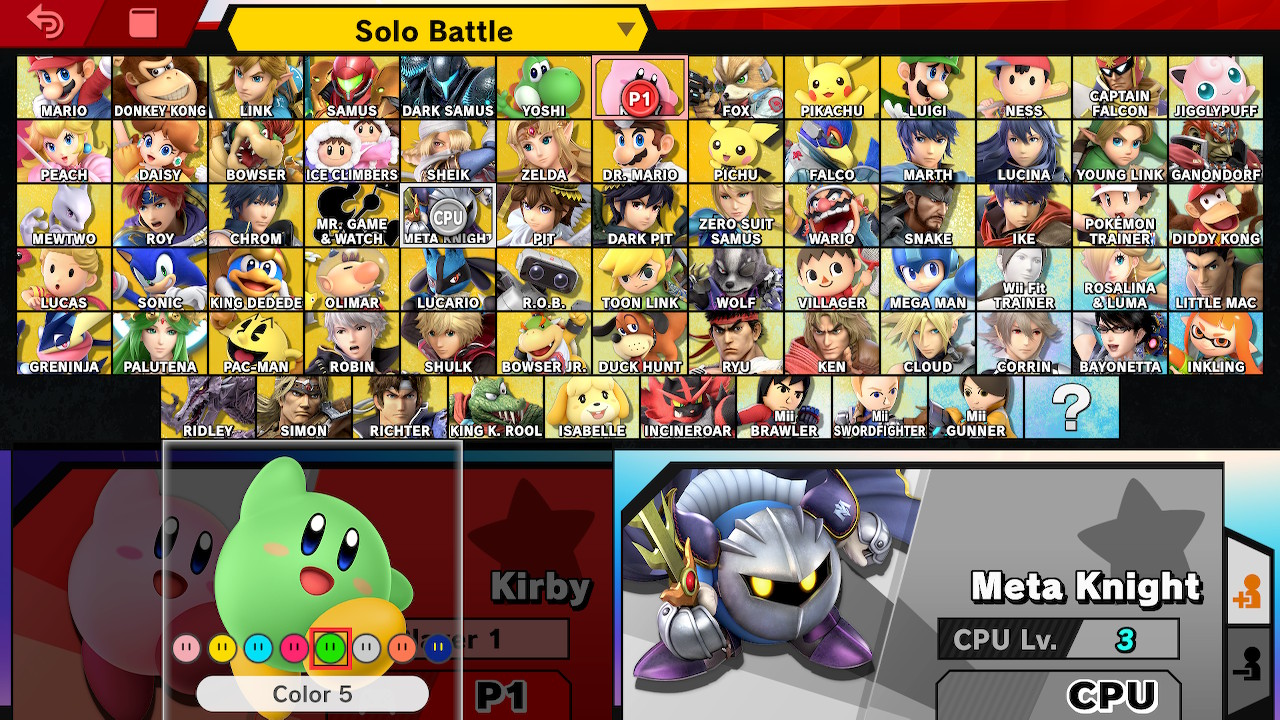
The game’s final roster includes 74 individual characters…
The game’s final roster includes 74 individual characters…
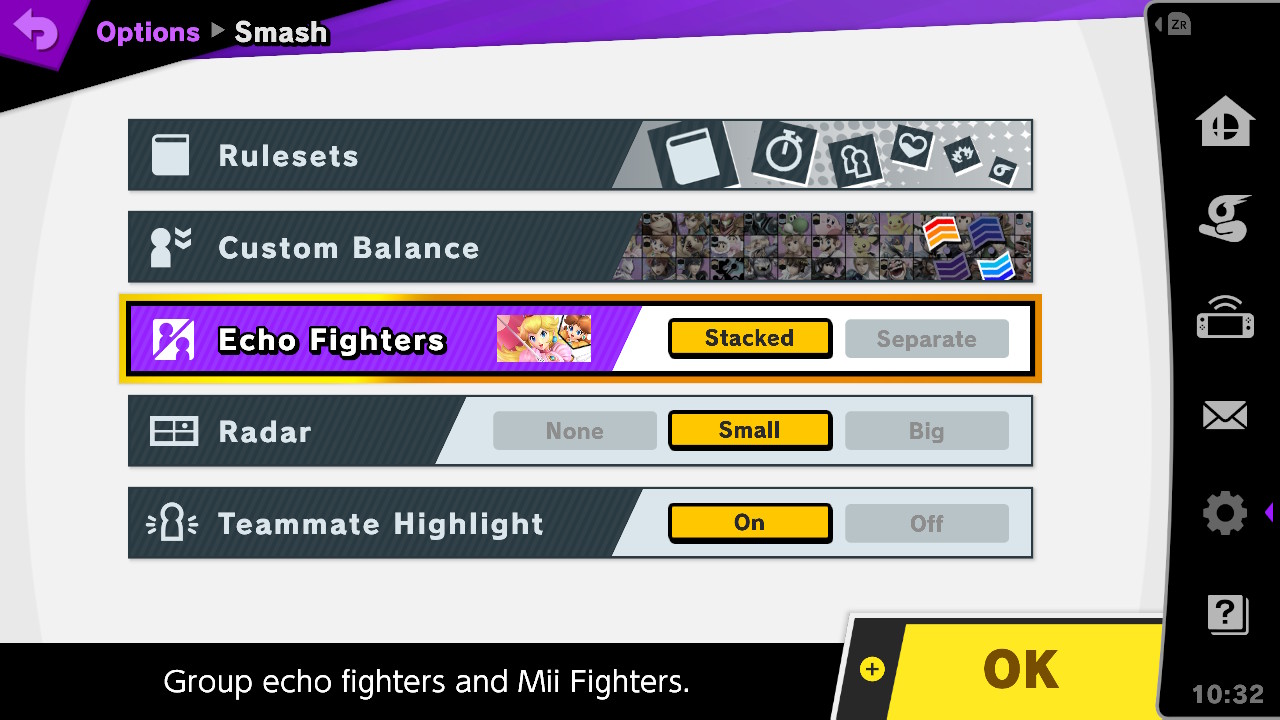
…though nine of these count as “echo” fighters—meaning, they are over 90 percent identical to another character. You can stack “echoes” via a menu toggle, if you’re picky about it.
…though nine of these count as “echo” fighters—meaning, they are over 90 percent identical to another character. You can stack “echoes” via a menu toggle, if you’re picky about it.
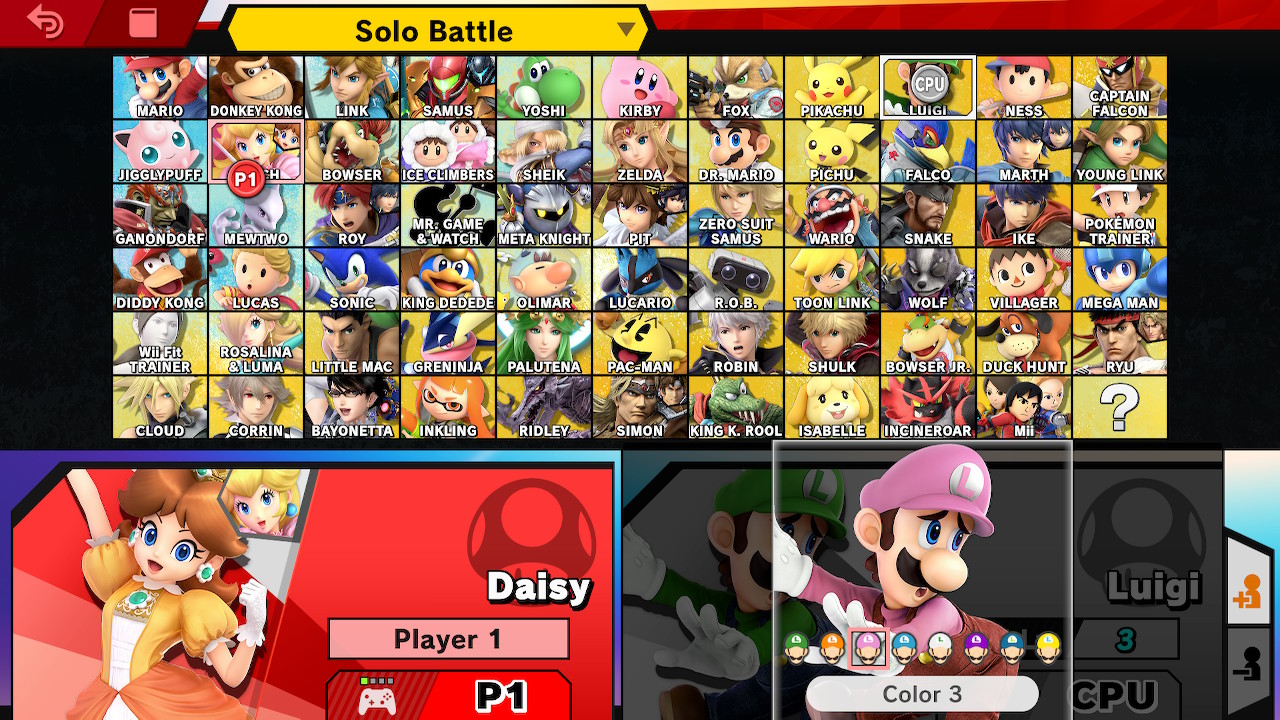
With that toggle active, the roster looks like this, and you pick from either echo by moving your pointer to your chosen character and tapping the alternate image.
With that toggle active, the roster looks like this, and you pick from either echo by moving your pointer to your chosen character and tapping the alternate image.
…though nine of these count as “echo” fighters—meaning, they are over 90 percent identical to another character. You can stack “echoes” via a menu toggle, if you’re picky about it.
With that toggle active, the roster looks like this, and you pick from either echo by moving your pointer to your chosen character and tapping the alternate image.
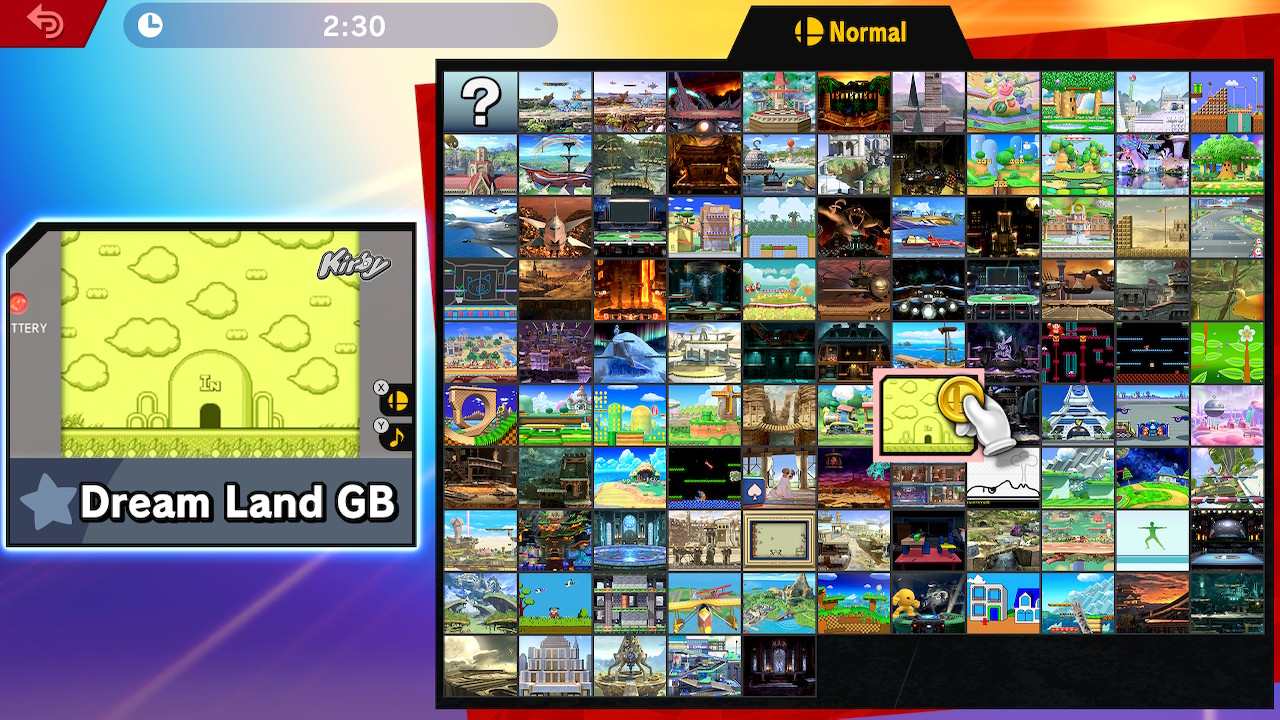
And, here, 103 levels to battle in. Each of these can be turned into “Battlefield” or “Final Destination” variants.
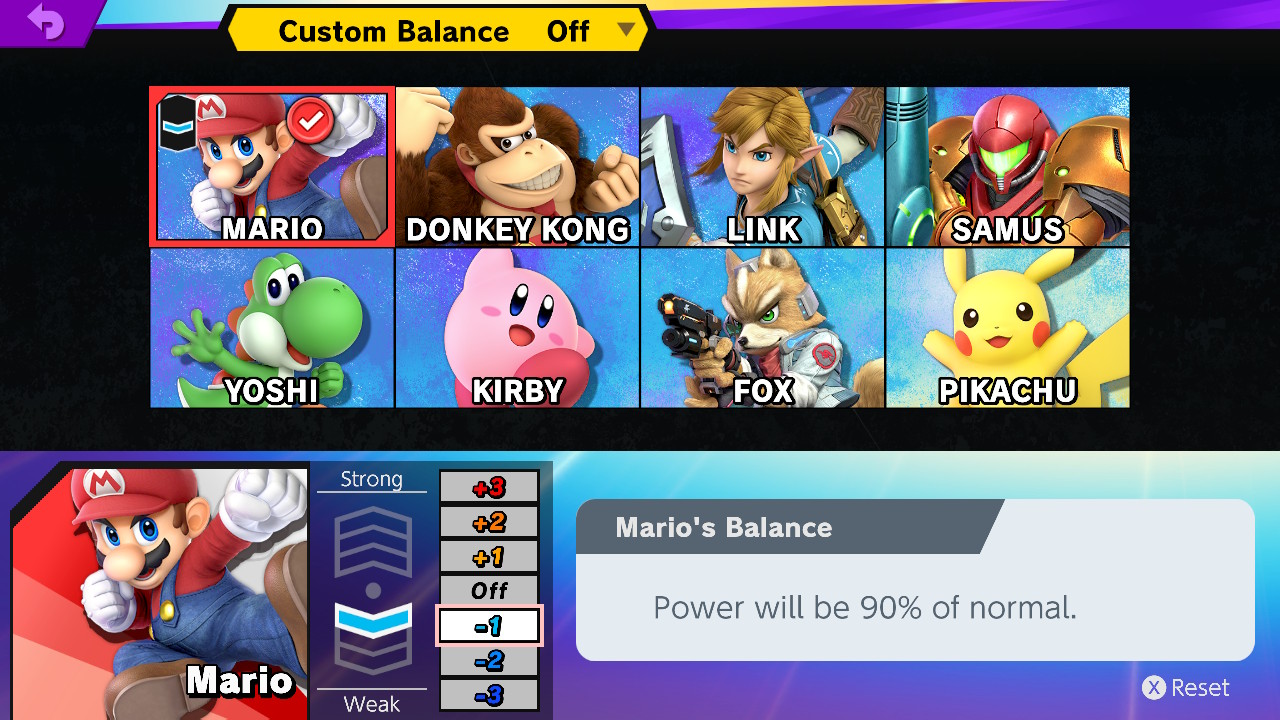
When you first boot Smash Ultimate, you can only use these eight combatants. This is the only screen I grabbed before going on an unlocking spree. This menu lets you adjust universal power tweaks for each, but only for local-versus modes. (Additional handicaps can be applied on top of these.)
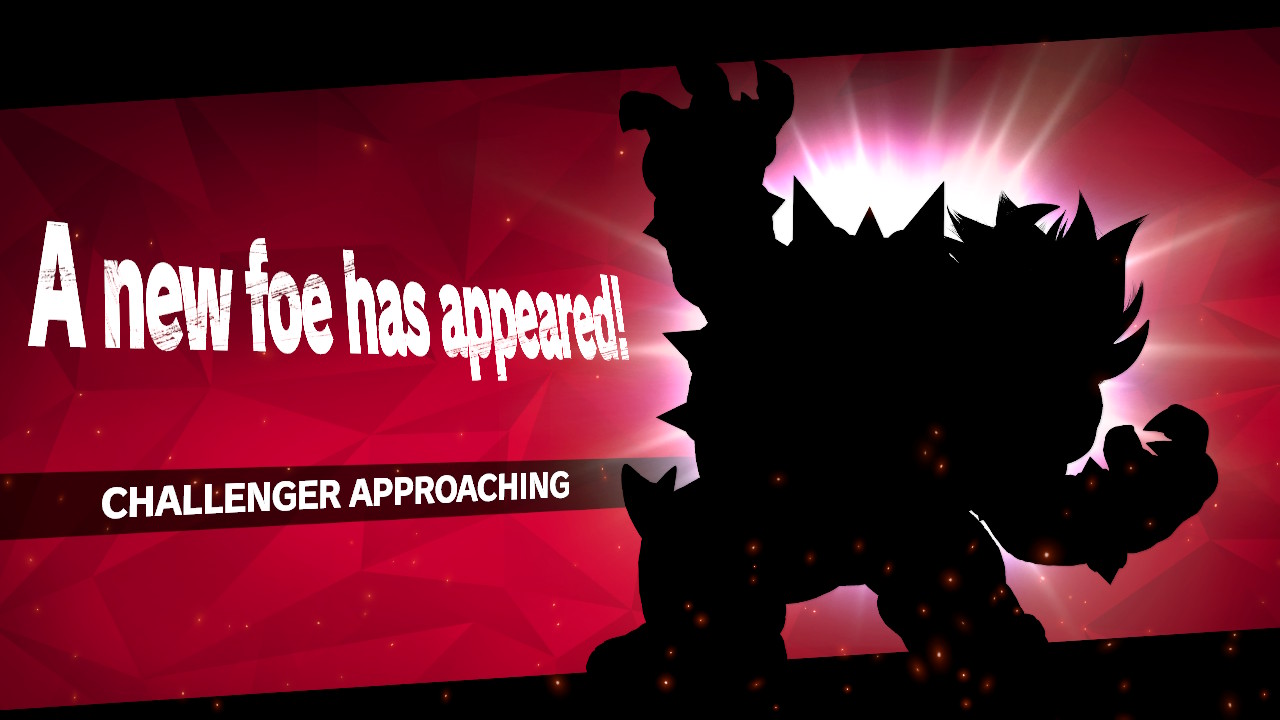
Roughly every 10 minutes, Smash Ultimate serves you a new, locked fighter, which you must defeat in battle to claim as a playable character. These fights start out easy but become harder as you reach the 50s, 60s, and 70s.
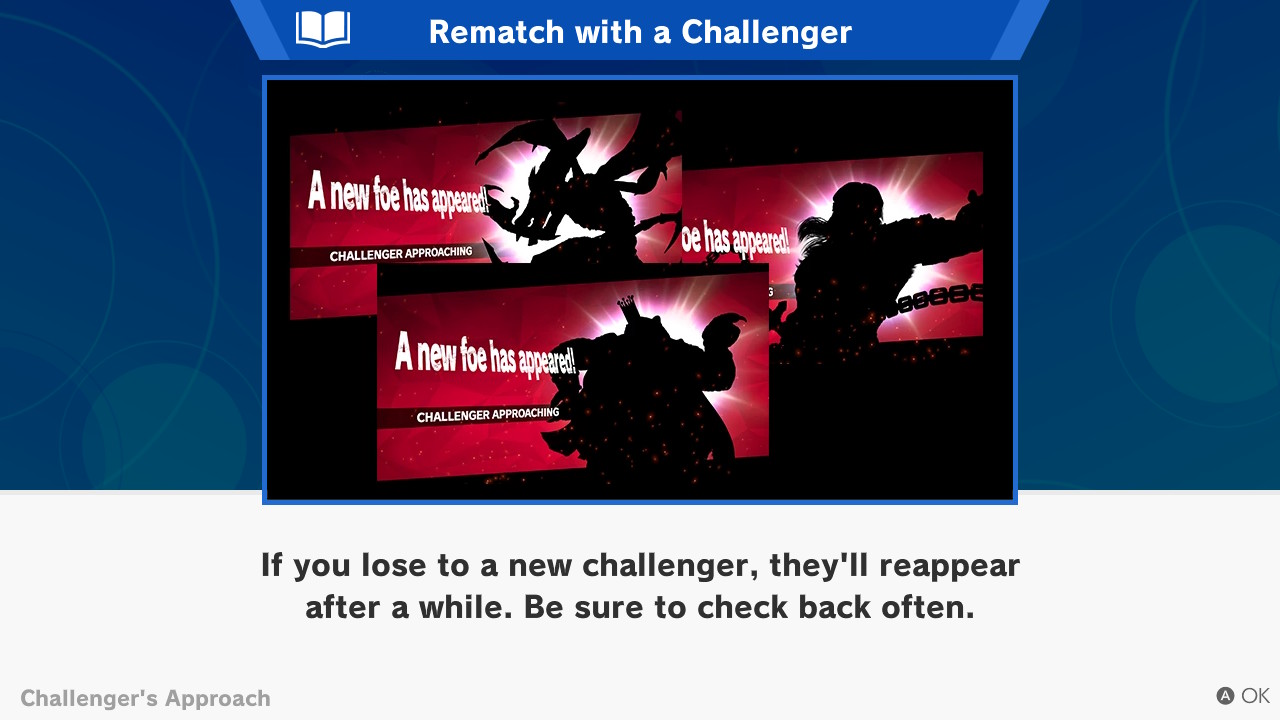
Losing isn’t the end of the world. They all come back for rematches (and get a little easier each time, in the case of tough ones). I only needed two days of “yes new Smash game!” excitement to unlock the full cast.
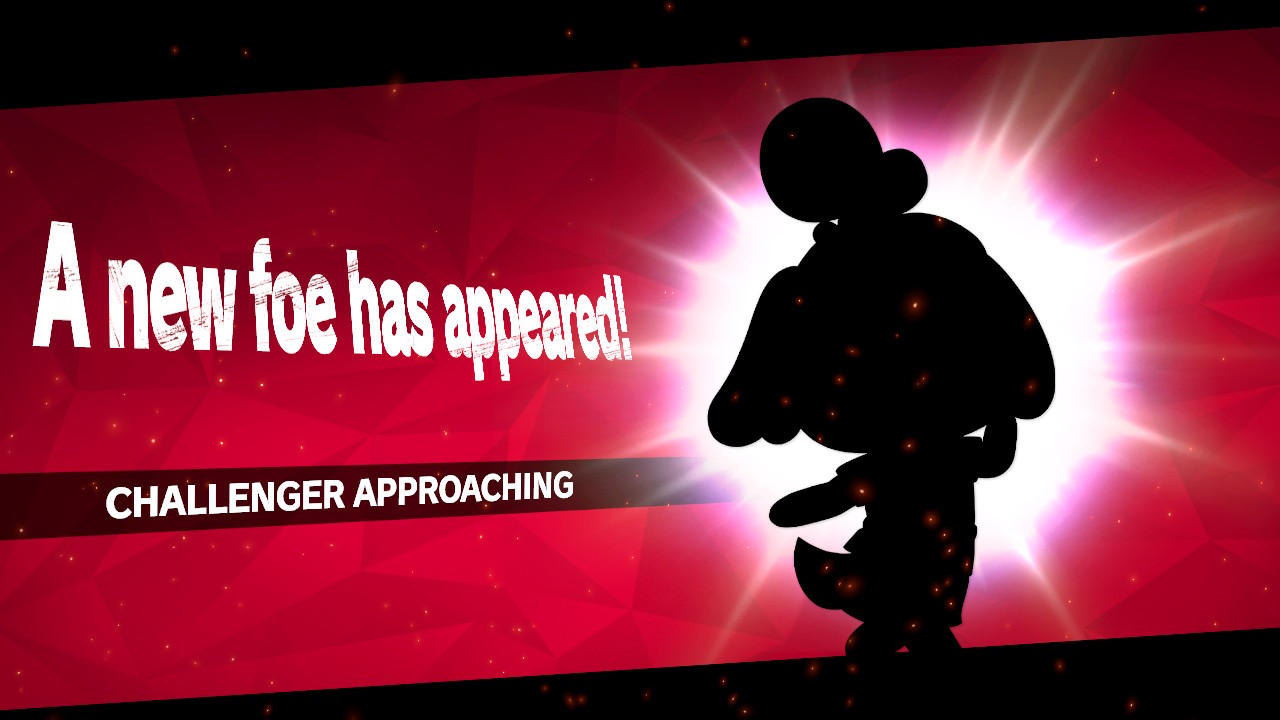
Who’s that Pokem—er, not a Pokemon.
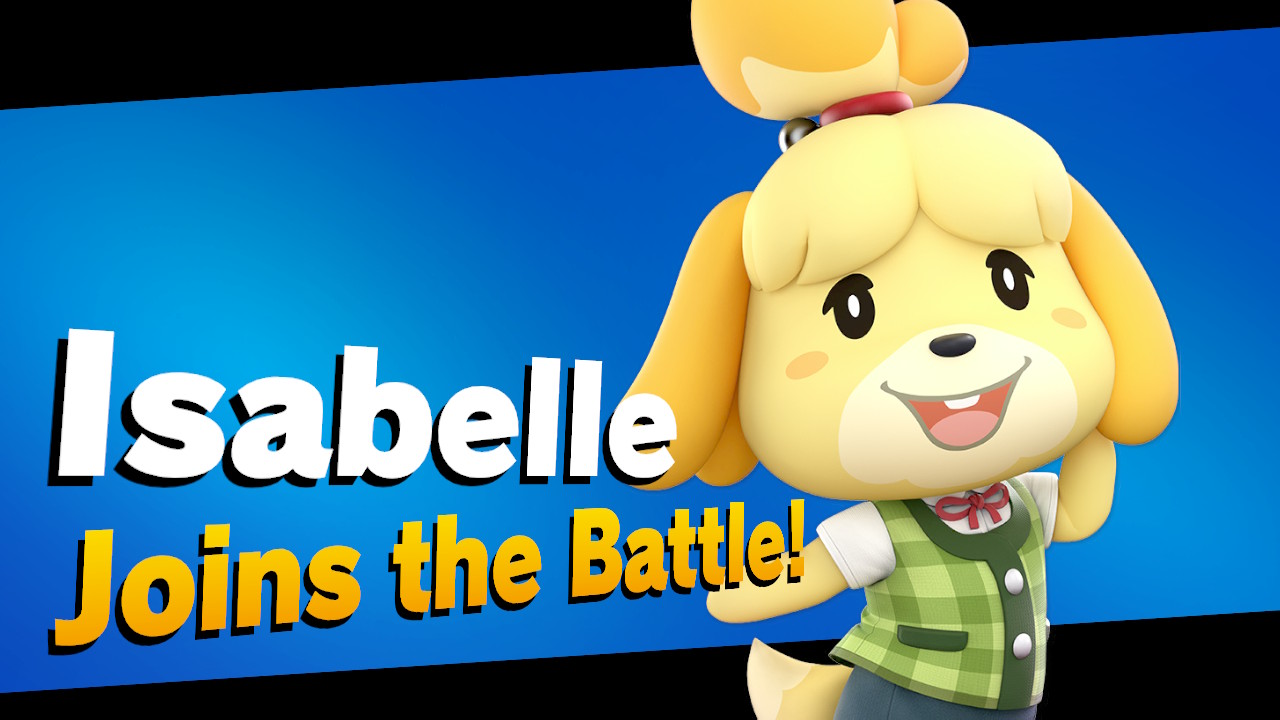
Yay! (She’s great.)
Unsure what Smash Bros. is all about? For a refresher, return to our review of the series’ 2014 entries on either 3DS or Wii U… or rewind back to April 1999, when my 17-year-old self reviewed the series’ first N64 game for the Dallas Morning News. As I wrote back then:
The fighting system is remarkably different than most street fighters. Players fight on top of a floating platform, and the object is to knock all opponents off. Thus, mindless button-mashing won’t win the fight alone, as proper technique is needed to stop an opponent from jumping back onto the platform. Also, players don’t have to memorize ridiculous 20-button combos, because game play requires only three buttons and the analog stick. This simplicity makes the game accessible to any novice, but experts will appreciate how much strategy the game’s unique style offers.
In the years since, Smash Bros‘ core fisticuffs have stuck to this philosophy while expanding the selection of fighters and items. Though Ultimate has dozens more new items, their sum-total impact is pretty much the same as in other Smash games. Leave them on, and your fight strategy will revolve around movement and control of these tide-turning items. Otherwise, they all pretty much work in a “get item, get boost” way, so the ability to customize which ones appear (or remove them altogether) is appreciated. Play with them on for zany fun that drives every player equally insane; turn them down and cull your favorites for some classic, Mario Kart-style juice; or turn them off for pure Smash combat.
As for the cast, 2008’s Smash Bros. Brawl was the first to kick any of the series’ older characters to the curb, while 2014’s Smash 4 left a few fighters behind—but neither was a slouch in beefing up the combatant roster. Simply getting all of those characters back as a full-cast reunion gets the count up to 63 (this tally combines three Pokemon monsters as a single “Pokemon Trainer” fighter, to be specific).
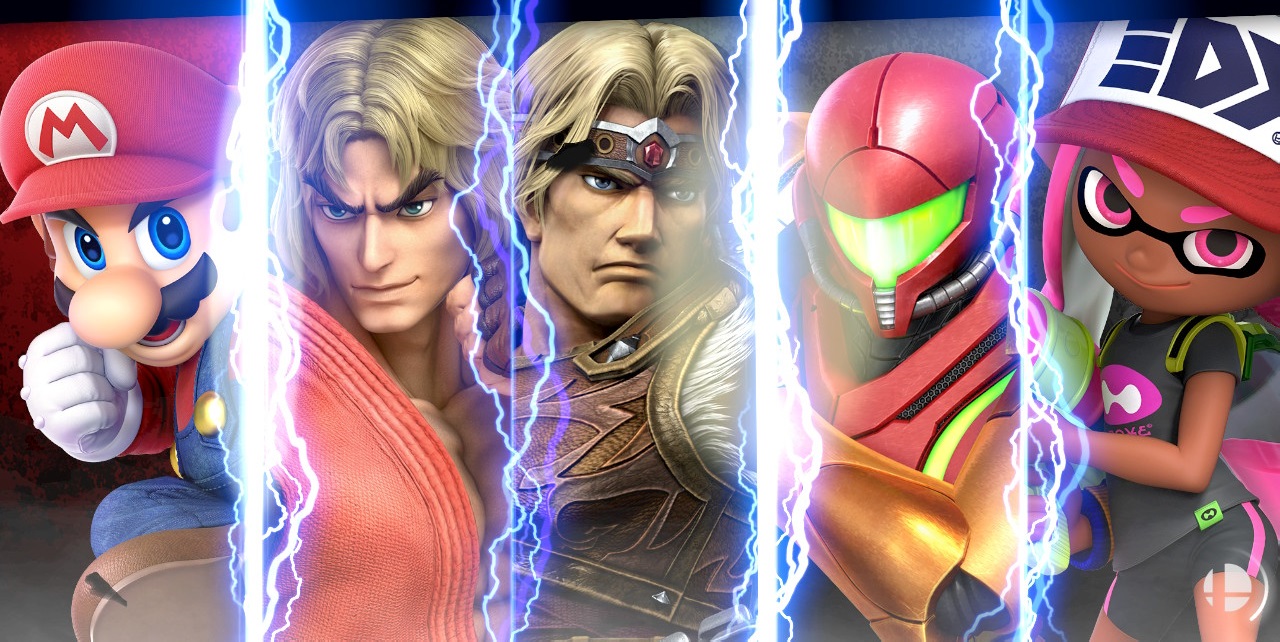
Those 63 returning faves are joined by another 11 newbies, but technically, five of these “brand-new” cast members are actually known as “echo” fighters—meaning, they’re over 90 percent identical to another cast member. One example of this is Smash 4‘s Ryu from the Street Fighter series. He’s back in Ultimate, and he’s joined by a new-to-Smash fighter you may have heard of: Ken Masters. Just like in Street Fighter, Ken and Ryu have largely identical move sets with subtle differences in animations, speed, power, and specific perks.
Fighters old and new, together at last
The brand-new character count, then, is six: King K. Rool (Donkey Kong Country), Isabelle (Animal Crossing), Simon Belmont (Castlevania), Inkling (Splatoon), Ridley (Metroid), and Incineroar (Pokemon). And I’m in freaking love with this selection of new combatants, mostly because they steer very, very far from the series’ previous obsession with adding too many freaking sword-fighters.
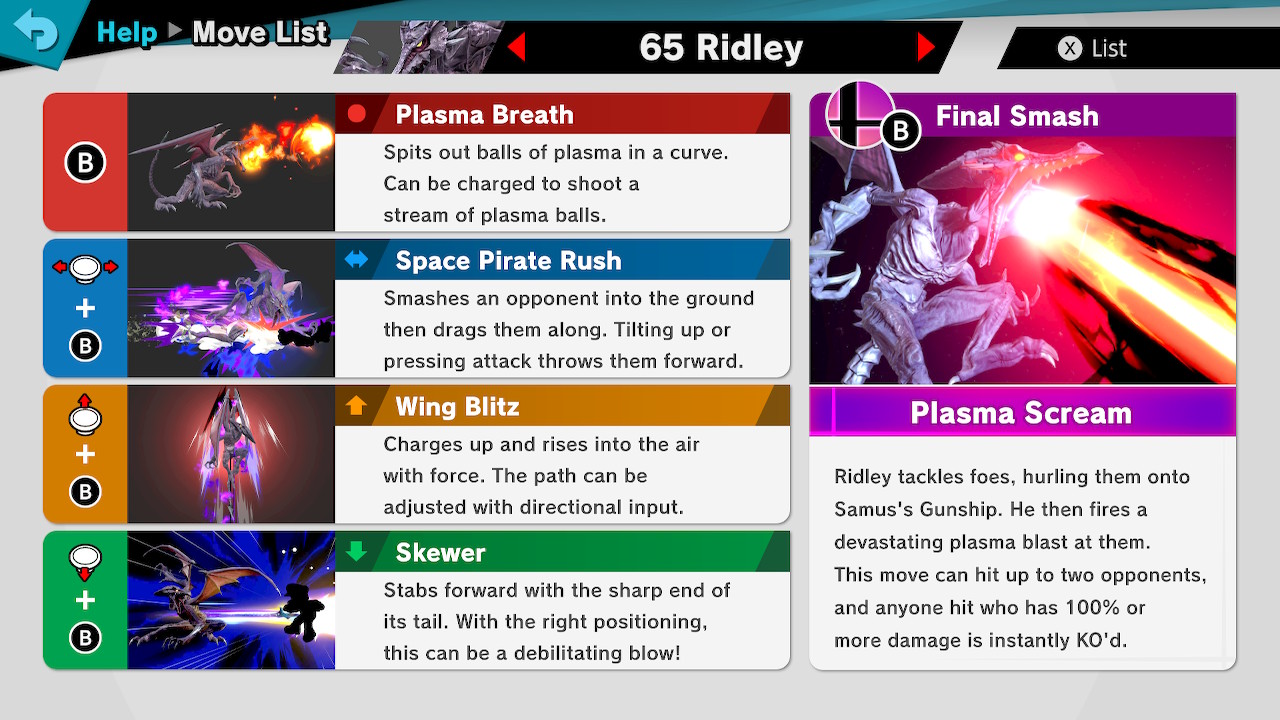
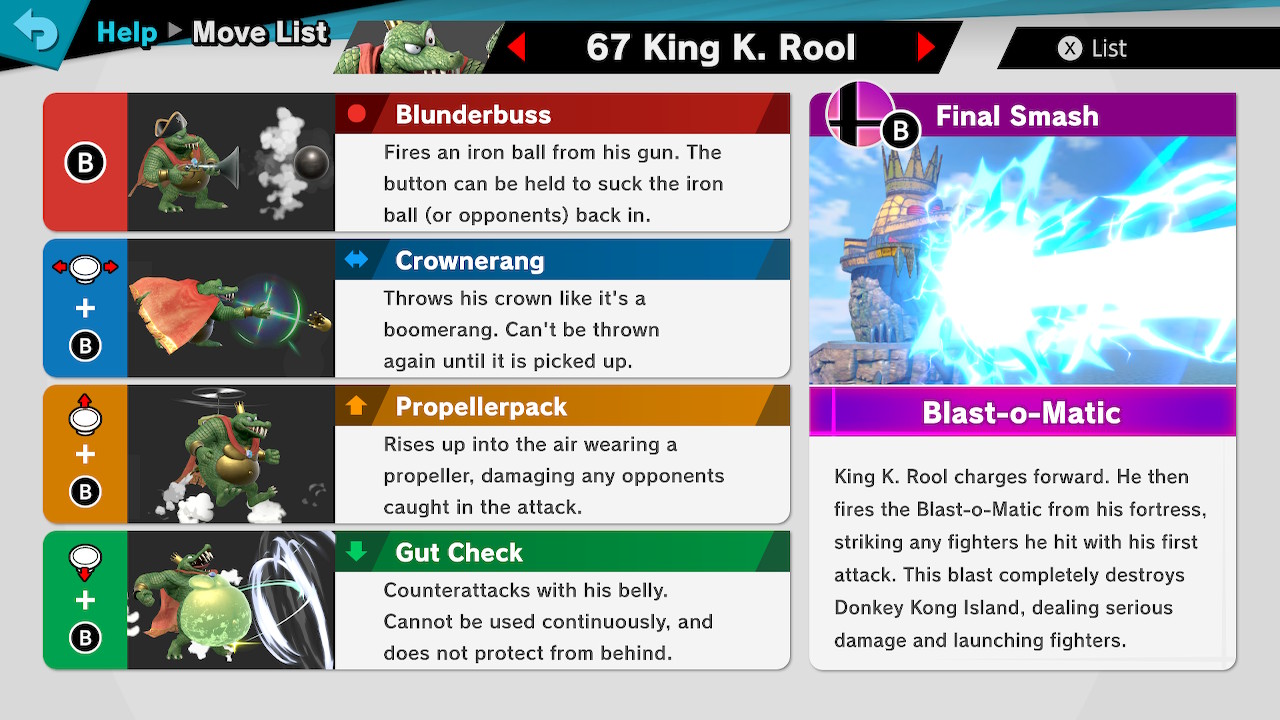
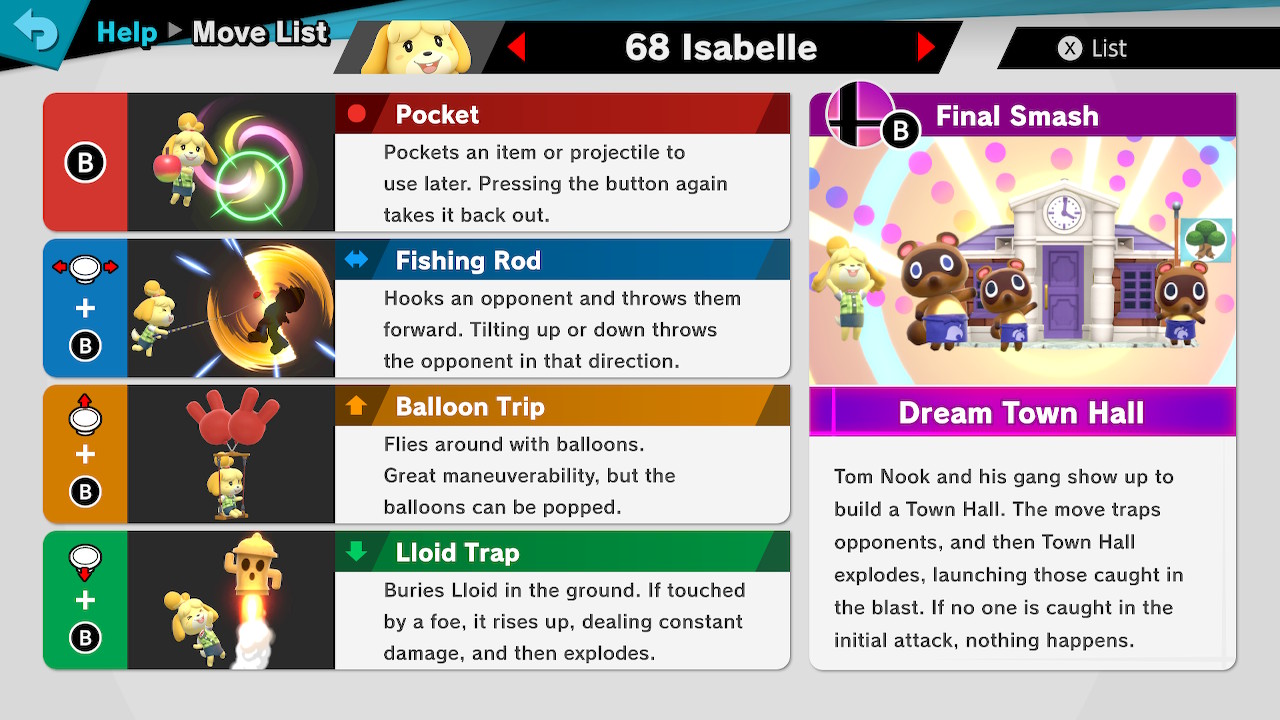
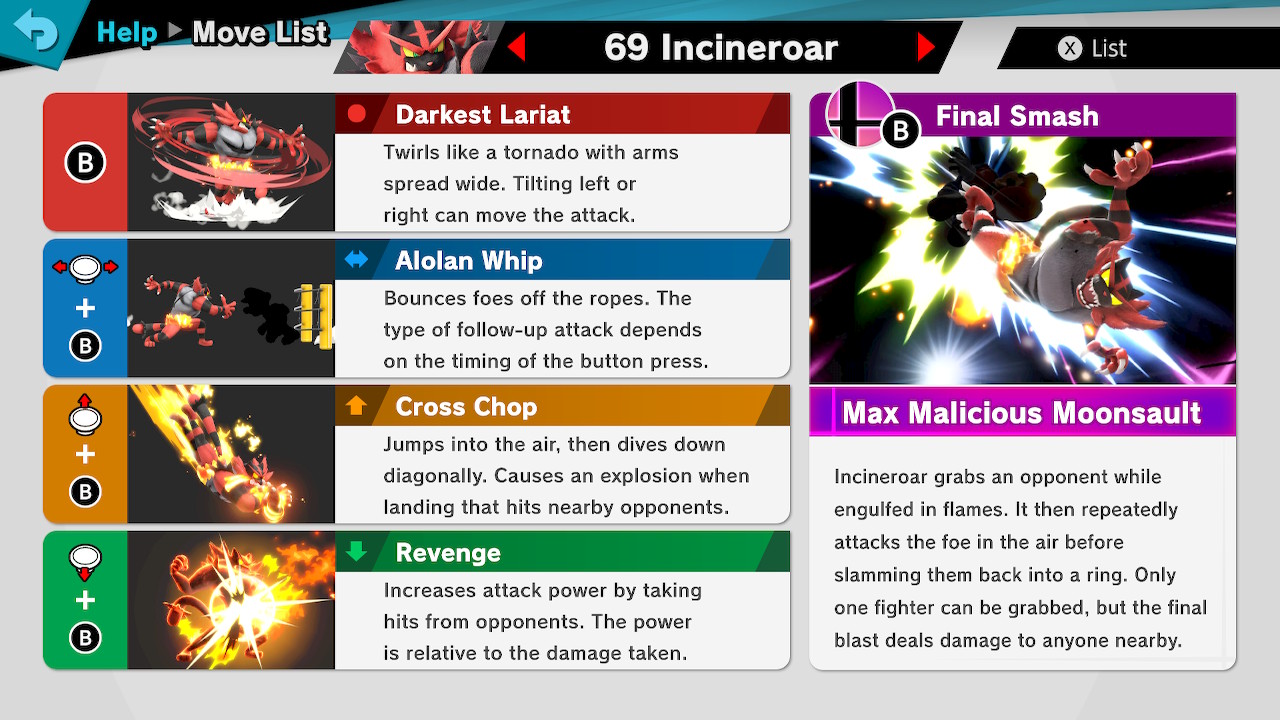
Want to know more about this sequel’s brand-new characters? Here, read about their special moves in the game’s help menus. Ridley’s Space Pirate Rush is a momentum-turner of a dash attack.
Want to know more about this sequel’s brand-new characters? Here, read about their special moves in the game’s help menus. Ridley’s Space Pirate Rush is a momentum-turner of a dash attack.
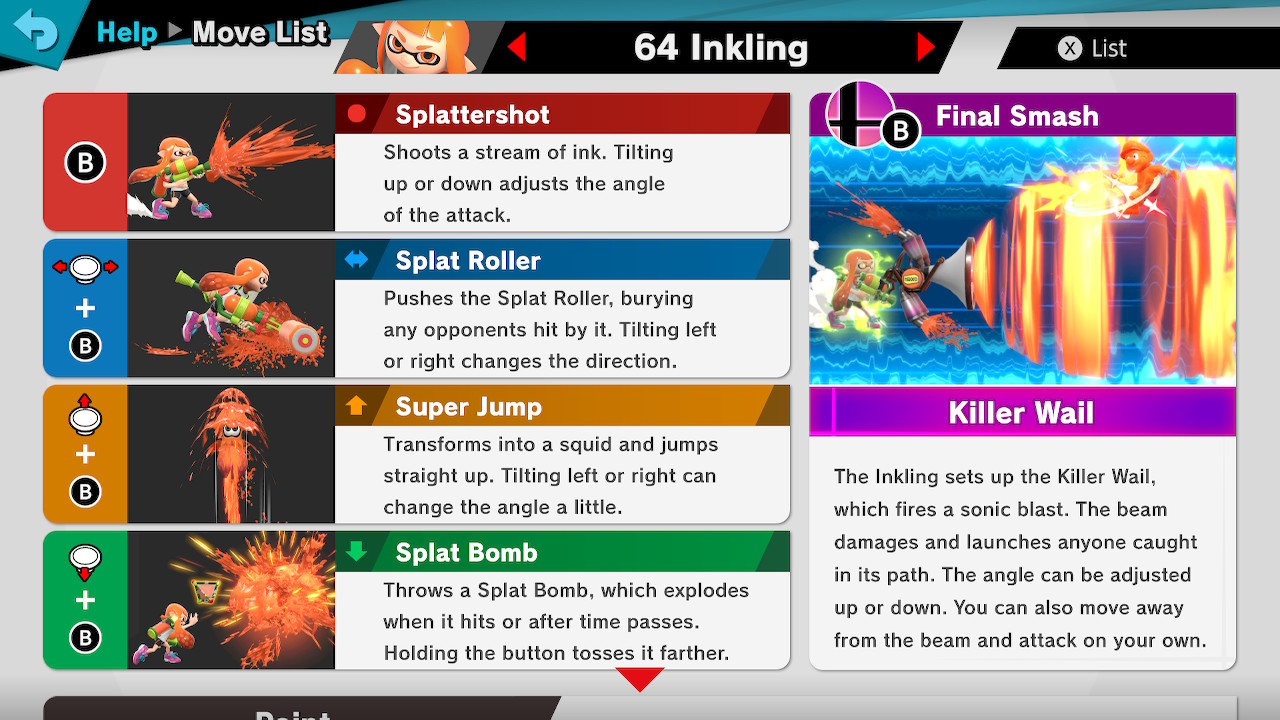
Missing here: an explanation of Inkling’s need to refill its paint meter, which can be done by pressing “dodge” and “down-B” at the same time.
Missing here: an explanation of Inkling’s need to refill its paint meter, which can be done by pressing “dodge” and “down-B” at the same time.
The neutral-B Blunderbuss includes two functions, which makes it a multiplayer-combat stunner.
The neutral-B Blunderbuss includes two functions, which makes it a multiplayer-combat stunner.
Missing here: an explanation of Inkling’s need to refill its paint meter, which can be done by pressing “dodge” and “down-B” at the same time.
The neutral-B Blunderbuss includes two functions, which makes it a multiplayer-combat stunner.
Beware Isabelle’s incredible zone-control moves, particularly her Fishing Rod and Lloid Trap. (The latter either works as a proximity mine or a remotely triggered rocket.)
Timing matters with Incineroar’s Alolan Whip, which throws foes into a wrestling-style wall of ropes.
King K. Rool and the Inkling deliver guns and gadgets; Simon Belmont balances slow reaction time with useful items and insane reach; Ridley adds new blood to the game’s slow-and-heavy selection; and Incineroar counts as the series’ first true “luchador” wrestler, with high-speed, quick-reversal options up his furry sleeves. Isabelle is the bonkers wild card above all of those, surprisingly. Though her move set has a few things in common with the other Animal Crossing fighter (Villager), her arsenal includes entirely new zone-controlling moves like a plantable rocket, which goes off either via proximity or by Isabelle’s trigger, and a fishing rod, which lets the fighter lay out a nasty wired trap.
Each character has its share of subtle weirdness and weaknesses, and breaking this down requires using some of the series’ special-move parlance. For example, King K. Rool has a painfully long recovery time attached to his “up-B” special, which has him float a very long distance upward—so he can get out of more pinches, but the character will likely land in even bigger trouble as a result. Yet K. Rool also gets a secondary function out of his neutral-B cannon-shotgun attack: hold the button down after shooting, and the gun becomes a suction tube that can grab a foe, then launch it sky-high. (Oh, and his floaty up-B jump can also attack enemies, should its propellers hit anyone above.)
Ridley, meanwhile, is a slow, lumbering beast with a hair-trigger run speed—so the fighter is surprisingly touchy, and its side-B special includes a dramatic, screen-crossing rush move that can kill foes as easily as it can kill itself.
Incineroar’s up-close combat prowess comes with a caveat of odd air maneuverability, in that its up-B recovery move will actually dive downward. You’ll want to favor its side-B move, with its decent-length lunge, to bounce around in a pinch. Inkling’s true potential remains to be seen, since playing the character requires managing a “paint” meter of gun ammo. That has slowed down my ability to consistently dole out damage, but mileage may vary for pro players.
As far as returning characters go: we get three versions of Legend of Zelda‘s Link, and if you’re wondering why anyone might need so many Links, Smash Ultimate answers that in satisfying fashion. Vanilla Link, Toon Link, and Young Link offer surprisingly interesting twists on a familiar move suite. Noticeable buffs lift up formerly lower-tier characters like Robin and Sonic, while Ken’s moveset takes the same moves Ryu has and pumps the right amount of secret sauce into them (particularly his flaming dragon punch). And while the customizable “Mii Fighter” choices may never reach tournament-tier status, they offer enough disruptive fun to deserve a spot in your friendly-buddy battle rotation.
Blowing dust off my Wii U Gamepad
Speaking of pros: I’m absolutely not in a position to speak about how top-tier Smash players will rank this game compared to Wii U’s Smash 4, but they’ll likely feel a sense of deja vu.
In studying the returning combatants, I put a Wii U Gamepad side by side with my Switch in portable mode, then studied a dozen characters’ movements when pressing buttons simultaneously. I found that Smash 4‘s polygonal designs, animations, and frame timings have pretty much all been carried forward to Ultimate. Some characters have different body orientations this time (perhaps facing more toward the camera or standing with legs bent differently), while other visual flourishes emerge (like more sparkly effects from Captain Falcon’s biggest punch), but melee flurries, special moves, jump cycles, and run speeds all look incredibly familiar.
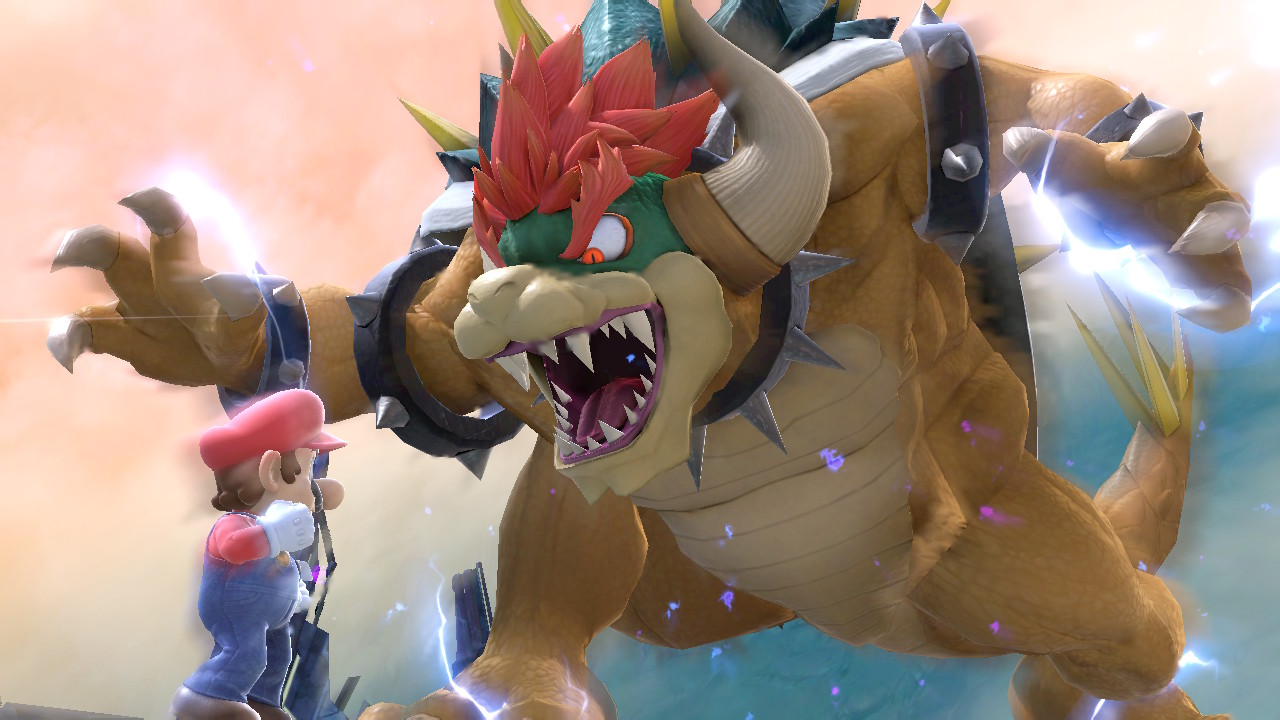
A Classic mode example of a boss encounter. Hi again, Giga Bowser.
A Classic mode example of a boss encounter. Hi again, Giga Bowser.Sam Machkovech
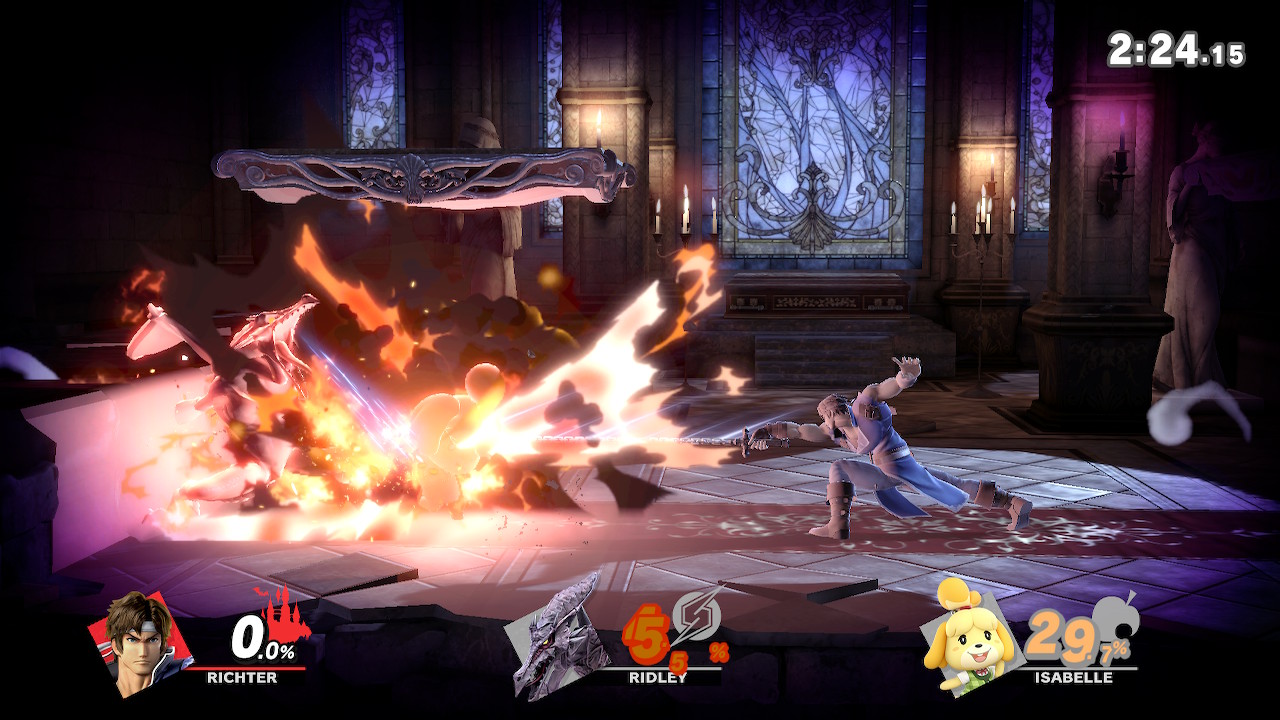
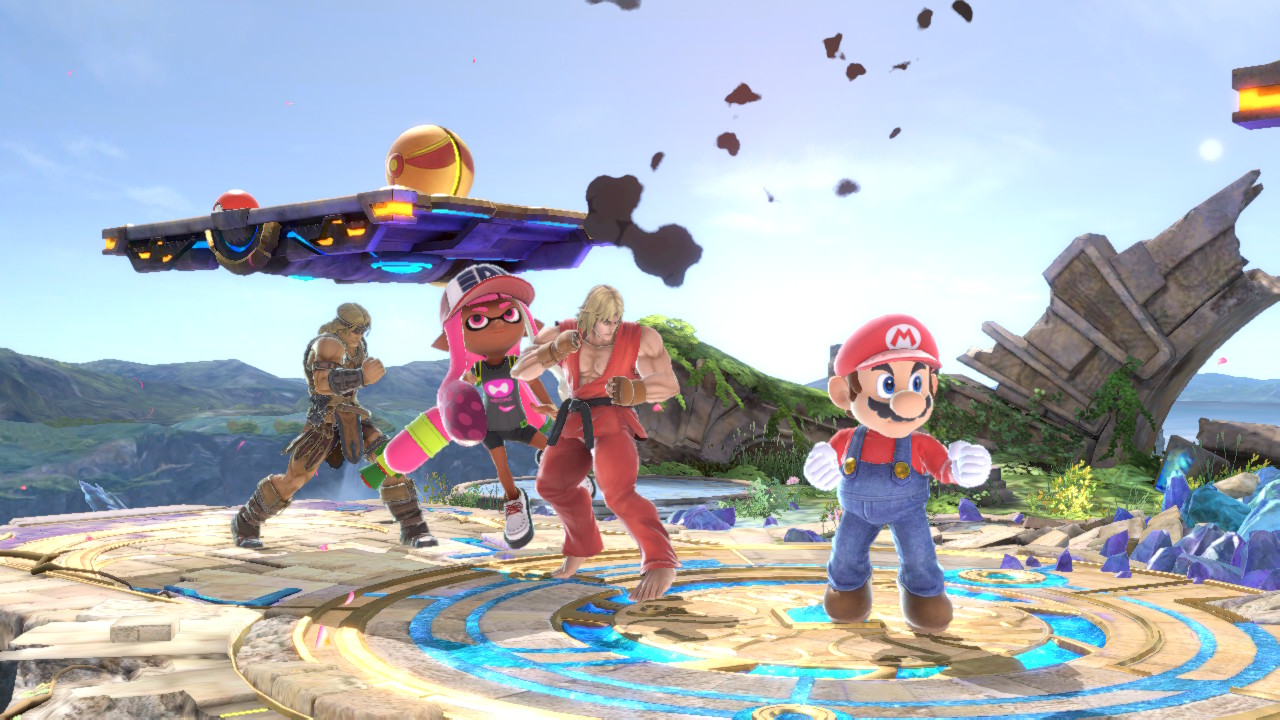
Newcomer Simon brings the whip-fueled pain.
Newcomer Simon brings the whip-fueled pain.
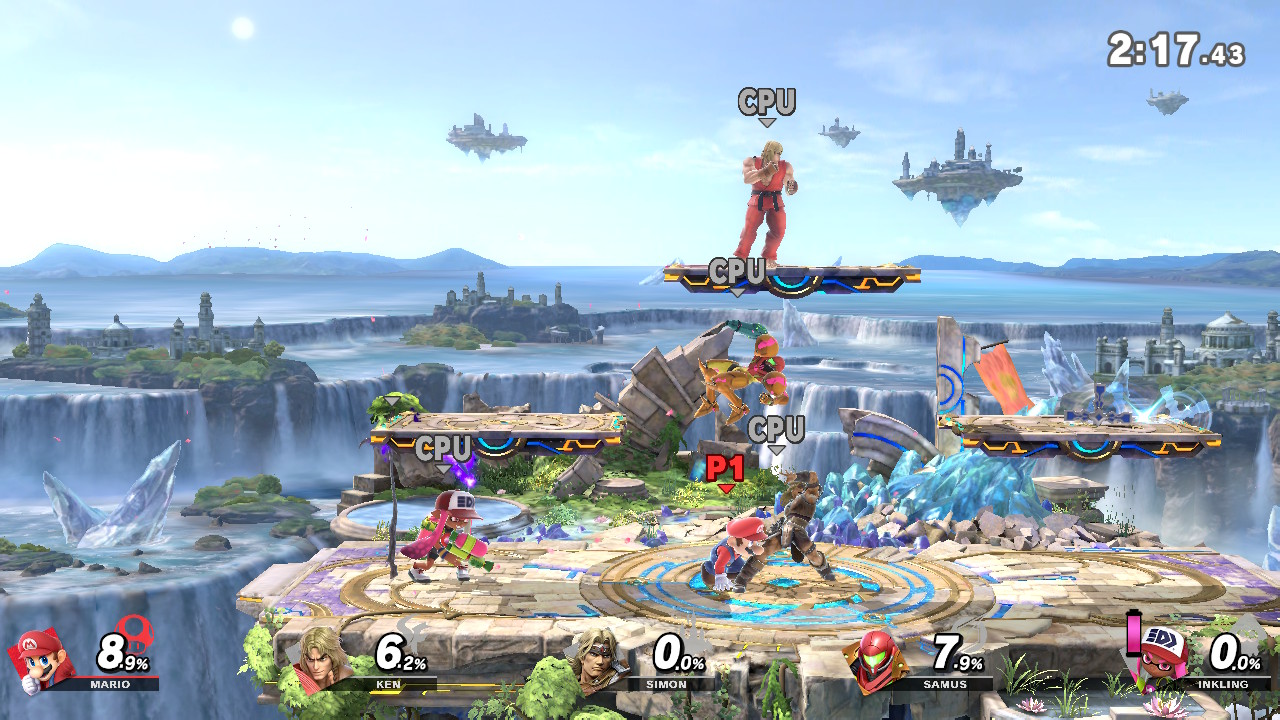
Combat tends to look bright and frenetic—so the anti-aliasing stinks, but the image is about as clean and clear as you can expect from this kind of item-filled frenzy.
Combat tends to look bright and frenetic—so the anti-aliasing stinks, but the image is about as clean and clear as you can expect from this kind of item-filled frenzy.
Newcomer Simon brings the whip-fueled pain.
Combat tends to look bright and frenetic—so the anti-aliasing stinks, but the image is about as clean and clear as you can expect from this kind of item-filled frenzy.
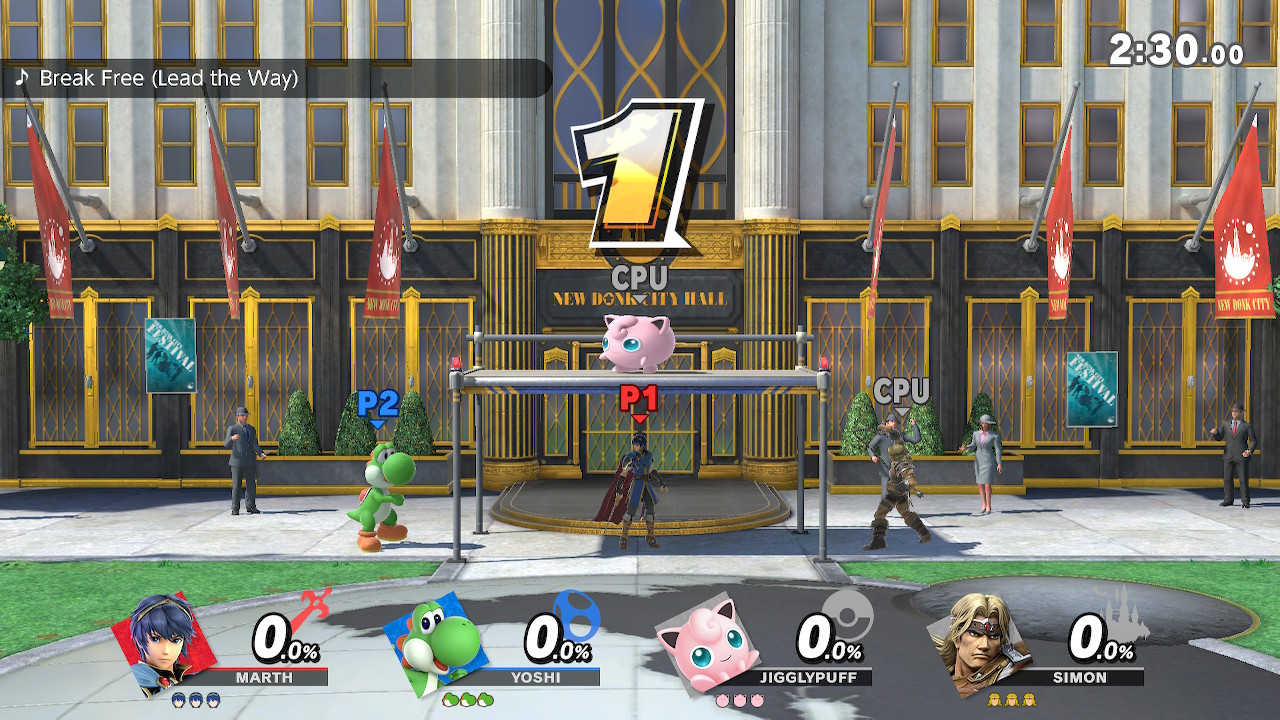
Another look at in-game action, taking place on the brand-new New Donk City level.
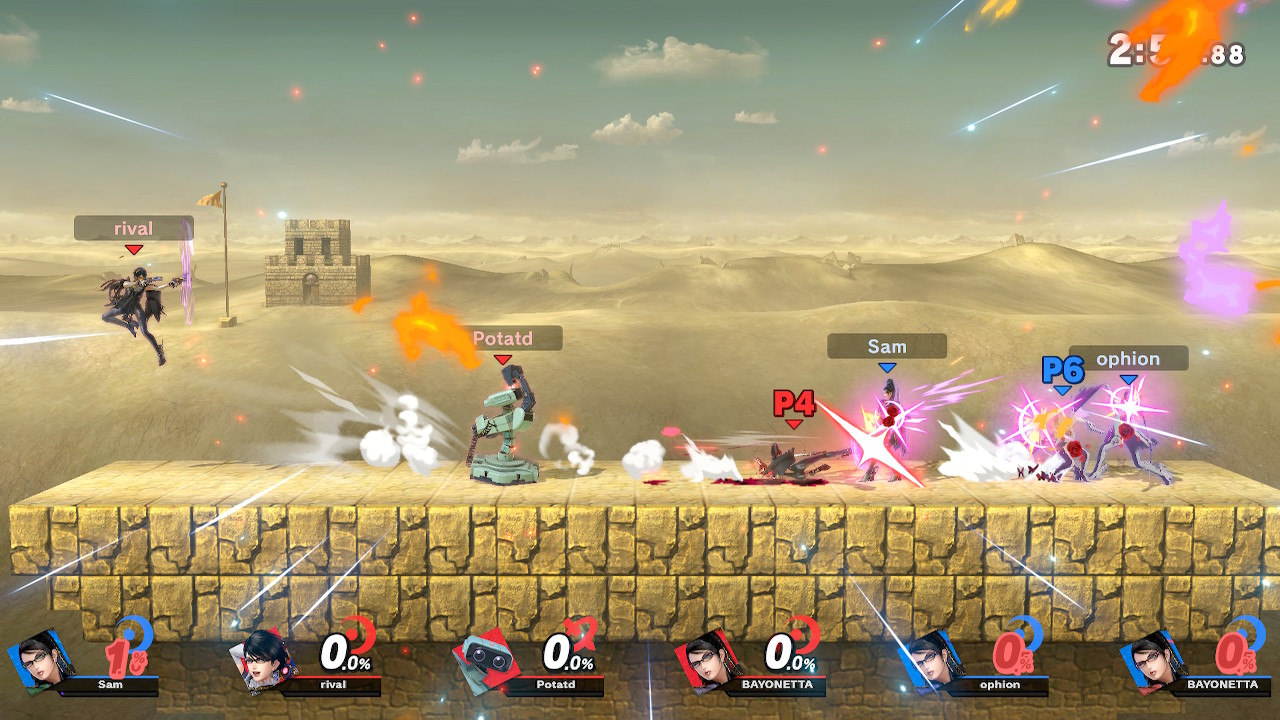
It’s easy to get the action up to eight players. Here’s a three-on-three team battle, made up mostly of Bayonettas.
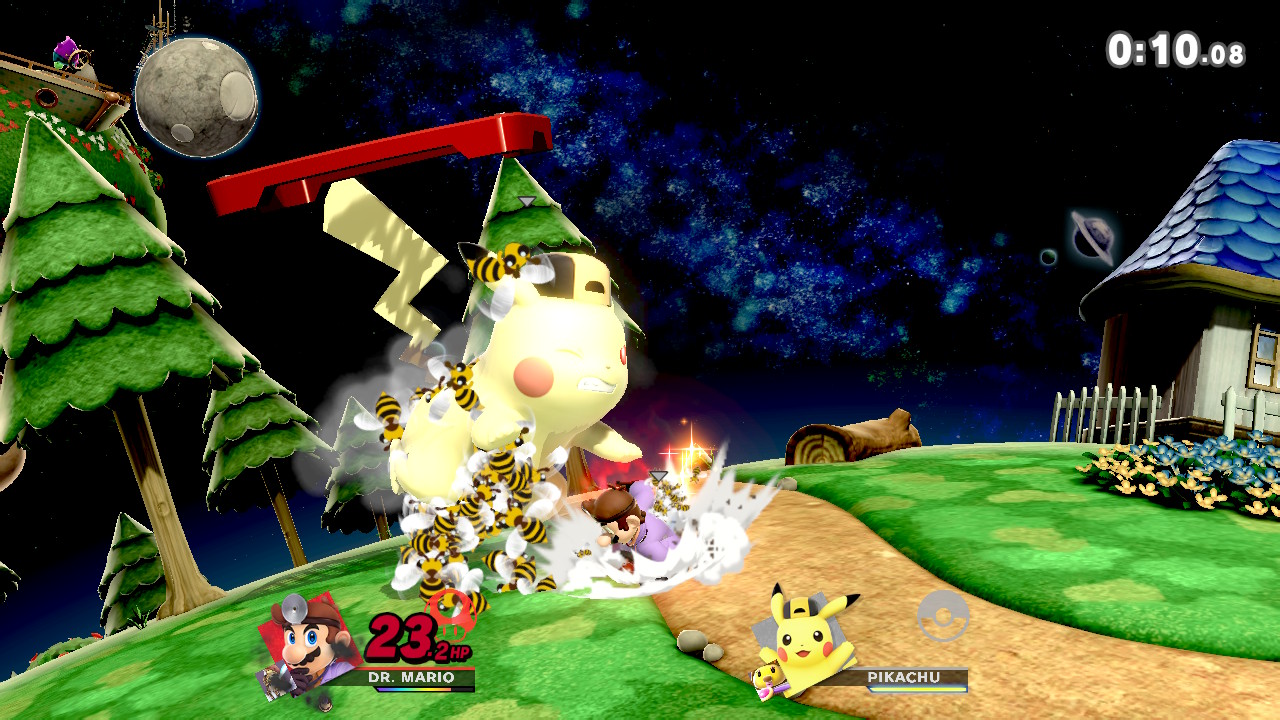
Sorry, Giant Pikachu. I got you bees.
Another in-game example of how standard combat looks; here, we’re on the standard “Battlefield” level.
Use the game’s built-in photo editor to change angles, zooms, tilts, and more.
Yet even from my admittedly amateur perspective, I noticed tweaks. The biggest came during a pre-release event, when I saw knowledgeable players chain together dramatic, mid-air juggling combos with the character Bayonetta. This attack combo has become notorious among Smash 4 pros, due to its ability to knock combatants out incredibly quickly, but Smash Ultimate has indeed nerfed it to remove the insta-kill potential. (Why Sora Ltd. hasn’t applied this patch to the Wii U version is beyond me; it appears to be a numerical patch to damage numbers, not to animations or move sets.)
Side-by-side comparisons in the training mode revealed a lot of other different damage amounts for various attacks. The general tone I’m noticing is more damage power is available for everybody across the board. That extra pep in the step is good news for the returning likes of Ice Climbers (an utter beast of a fighter when its combined pair lands big blows) and Solid Snake (whose lighter feet breathe new life into his otherwise unwieldy, heavy-weapon loadout). Star Fox‘s Wolf still feels Brawl-speed sluggish, but he gets some tide-turning power in a satisfying trade-off compared to his quicker “space animal” friends.
One update that absolutely differentiates Smash Ultimate from Smash 4 has not been lost on pro players: an improved suite of dash options, which now includes directional air-dodging and dash-canceling. While I’m not good enough of a Smash player to speak to these arguably subtle motion options, my pro-minded testing crew was unanimous: transitions between “smashes” and dashes feel enough like Smash Melee‘s famed “wavedashing” to pique their interests in this new game’s competitive future.
Speaking of side-by-side comparisons: Smash Ultimate may not seem like the “ultimate” in the graphics department, considering that it doesn’t look all that different from 2014’s Wii U version. For starters, in TV mode, both run at 1080p resolution with a locked 60 frames-per-second refresh, and both largely eschew anything in the way of convincing anti-aliasing. But should you get a rare moment to breathe and admire the view in a typical Smash Ultimate arena, you’ll find noticeable boosts to the scenery, particularly in texture resolution and anisotropic filtering.
The Switch difference also carries over to portable mode, where an apparent 720p resolution makes this look light years beyond the series’ sole portable Smash game on the 3DS. It looks phenomenal on the Switch’s 6.2-inch screen, and I’ve been playing it everywhere as a result. (I’ll just say this: I put together a “best hygiene practices” set of rules for myself before getting my copy of Smash Ultimate, and glad I did, because I’ve, er, played a lot of this game on the throne.)
The biggest visual difference can be seen when posing identical characters on identical stages in both games. It’s at this point that a refined lighting system emerges. We’re not looking at some phenomenal system with surface-based reflections. Instead, the new game has a lighting system pretty much as flat as the Wii U one, only now there’s an emphasis on each combatant’s edges looking crisper and brighter. This doesn’t appear to be done with some cel-shading technique, mind you, but with an emphasis on higher-contrast pop from the levels’ busy backgrounds. The characters still don’t look like they blend realistically into their arenas, but if it’s going to be “inaccurate,” we’ll take this easier-to-read version any day.
Animation and pose tweaks can be found if you’re obsessive, but while some character redesigns are pretty blatant (Link now dresses in Breath of the Wild garb), others are subtle—and arguably worse. Donkey Kong is the biggest offender, as his Wii U version’s lush fur has been smoothed over to look like a smoother, previous-gen model. This may have been done to make his appearance sharper in the midst of frenetic battle, but it’s a curious downgrade (especially in light of Incineroar, who sports a lush coat of fur).
The other game-wide visual tweak is a perspective shift. The Wii U game applied a rounder 3D perspective with its zoomed-out camera, while the Switch version appears to subtly guide its platforms and level wrappings in such a way that everything looks a little flatter and more set to a grid. I only noticed this when doing side-by-side tests, but now that I’ve noticed it, I like it a lot. Additionally, Smash action on the Switch is anchored to the bottom of the screen more often than on Wii U, which tended to centralize combat’s vertical axis.
That kind of camera framing and anchoring tweak sells just how detail-obsessive Smash Ultimate‘s design team is. Animations and basic assets were reused, obviously, but the design team clearly didn’t rest on its laurels.
Spirited performance?
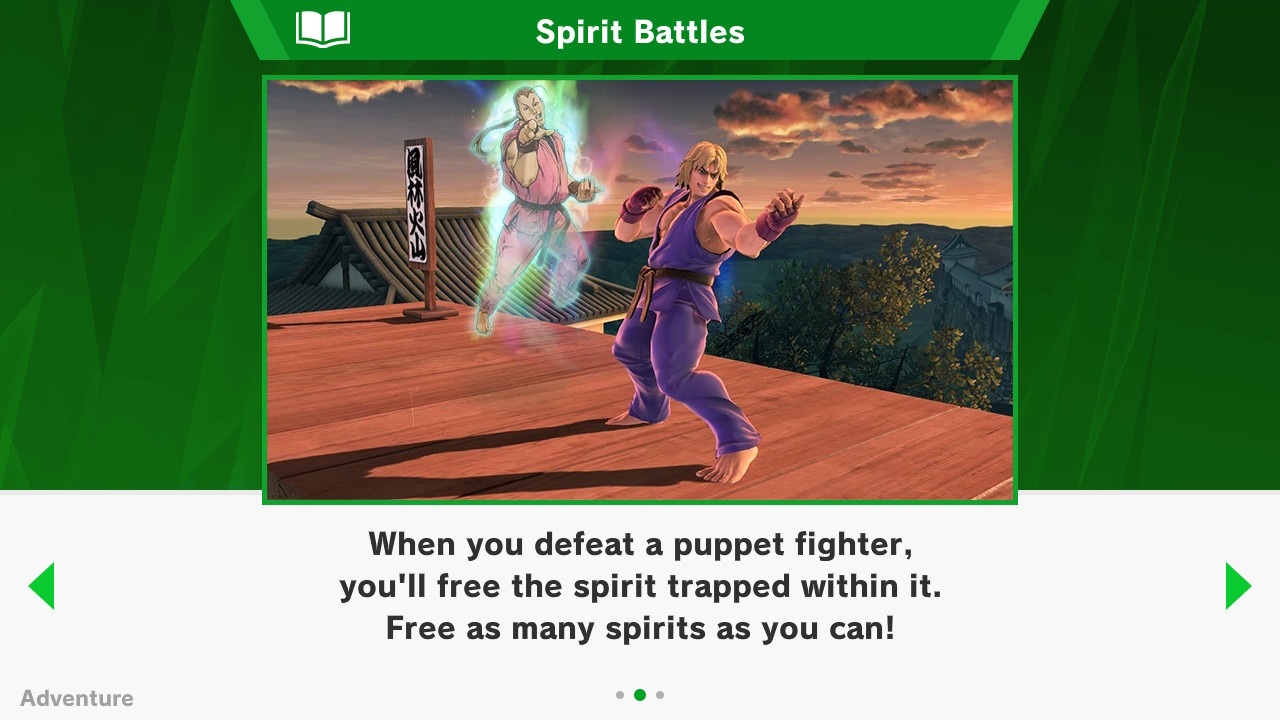
Smash Ultimate includes a few single-player options, but none are as massive as “Spirits.” This mode is where the game gets up to that aforementioned 1,200-character count, and it does this by turning the history of Nintendo’s console games into a massive book of stickers.
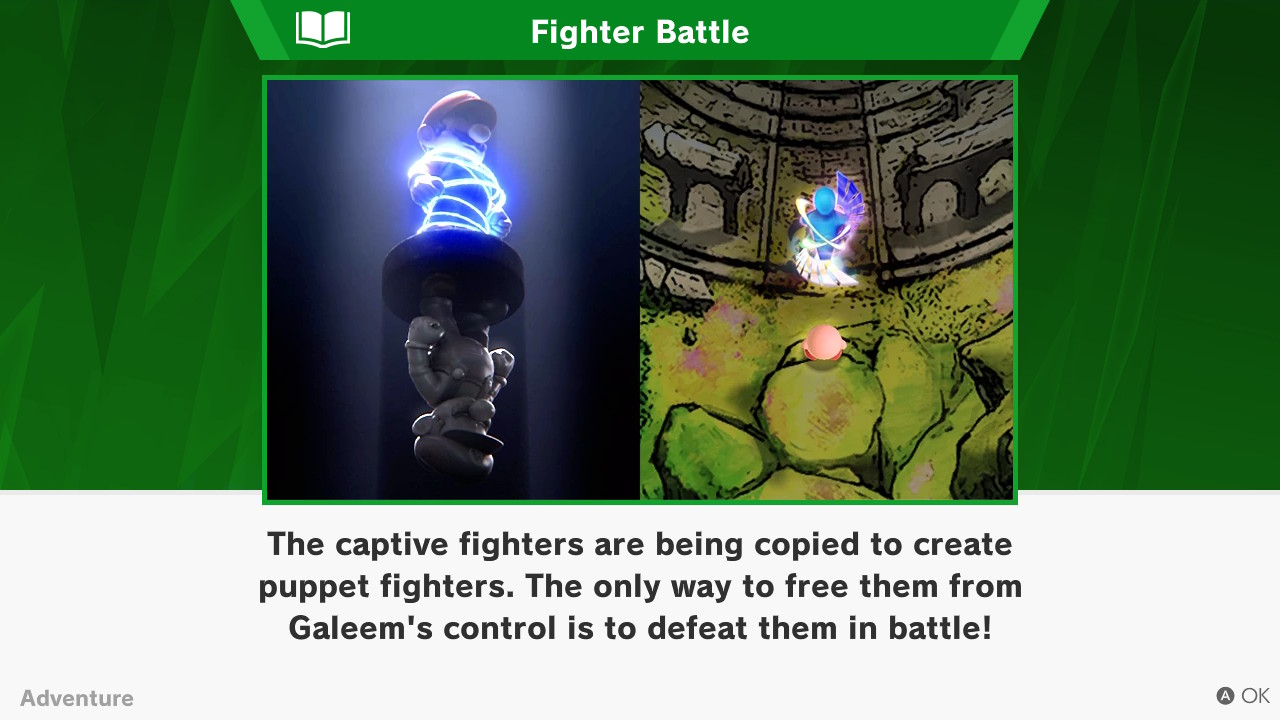
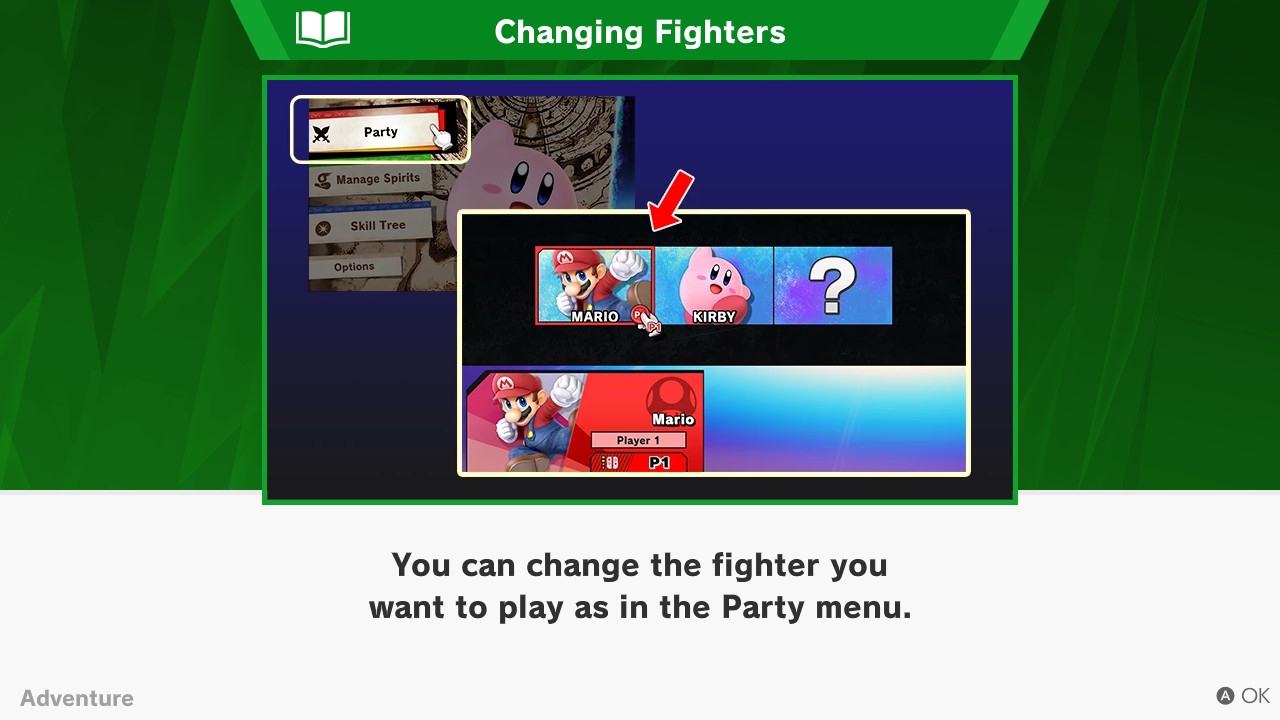
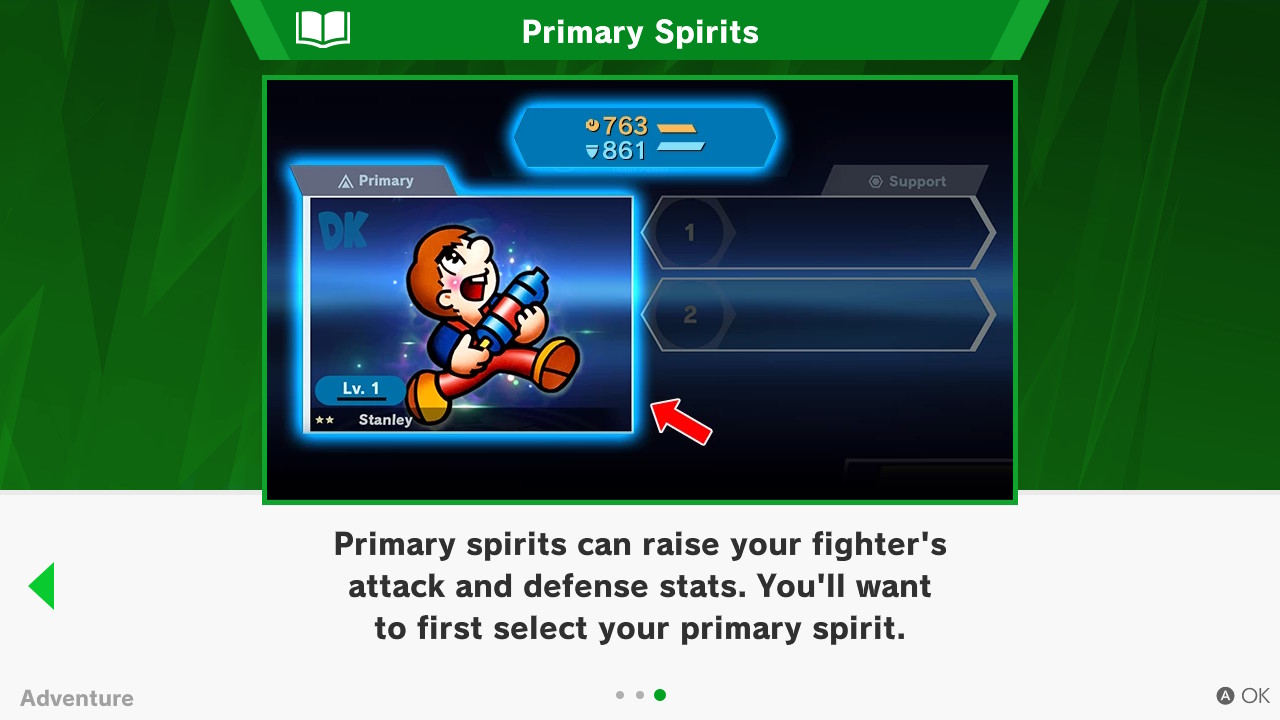
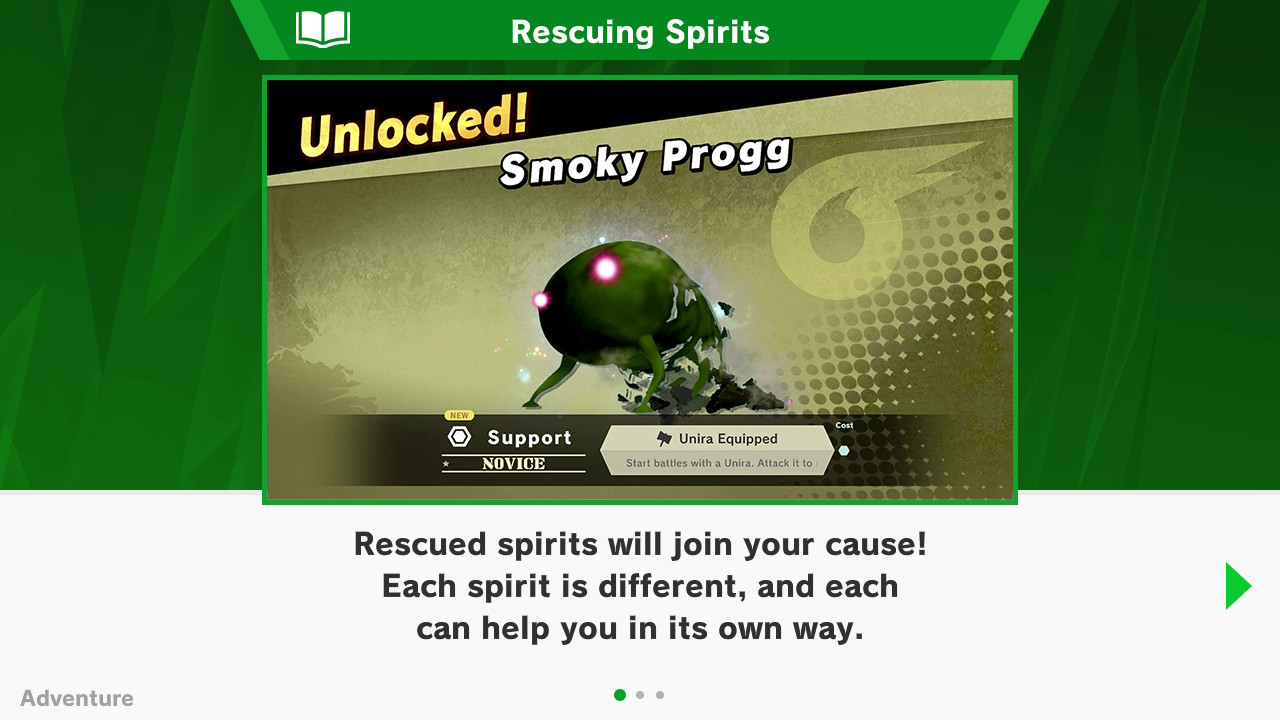
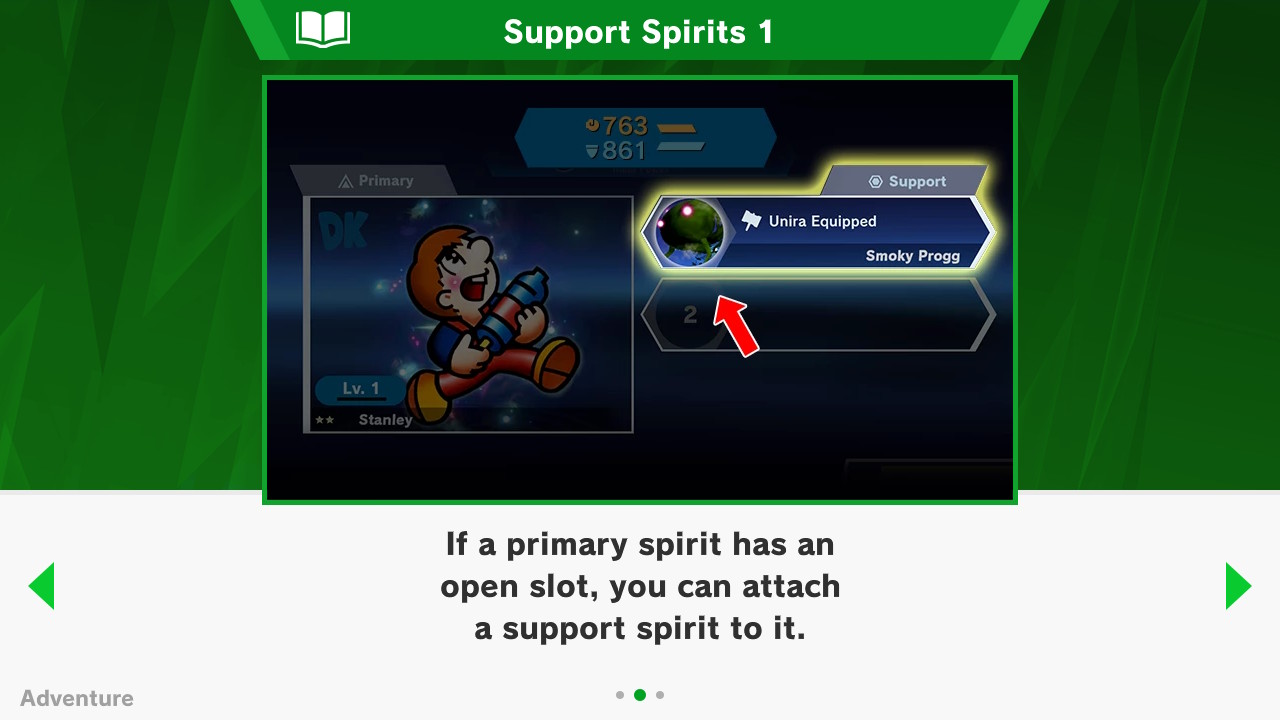
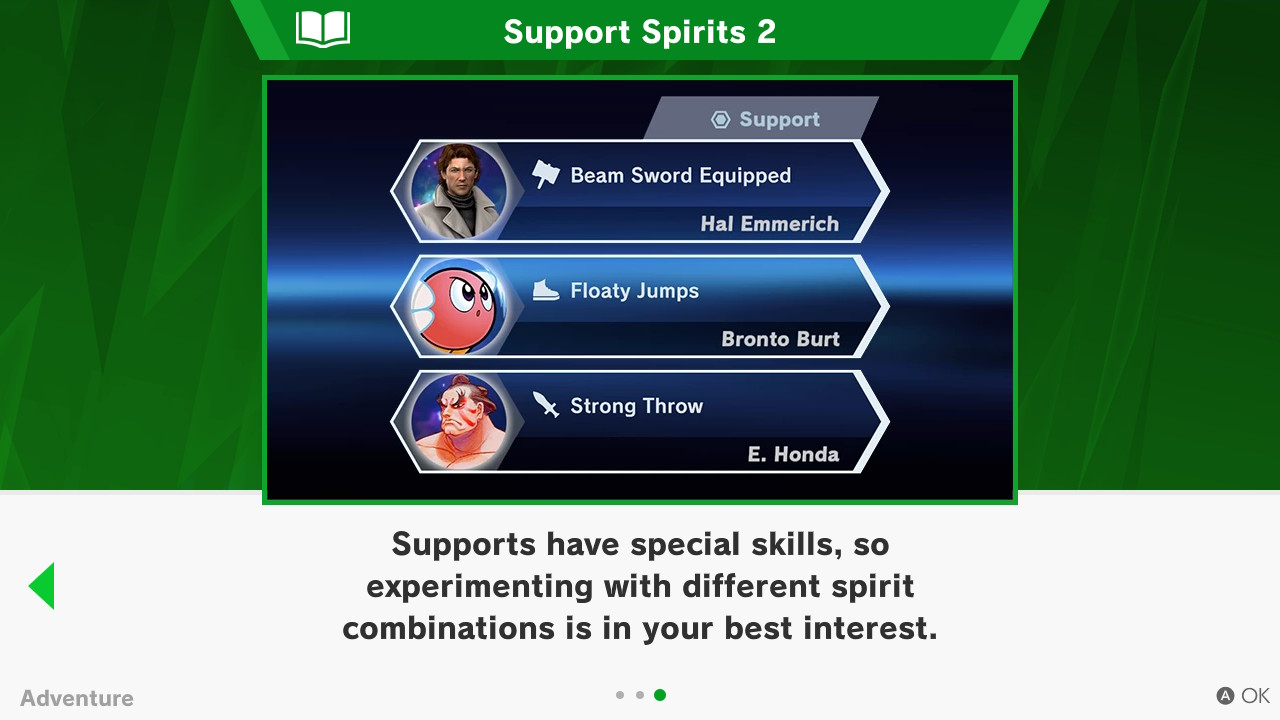
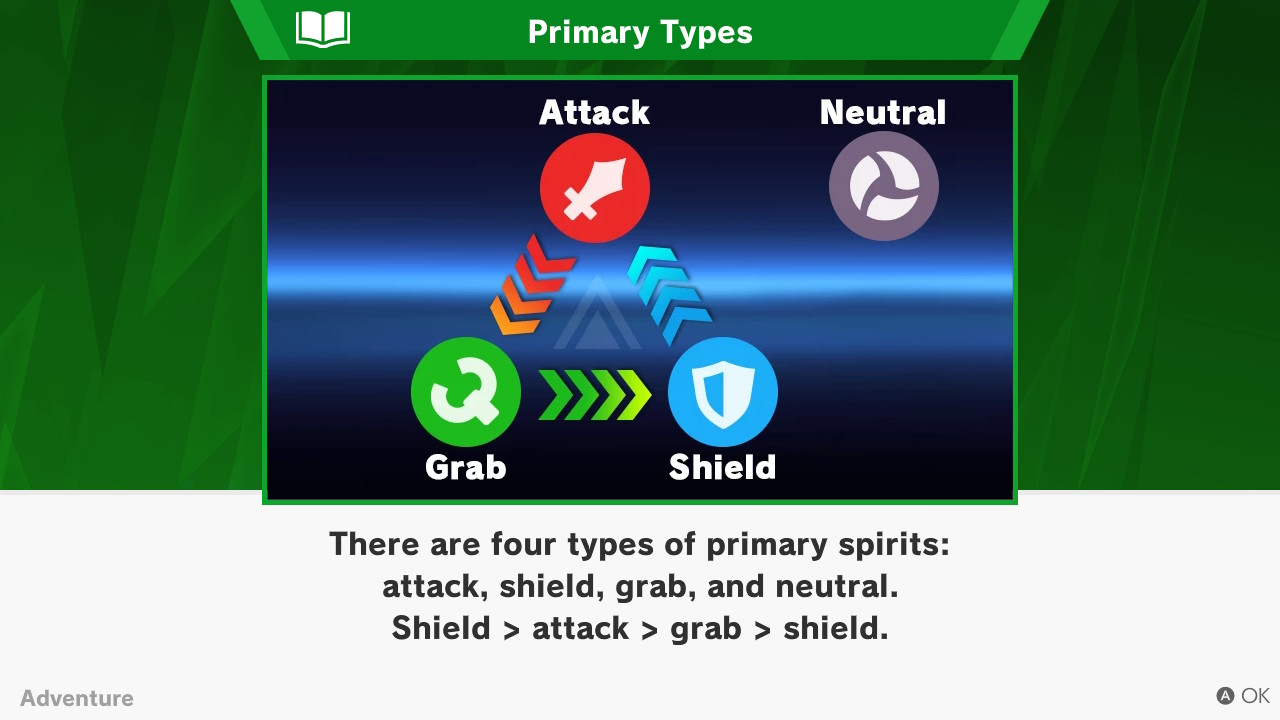
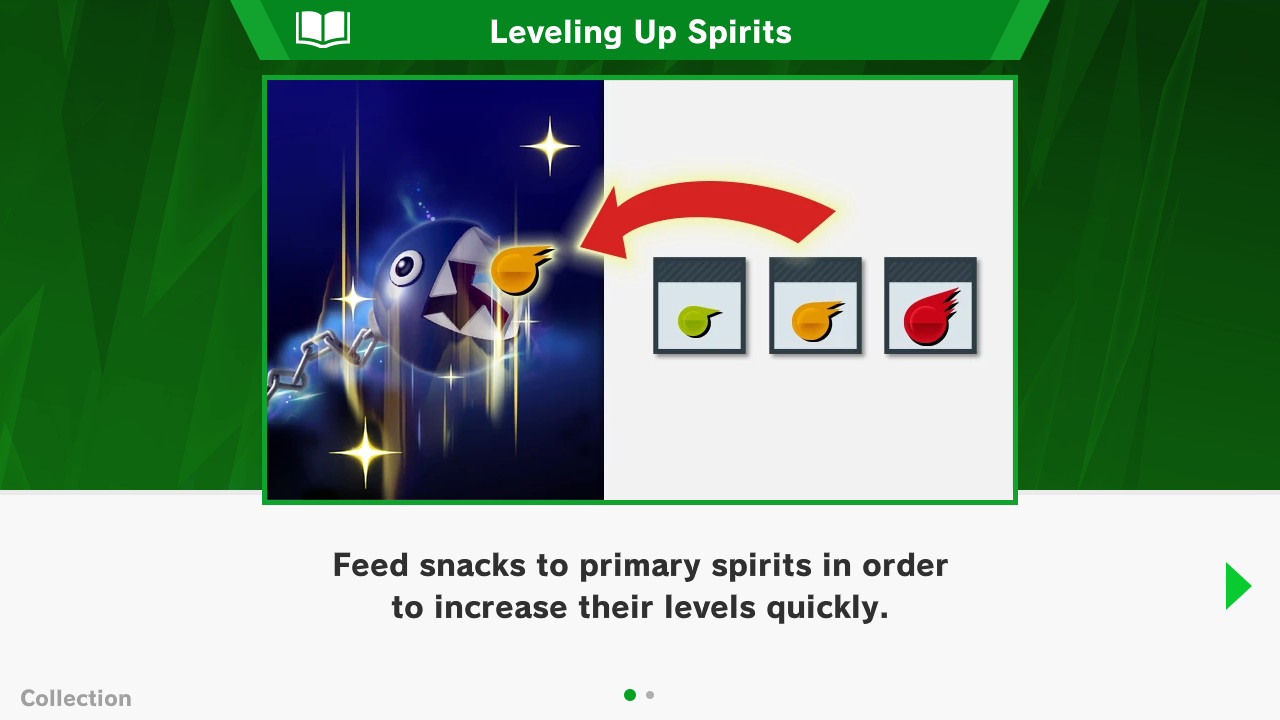
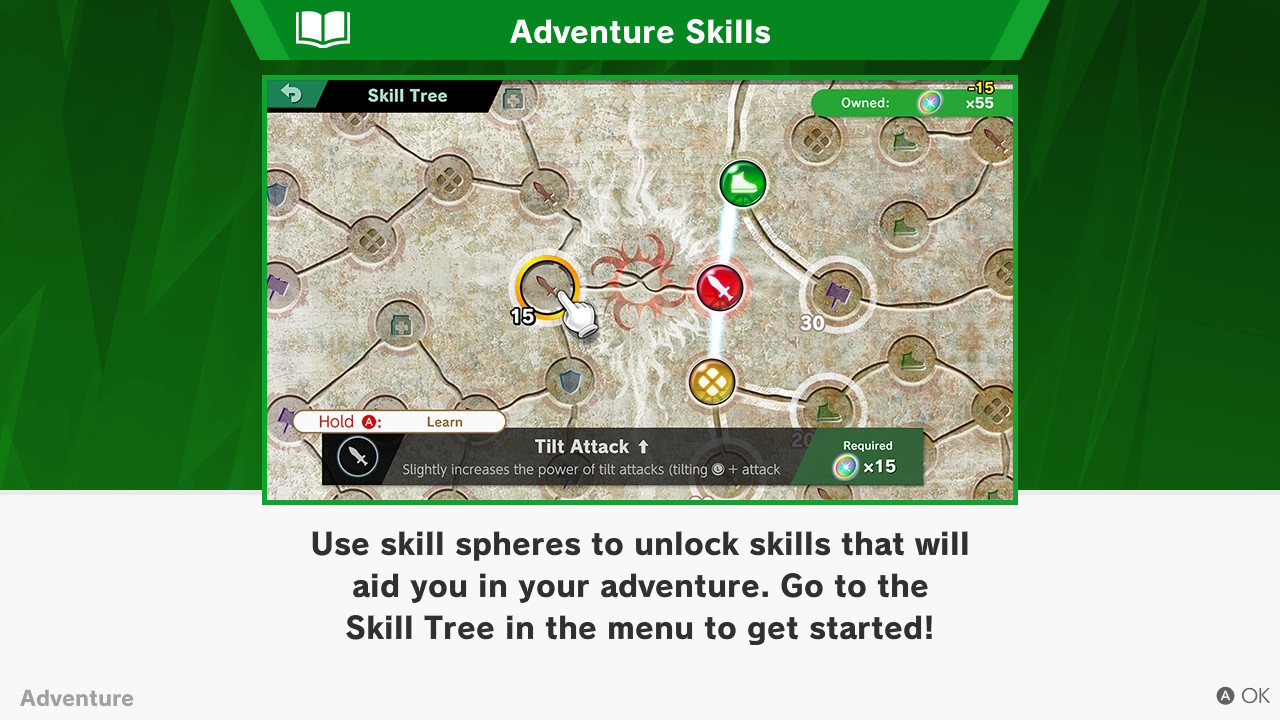
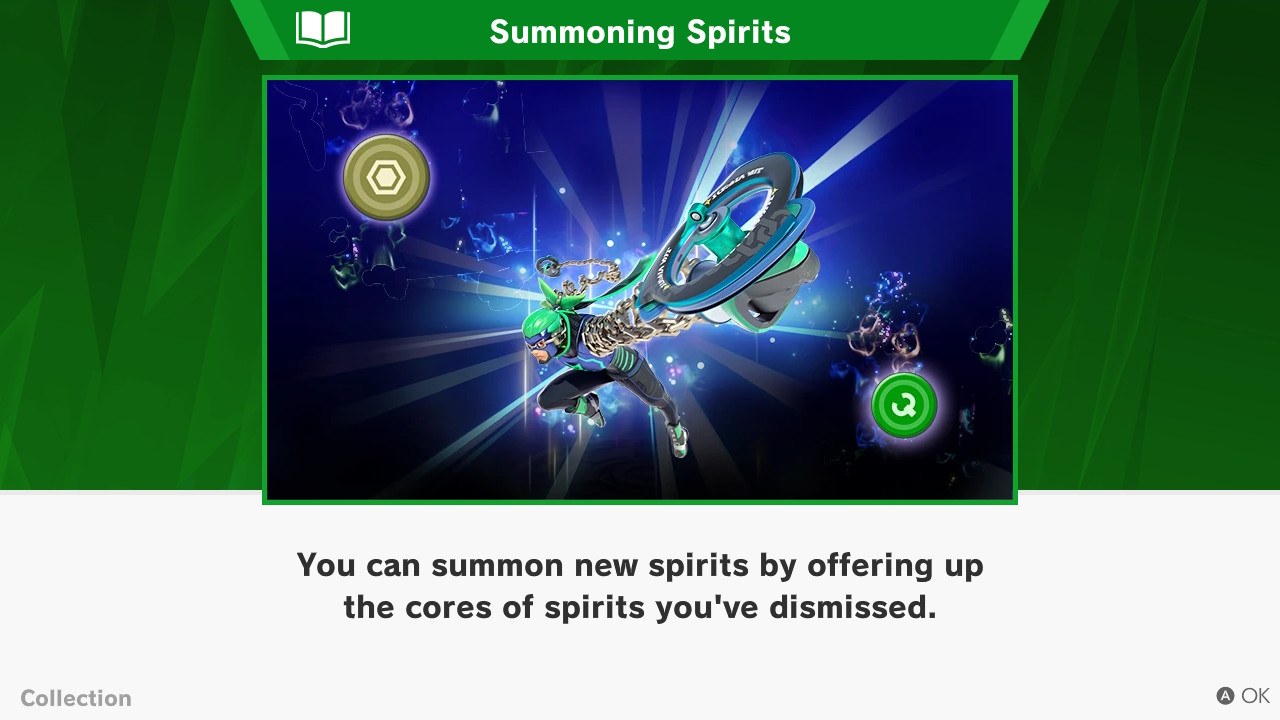
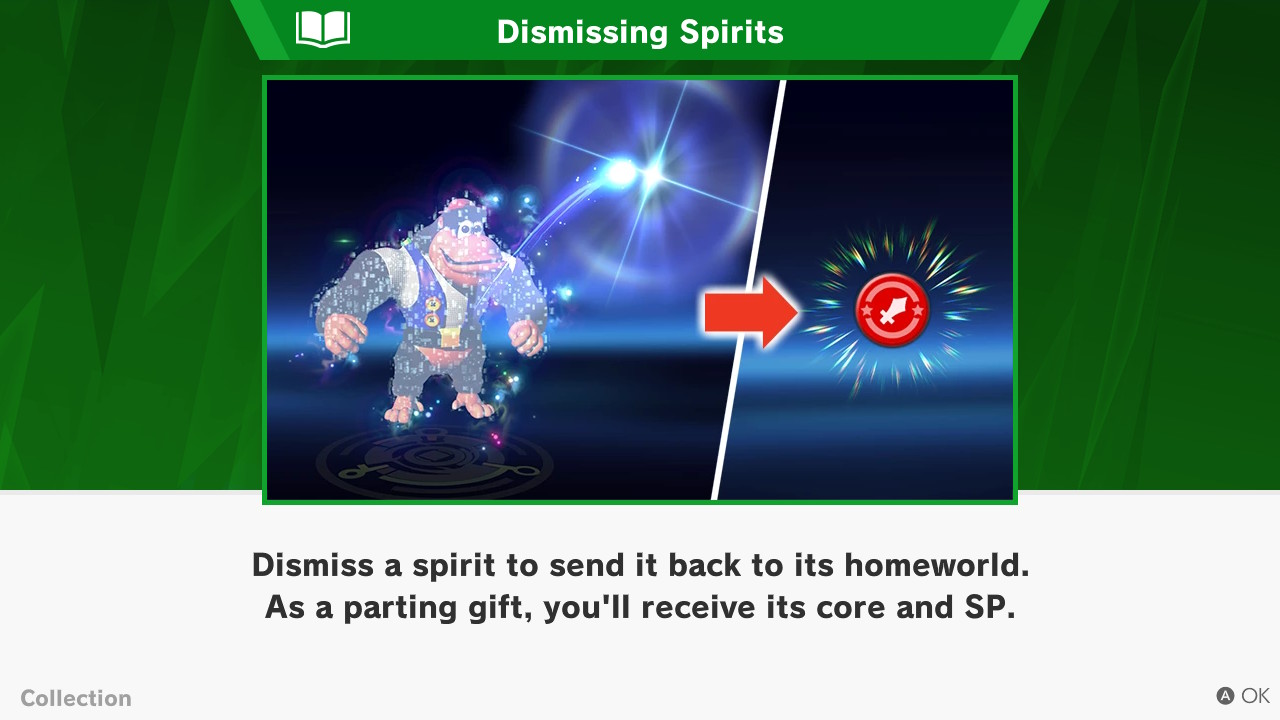
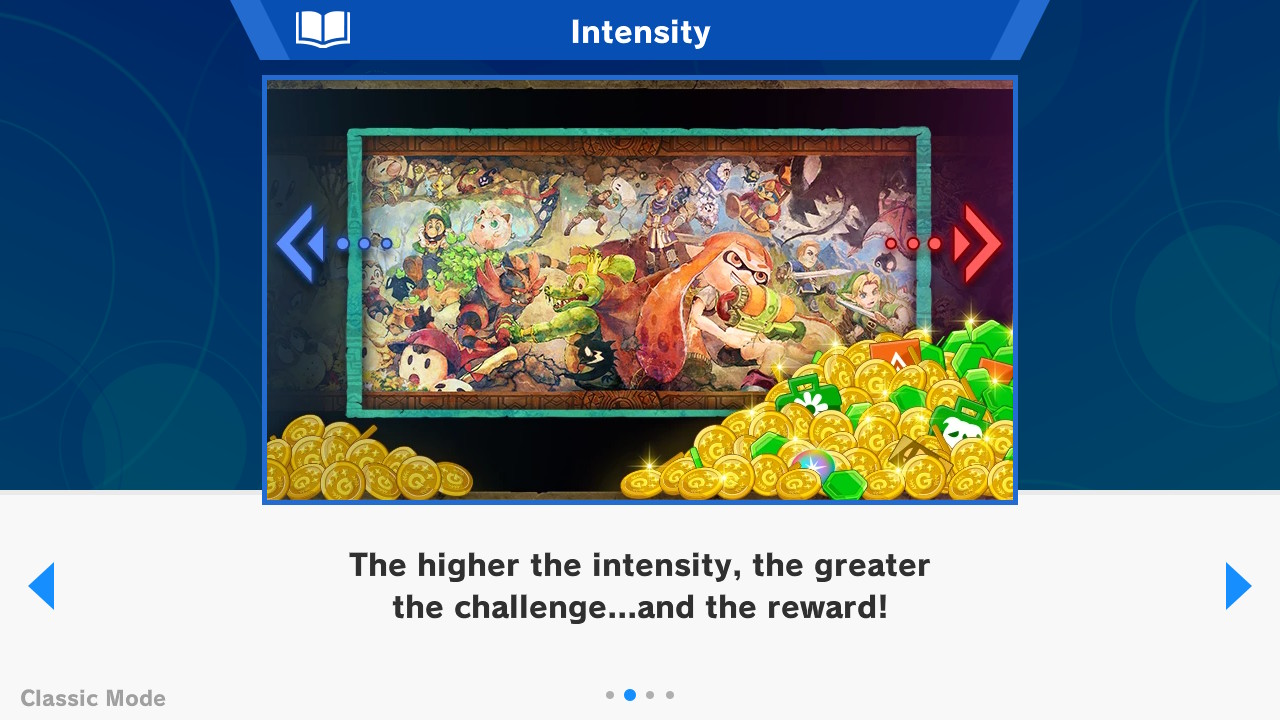
This gallery about the Spirit adventure is ripped from Nintendo’s in-game instructions, so most of these are self-explanatory. Or, at least, if you’re confused by them, I can’t help much. The mode is strange.
This gallery about the Spirit adventure is ripped from Nintendo’s in-game instructions, so most of these are self-explanatory. Or, at least, if you’re confused by them, I can’t help much. The mode is strange.
“Galeem” is the mode’s villain. It doesn’t talk, and it doesn’t make sense.
“Galeem” is the mode’s villain. It doesn’t talk, and it doesn’t make sense.
The character roster in Spirits is different from the rest of the game. It takes much longer to unlock playable characters in Spirits.
The character roster in Spirits is different from the rest of the game. It takes much longer to unlock playable characters in Spirits.
“Galeem” is the mode’s villain. It doesn’t talk, and it doesn’t make sense.
The character roster in Spirits is different from the rest of the game. It takes much longer to unlock playable characters in Spirits.
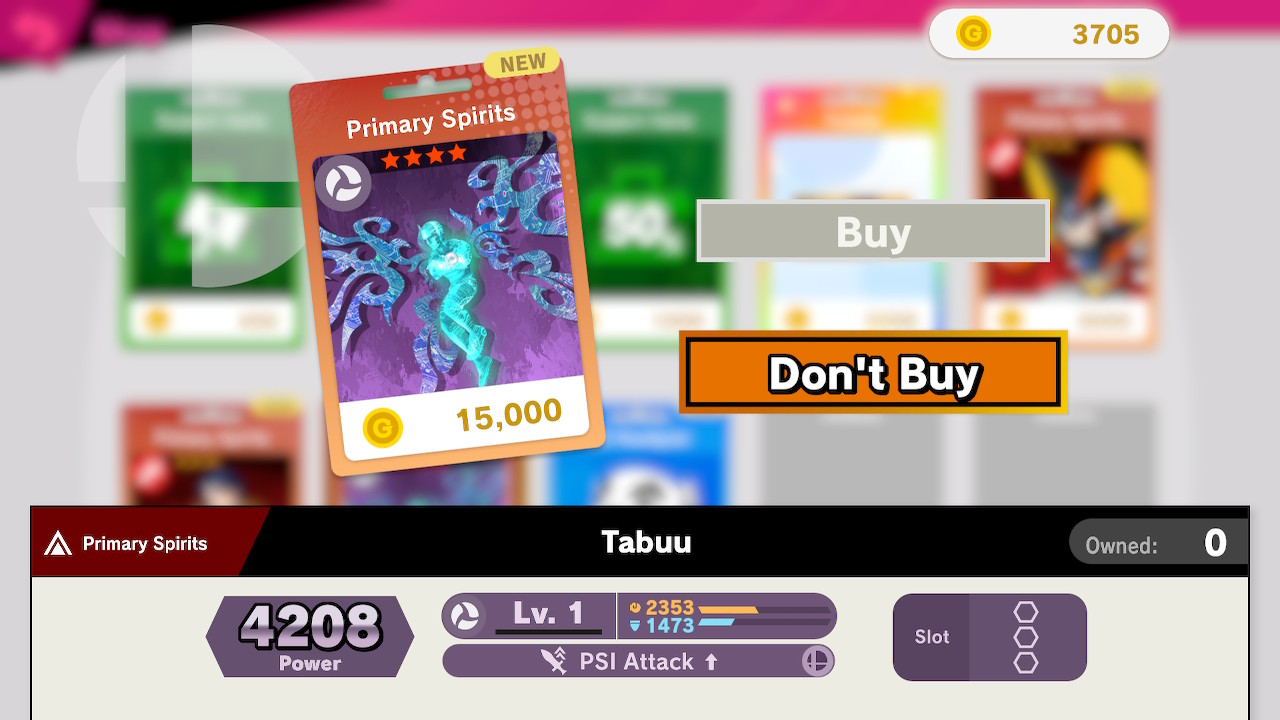
How many currencies will you encounter in Spirits mode? One…
Two…
Three… (as in, gold coins, which can also be spent to unlock Mii Fighter outfits, extra songs, and other unlockables.)
…and four!
This spirit-summoning system is confusing, and the game doesn’t clarify an important point about why you should save your “Spirit core” currency longer than you might think is necessary.
So many currencies.
If you can imagine a creature, character, or cameo from a first-party Nintendo game, or from a series with a significant Nintendo-console history, Smash Ultimate likely includes it as a single-battle combatant. Each of these appears in the game as a flat, 2D image, and they’re slapped, sticker-style, onto one or more existing Smash combatants to create a one-off battle. Meaning, the game will consider how that sticker-character looks and acts in its original game, then it mixes together Smash fighters, Smash items, and Smash traits to make a facsimile fight.
With roughly 1,200 stabs at this concept, the results are all over the nostalgic map, but it’s fair to say these one-off fights can range from ho-hum to utterly arresting. One of my favorite examples is Dr. Light, the benevolent robot inventor from the Mega Man series. After choosing his sticker in Spirits, a battle begins (controlling whatever hero you’ve chosen), but there’s no “doctor” anywhere. Instead, two Mega Man characters appear in a level based on the series, each favoring that character’s special B-button attacks and adorned in a “metal armor” trait. Clear this duo, and two more Mega Man fighters appear.
You’ll defeat a grand total of eight metal-plated Mega Man fighters before a final combatant appears. It’s Dr. Mario, dressed in an all-white color pattern, and he’s… running away. This version of Dr. Mario has been given an “avoid conflict” trait, and the fight ends when you wipe him out. (It’s OK, the game’s lore explains. You’re freeing this original character’s spirit from a demonic possession… or something.)
Once this version of Dr. Mario appeared, I hit my head in a “oh, duh!” fashion. Right: I had to fight “eight robot masters,” followed by a Smash approximation of their kind, good-intentions inventor, Dr. Light. It wasn’t a perfect corollary to a specific Mega Man game, since the Mega Man fighters didn’t each have different special moves, but it was still a cute single-player twist on what could have been a typical Mega Man fight, wrapped up in series lore.
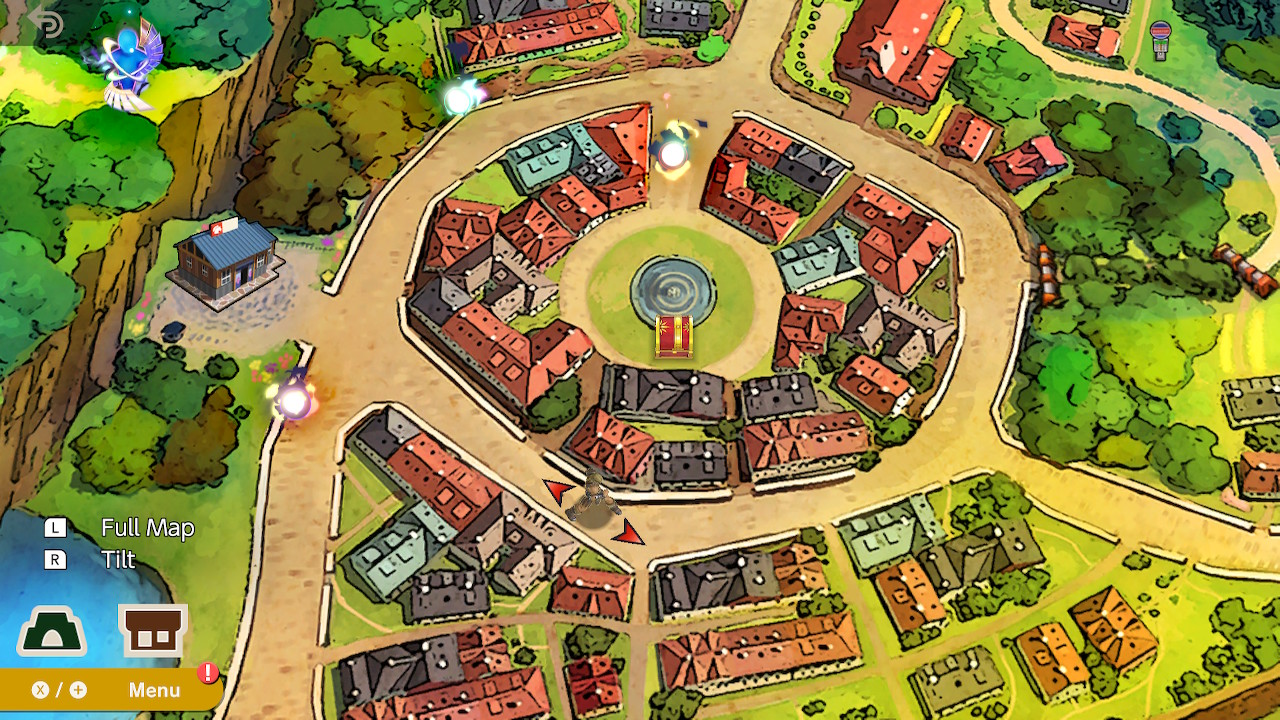
This is how you’ll fight everything from Shovel Knight‘s Specter Knight to the heroes in the game Knuckles Chaotix to the casts of other fighting games (Street Fighter II, Arms). And you get two conceits to tackle all of these encounters. The first, an “adventure” mode, makes you wander around a giant overworld that looks like a cross between a JRPG and a board game. At every stop of its map, you’ll either face off against a Spirit, pick up a treasure chest, or come across an obstacle that can only be unlocked once you’ve beaten another Spirit, typically on the other side of the map and not clearly marked.
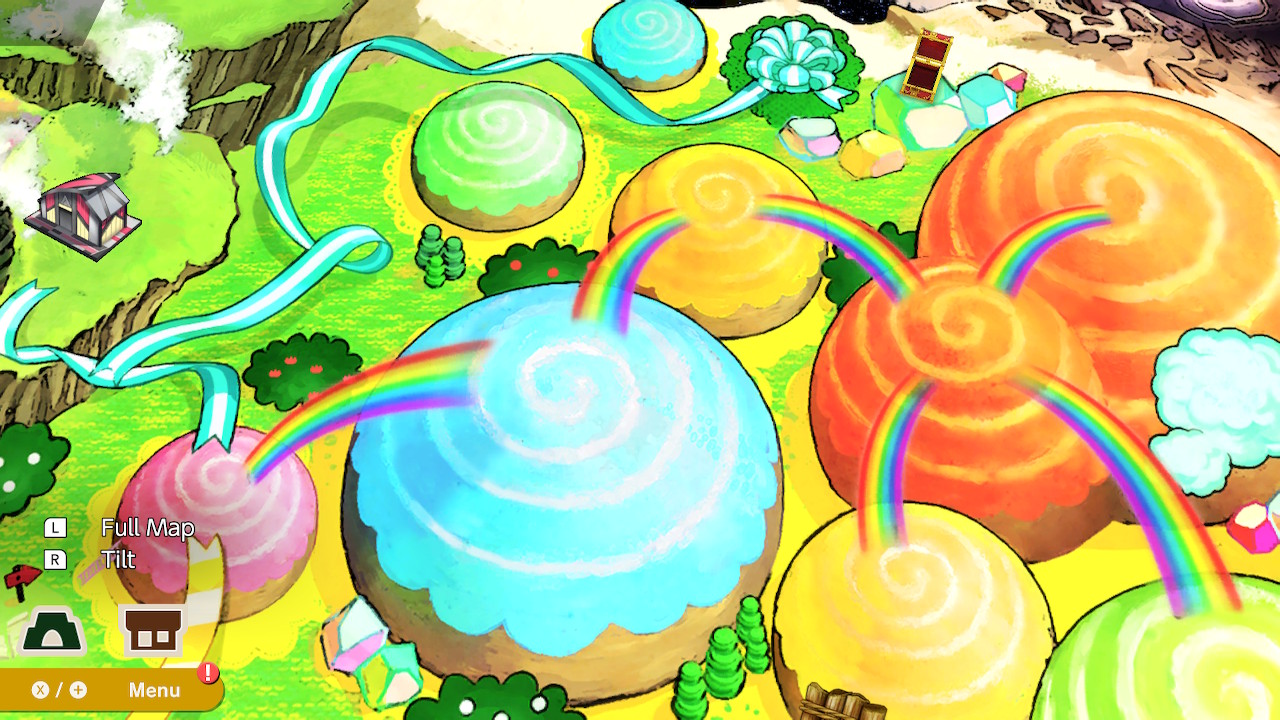
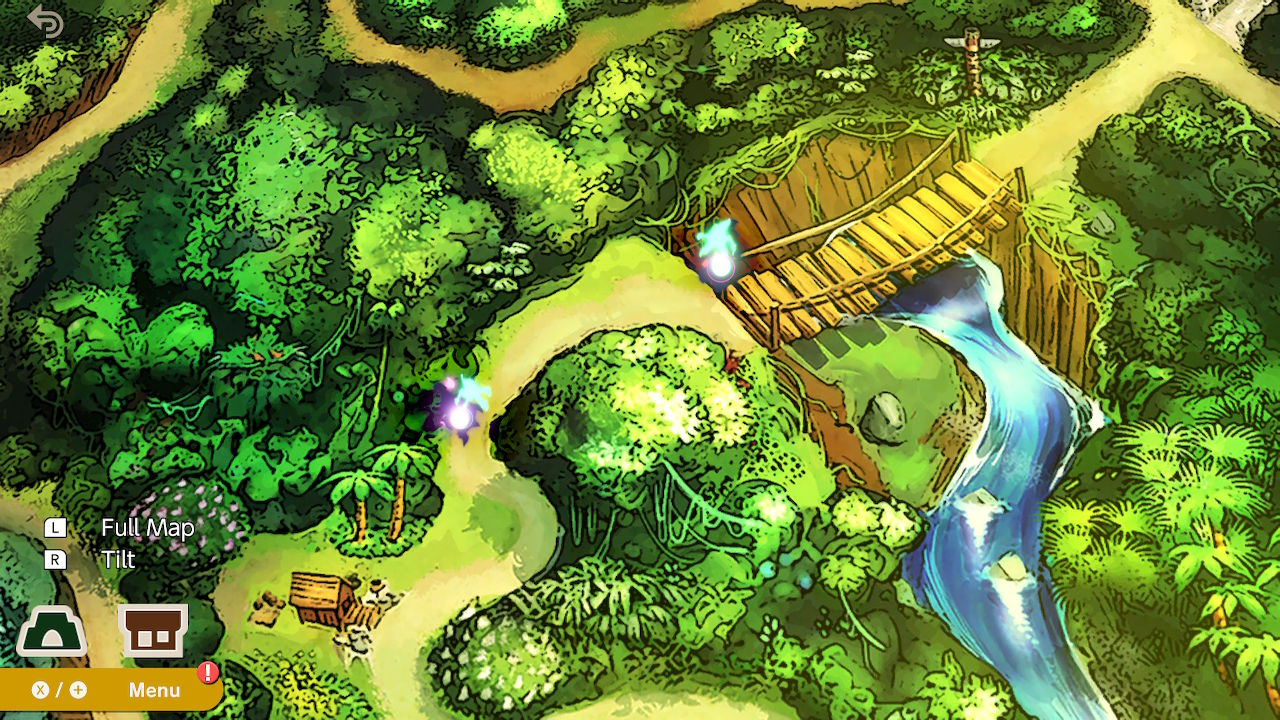
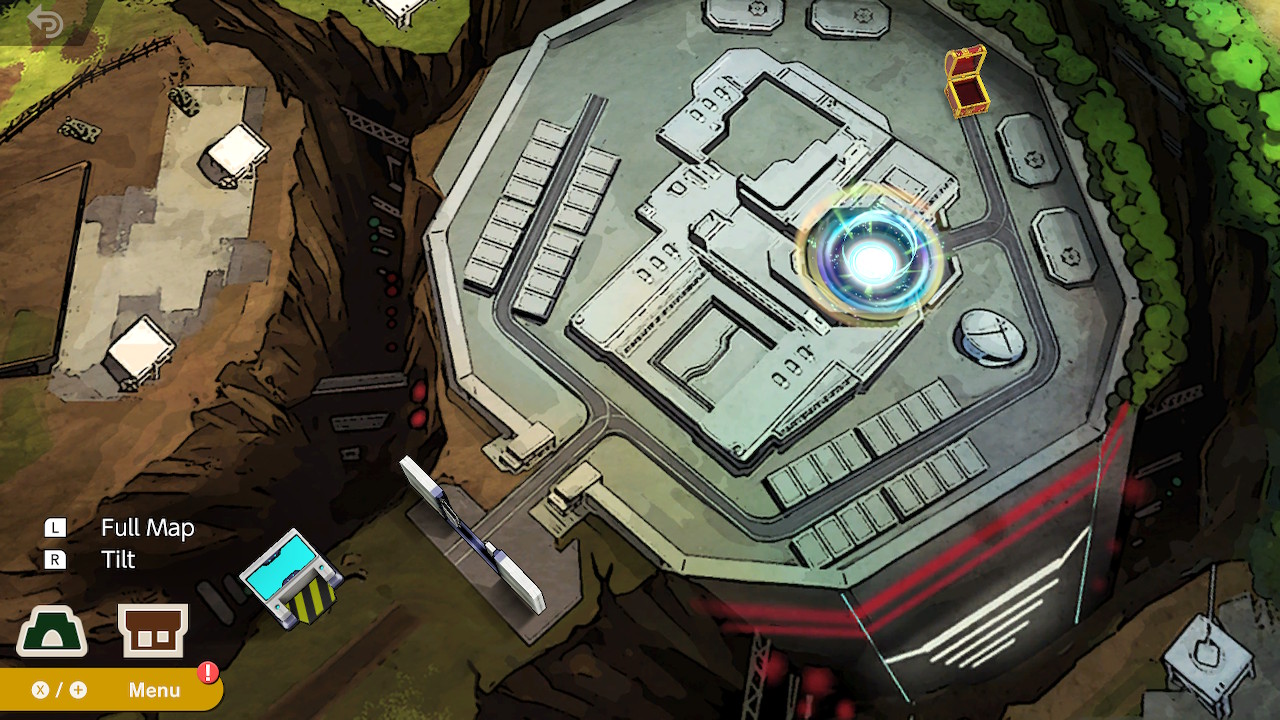
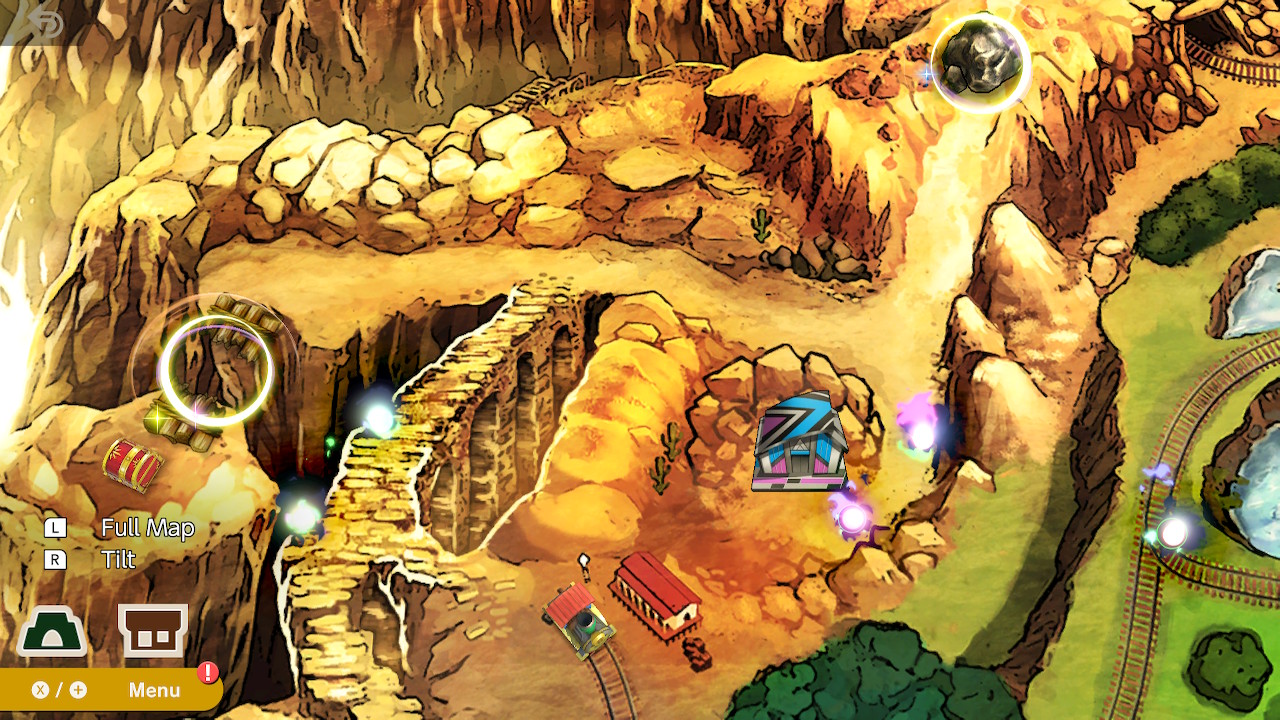
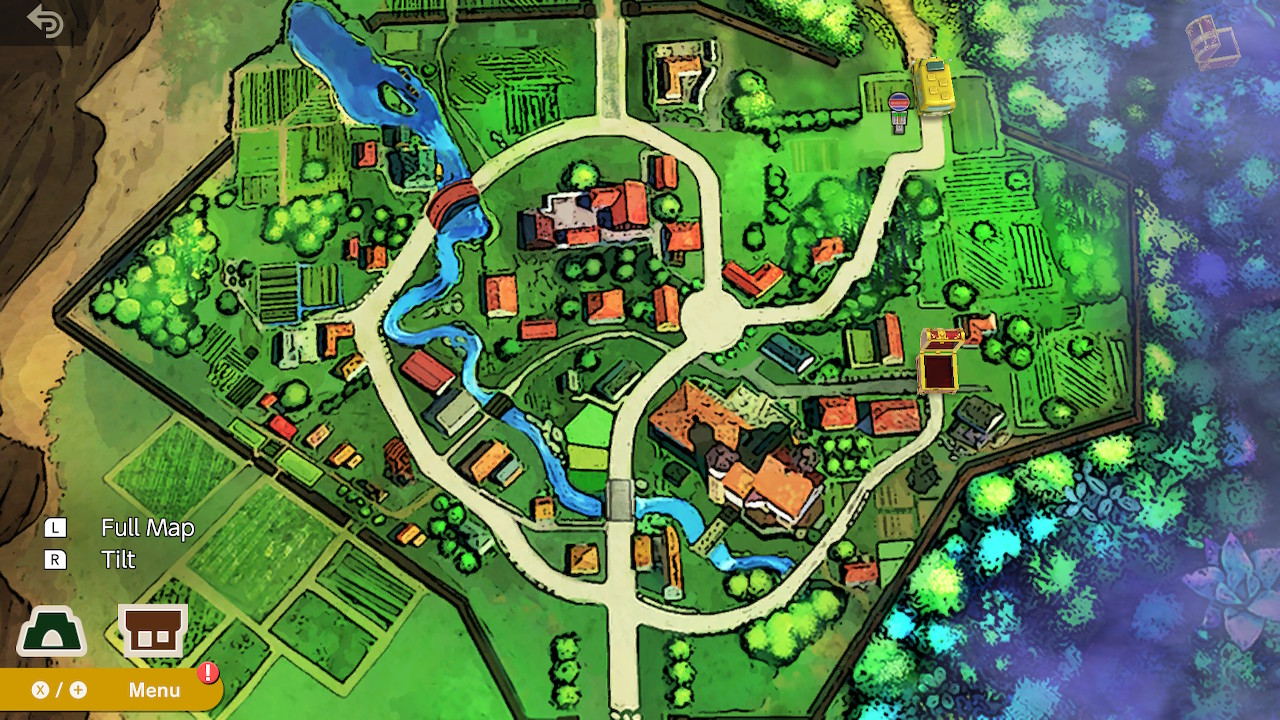
This gallery contains six sample images of the Spirits quest-mode map, which you guide an avatar around from a bird’s eye perspective. Do not adjust your monitor; the art’s resolution is indeed this blurry on the Switch.
This gallery contains six sample images of the Spirits quest-mode map, which you guide an avatar around from a bird’s eye perspective. Do not adjust your monitor; the art’s resolution is indeed this blurry on the Switch.
A rainbow-cupcake… thing?
A rainbow-cupcake… thing?
Some sort of jungle village.
Some sort of jungle village.
A rainbow-cupcake… thing?
Some sort of jungle village.
I’m not sure what this is supposed to be. An airport? A military base?
A mining town.
A low-res copy of something from Google Maps, maybe.
At its best, this Adventure mode choreographs a series of complementary fights in a row, as drawn out by whatever overworld zone you’re walking through. ’80s arcade characters appear in a Pac-Man-like maze; outer-space denizens of Earthbound and Star Fox games appear on a series of planets; and so on. But at its worst, this mode pads out the basic experience of getting into fights by making you criss-cross and backtrack across this map with zero puzzle-like payoff. You won’t use brainpower to find the Spirit that destroys path-blocking boulders or steers a boat. You’ll simply stumble into the right puzzle-unlocking Spirits at some point.
Wandering across this massive board and its zoo of icons isn’t really fun. The map is too tightly zoomed when you wander around. Your running action is sometimes awkward to aim. And worst of all, it’s just not nice to look at. The map’s squished, sloppy building designs and vague, incomplete references to existing series and Nintendo products look less like a Big N product and more like a theme-park map drawn by a college-aged Six Flags intern.
Not bored about the Board; more like, angry
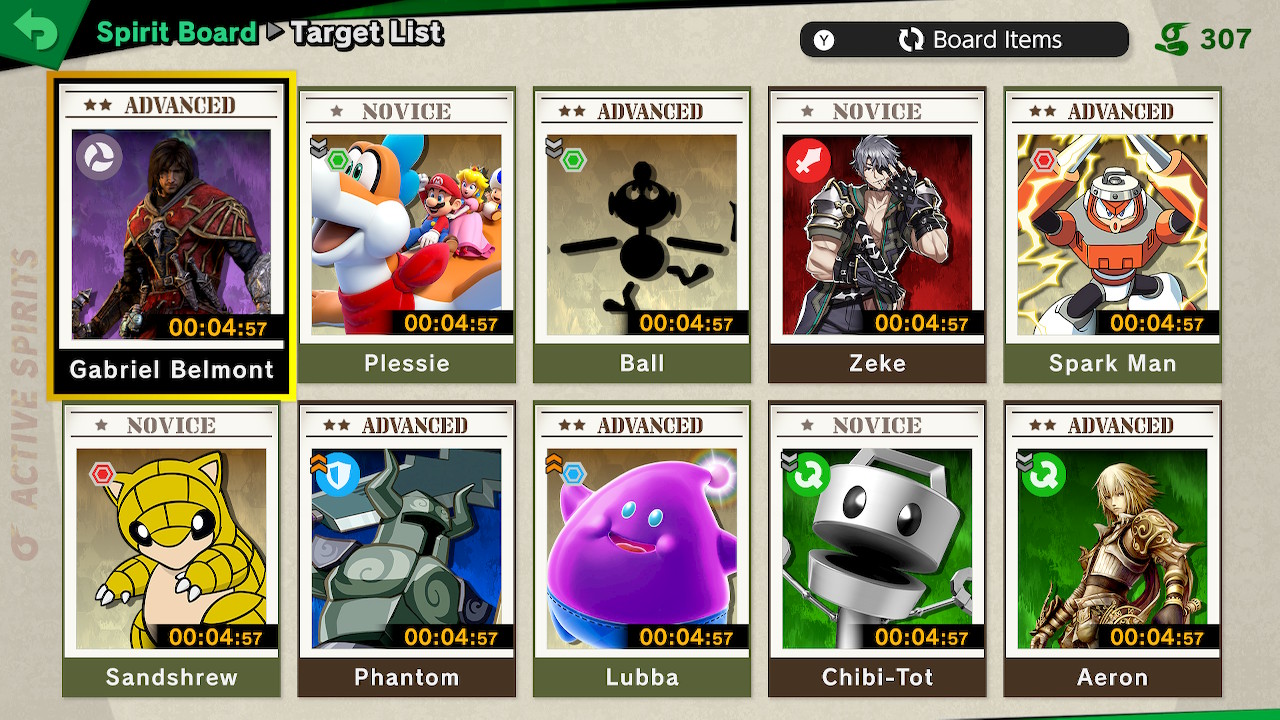
Just a few of the game’s 1,200+ Spirits, as arranged in the Spirits Board roster. Each timer indicates how long I have to fight them before their card is swapped for another one in the massive deck.
Just a few of the game’s 1,200+ Spirits, as arranged in the Spirits Board roster. Each timer indicates how long I have to fight them before their card is swapped for another one in the massive deck.
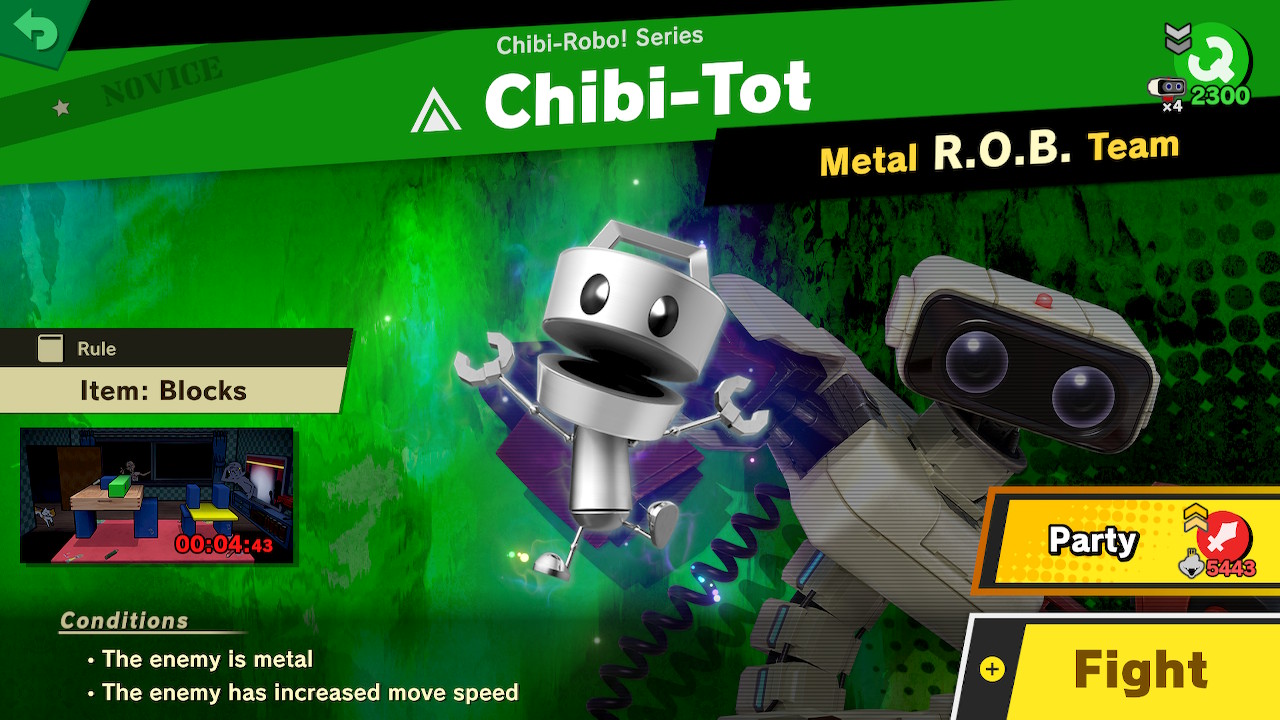
Let’s pick Chibi-Tot. This Spirit has specific weaknesses, listed at the bottom left.
Let’s pick Chibi-Tot. This Spirit has specific weaknesses, listed at the bottom left.
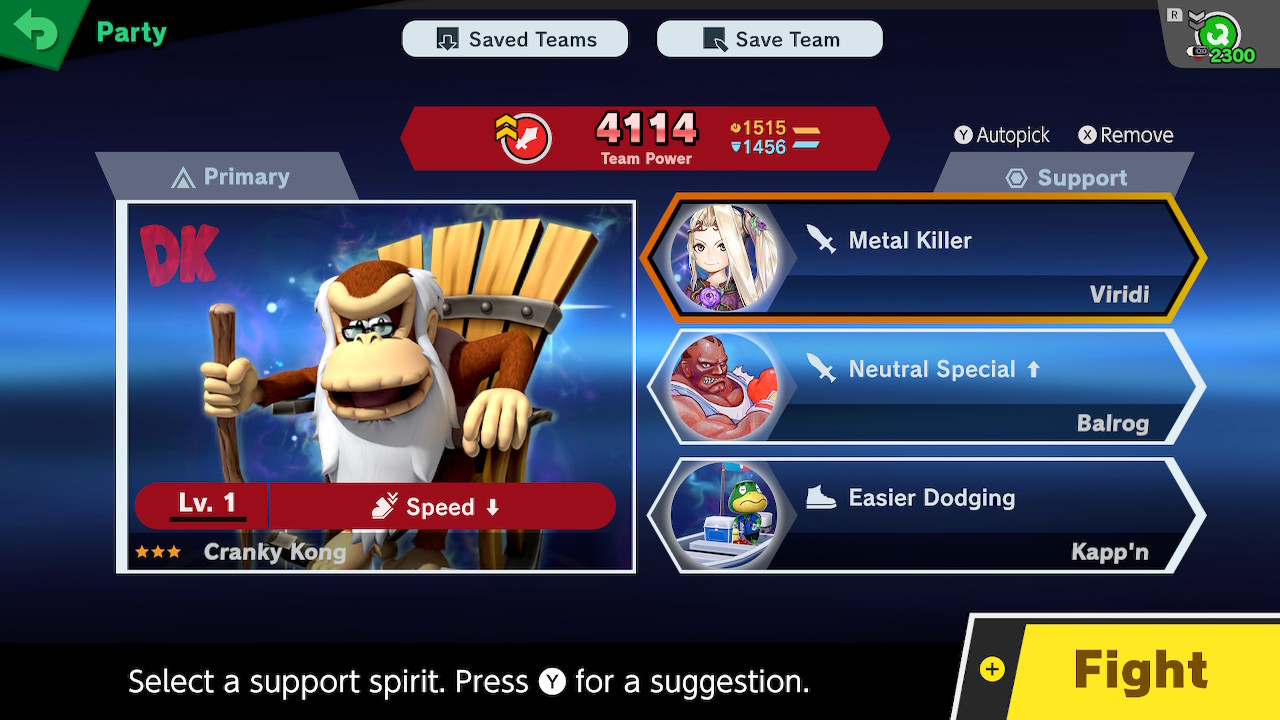
So I go to my own Spirit roster, hit the “autopick” button, and get these cards picked. That “metal killer” perk is perfect for a metal foe.
So I go to my own Spirit roster, hit the “autopick” button, and get these cards picked. That “metal killer” perk is perfect for a metal foe.
Let’s pick Chibi-Tot. This Spirit has specific weaknesses, listed at the bottom left.
So I go to my own Spirit roster, hit the “autopick” button, and get these cards picked. That “metal killer” perk is perfect for a metal foe.
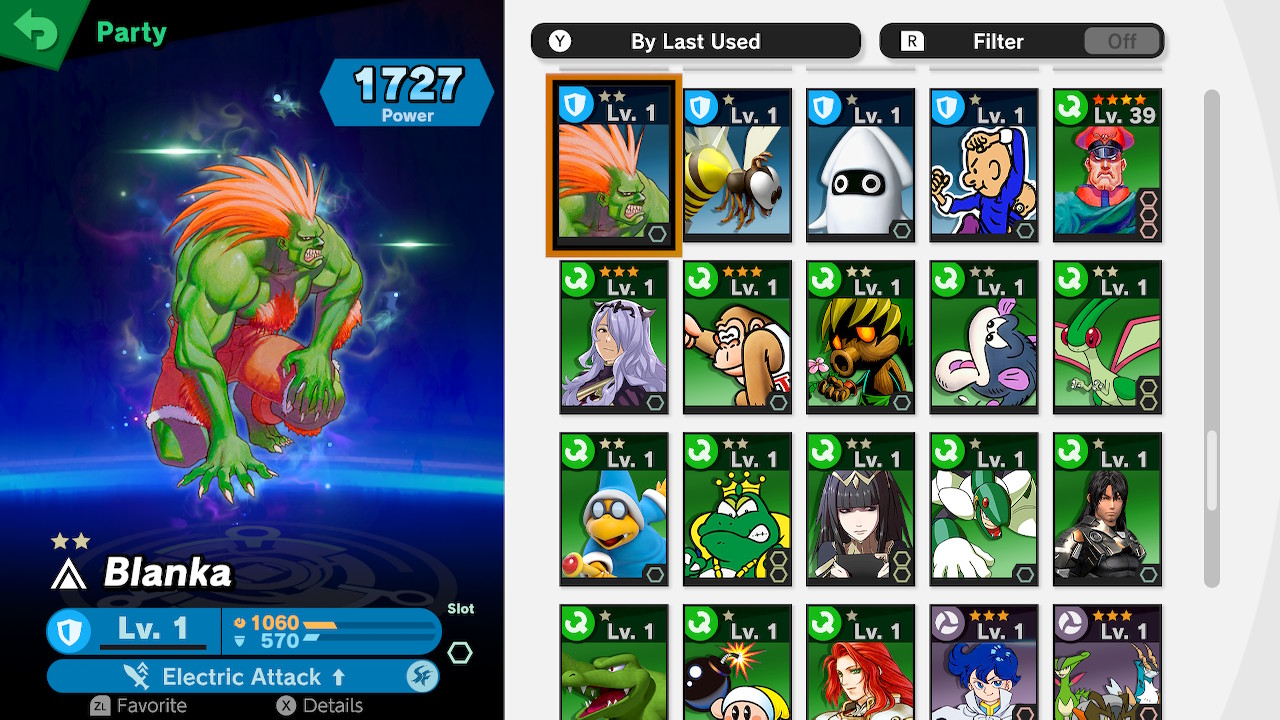
I should pick a red “primary” spirit, as there’s a color rock-paper-scissors game going on here, but I’ll get more bonuses if I win with a weaker team. Most primary Spirits have specific perks, like Blanka’s electric power.
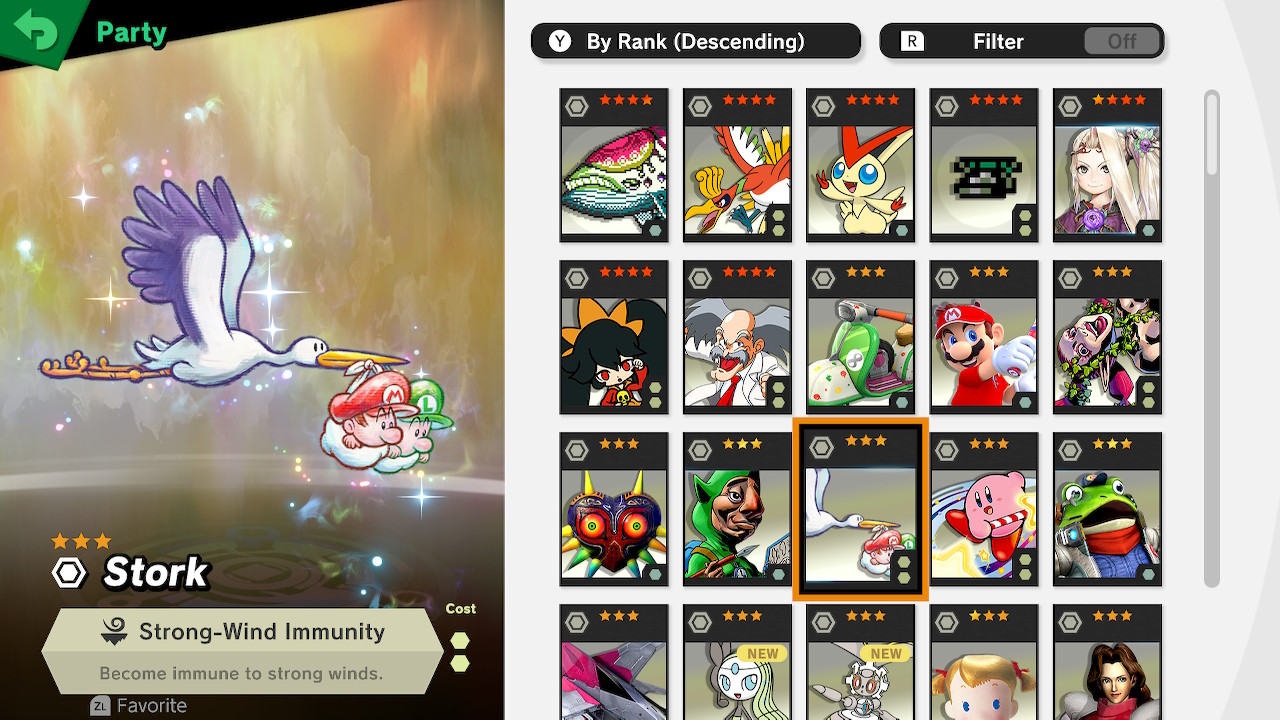
Support Spirits add specific boosts, and the best ones make sense for the character in question. Wind immunity for a stork makes sense—though, er, this stork infamously dropped both Baby Mario and Baby Luigi, so maybe that’s not the best example.
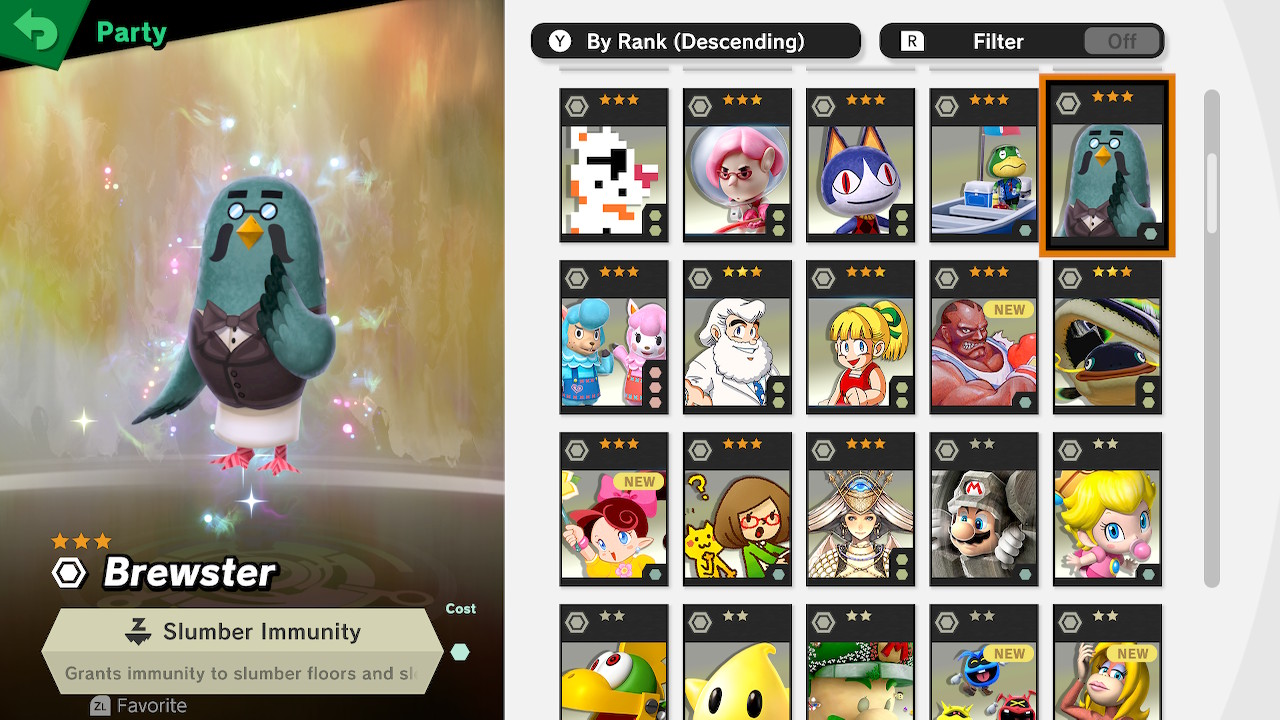
Now we’re talking. Animal Crossing’s Brewster is definitely about the caffeine, and all that implies.
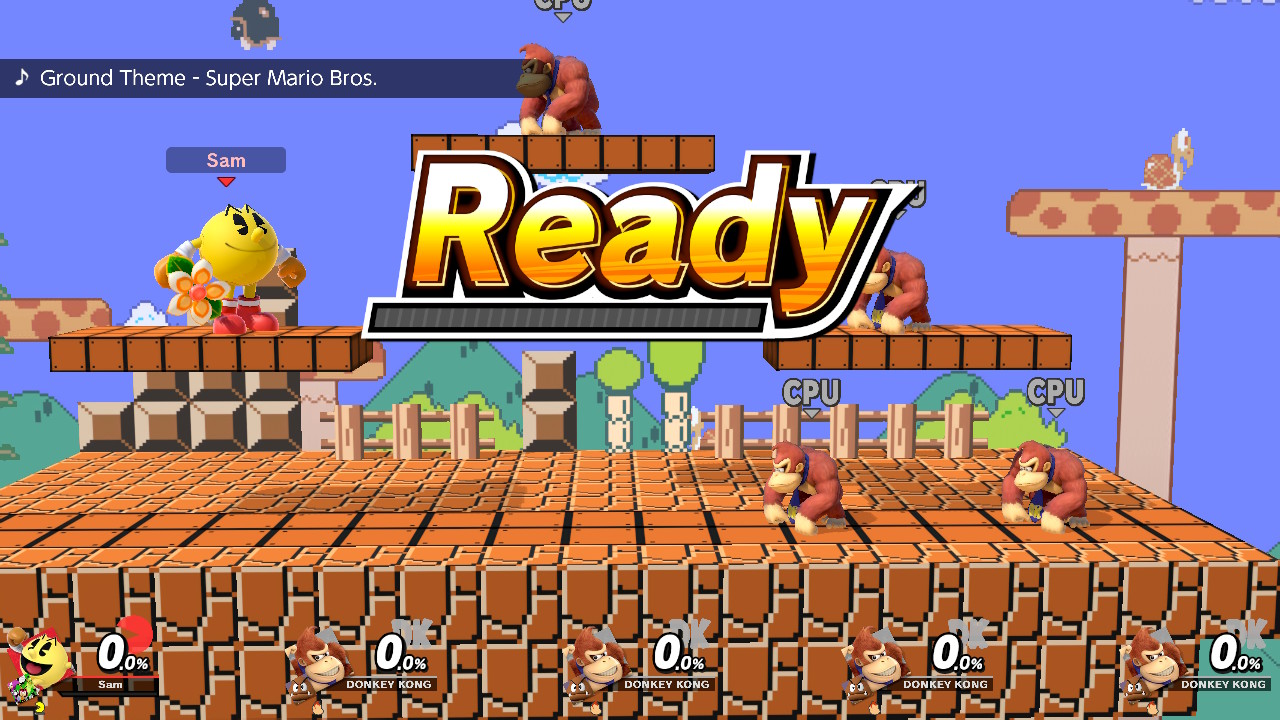
Many of the Spirits you fight have boring conditions, like this battle against “goombas”—meaning, shrunken Donkey Kongs who do nothing other than walk forward. I guess, yeah, they’re small and brown.
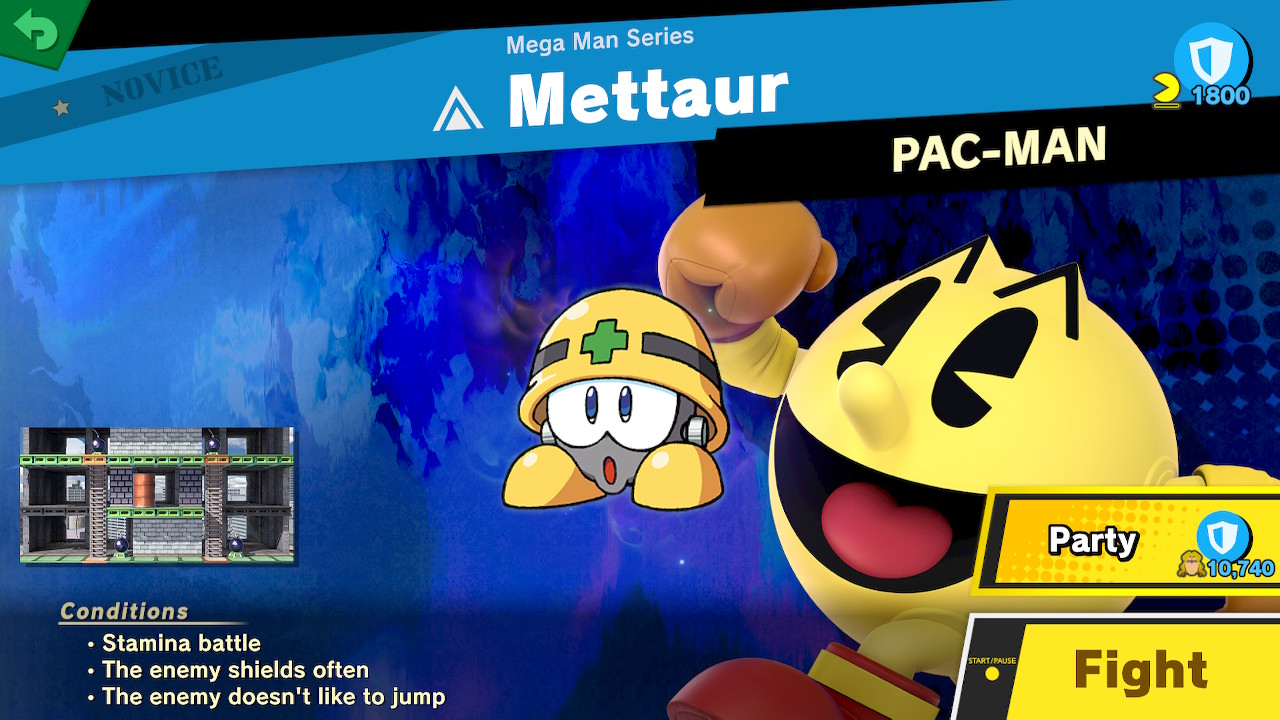
At their best, these fights are quite clever. Also, I never knew these freaking Mega Man baddies were called Mettaurs.
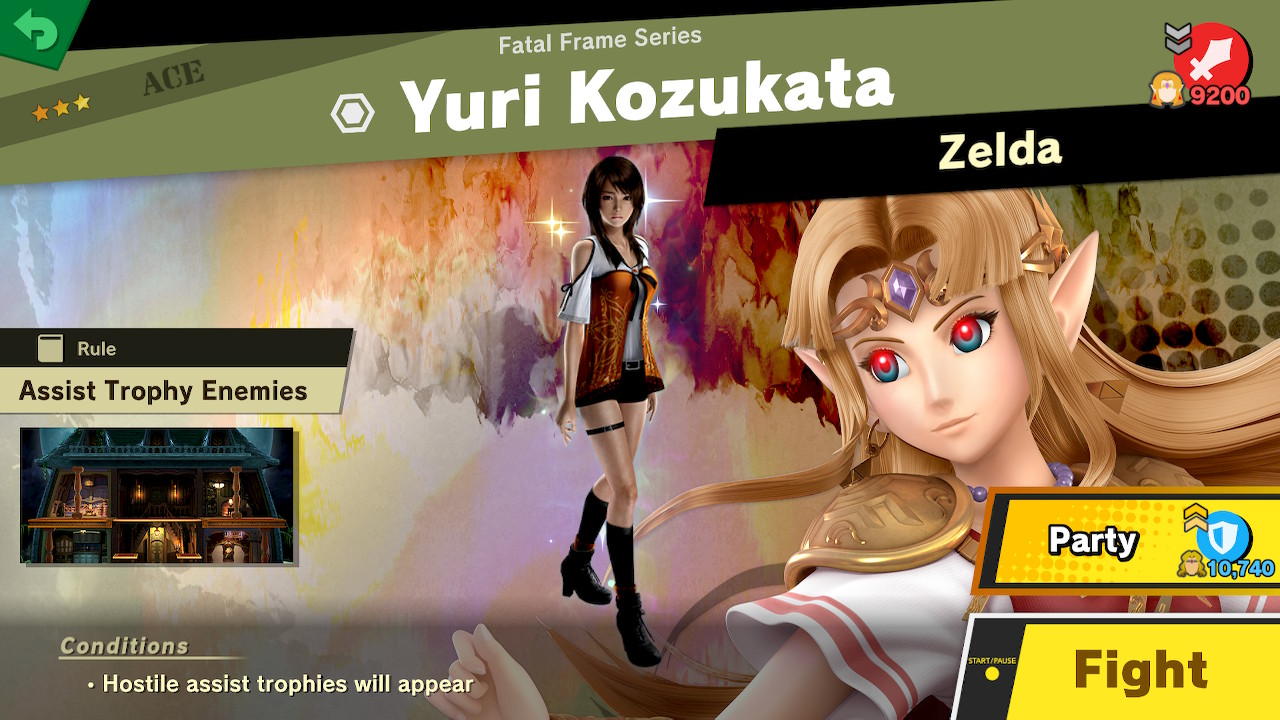
Since this is a game about a woman who controls spooky ghosts, this Spirit translation in Smash Ultimate is on point.
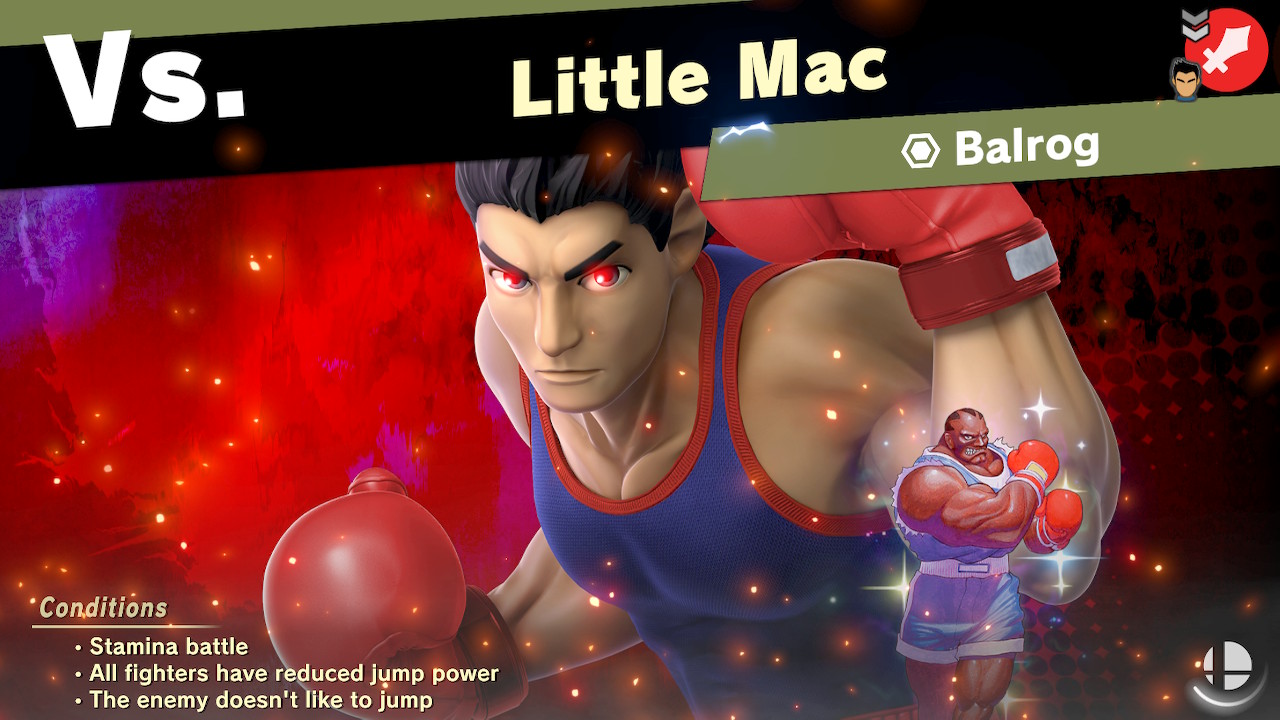
And LOL at this Balrog-ified version of Little Mac.
Should you want to skip the board game conceit, you can dive into the Spirit Board, which presents a batch of stickers as limited-time battles. Every five minutes, a roster of eight to 12 Spirits automatically refreshes, and this gives you time to pick your favorite three to four choices among the visible options and then fight them before new ones appear. However, unlike the Adventure, whose Spirits can be fought over and over and over, you only get one shot at each in this mode. Fail one of these fights, and its Spirit gets shuffled back into the 1,000-strong deck.
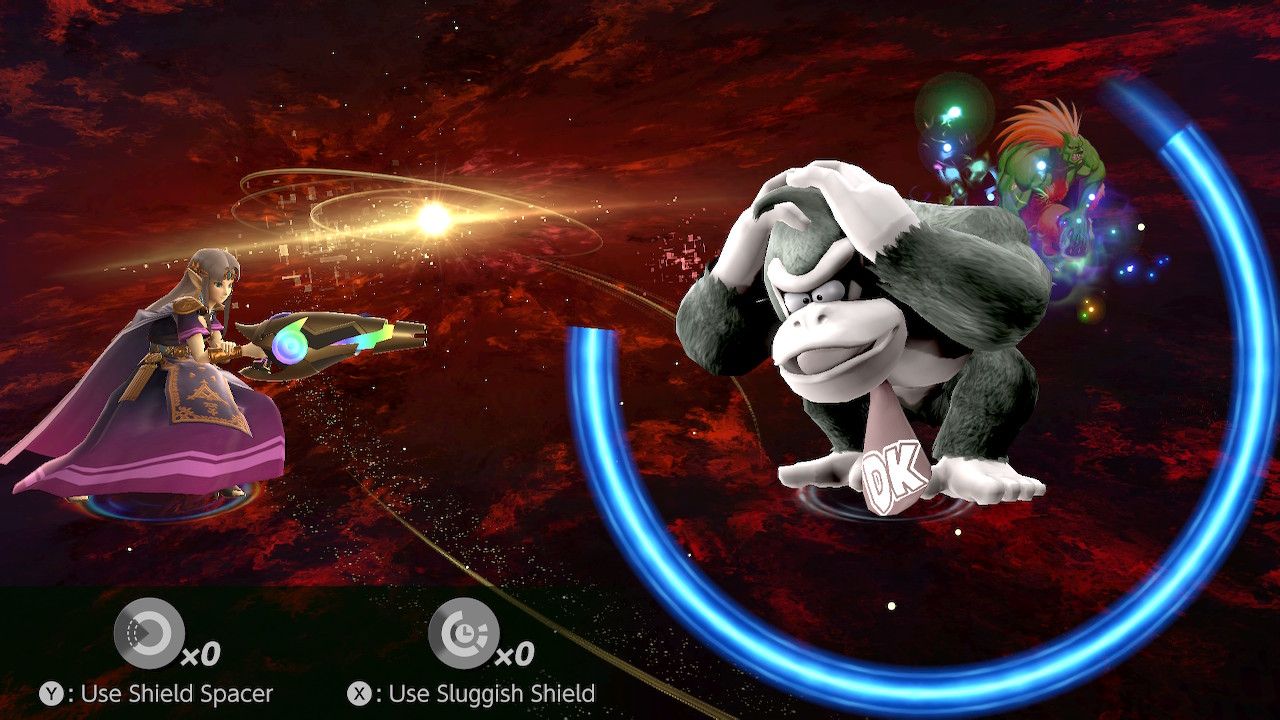
Worse, should you beat a listed Spirit in this non-Adventure mode, you’re not done; you then have to play a twitchy mini-game to shoot a laser gun at the Smash combatant you just beat and thus “free” its Spirit. Adding insult to injury, each mini-game session scales based on the fight you just finished. Easy opponent? Easy mini-game. Toughest opponent you’ve faced all day? Toughest mini-game. Fail this mini-game, and the spirit also gets shuffled back into the pile, waiting among all the other stickers to come back for another shot.
This blue shield spins rapidly, and you must shoot through its opening to claim a Spirit. I hate this mini-game.
This blue shield spins rapidly, and you must shoot through its opening to claim a Spirit. I hate this mini-game.
I am not sure I have screamed so loudly at my television in the past few years, grinding out a tough-as-nails victory against a highly ranked Spirit only to lose it to a single badly aimed laser blast in a stupid, freaking mini-game. The game does provide limited-use items to make this mini-game stuff easier, but that doesn’t excuse this laser-game annoyance.
Either way, whether you face Spirits in Adventure mode or on the Board, you’re getting into the same boat: fight after fight after fight with Smash series characters, all reimagined with a range of nostalgia-tinged traits and tweaks. Roughly 25 percent of these are genuinely clever, and the rest range from fine to average to forgettable. Pop a sticker for Super Mario’s goombas, for instance, and you’ll face roughly eight shrunken Donkey Kong fighters, all walking in a straight line. Or face off against a certain color of Pikmin seeds, and you’ll get an army of Kirby fighters colored in kind who come equipped with that Pikmin’s elemental trait.
You’ll feel compelled to fight all of them, however, because you’re not just “freeing” these Spirits to be a good Smash Samaritan. You’re claiming them as inventory, then slapping their traits onto your own fighter for boosts that range from fun to downright necessary. If you like your favorite Smash character’s “side-A” attack, you might equip an “improved air attacks” Spirit while facing tougher foes. Or, maybe a battle will take place in a poisonous fog, so you’ll skip your usual boosts and equip a “poison resistance” Spirit for that fight.
Sometimes, this meta game of picking and choosing stickers adds tasty spice to the proceedings. But a simplistic difficulty curve gets in the way of this playing out as ideally as Sora Ltd. likely intended.
In “standard” difficulty, Spirit battles range from stupidly easy to stupidly hard. Because the battles stretch out over a grid of criss-crossing board-game lines, or appear as random cards, this mode has zero opportunity to gradually ramp up and teach players good Smash habits. Dodging, blocking, throwing, chaining combos: no Smash game has ever done a great job of teaching new players how to “git gud,” but this mode’s specific-conditions fights might have presented an amazing opportunity. Imagine if a Spirit couldn’t be freed in a given fight unless you blocked or threw a certain amount of times.
Instead, you’ll either face dumb-as-dirt foes or brutally hard ones who flex incredible dodging, aiming, and positioning abilities. In the latter case, the mode’s very loud emphasis on Spirits means that players will have less incentive to learn smart play, and more incentive to find and equip perfect, diametrically opposed Spirits. One fight bombards you with Bullet Bill items in such robotically perfect fashion that the only viable solution is to find the “resist explosive damage” Spirit.
Then there’s a whole system behind the Spirit mode that revolves around upgrading spirits, retiring them, and earning a variety of in-game currencies (Spirit points, gold coins, Spirit coins, Spirit spheres) to min-max your cast of helper characters. The game doesn’t offer much in the way of instructions about this mode’s finer points. The worst part is that the game doesn’t clarify how awry the “Spirit retiring” system can go. At first, you might think that’s a good way to boost seemingly identical characters. Eventually, though, you learn you need to save specific Spirits to max out a “resurrect new Spirits” system.
Sound complicated? It is, and some of it is needless. Thankfully, the Spirit-selection process is helped by a “just pick some Spirits for me” button. Before any Spirit fight, tap this button to automatically equip counter-balance items for the foe in question—like a bullet-reflecting shield if you’re fighting a gun blaster, or a sleep-resistance token if your fight has a “fall asleep” trait attached. Should you get hooked on all of this Spirit collecting stuff, you can dig deeply into the menus to create your dream combatants.
But these equipable traits do nothing to add entirely new strategies—which, I would argue, is better than Smash 4‘s “custom fighter” system (that added so many legitimate moves and tweaks that it wreaked havoc in that game’s balance). This Spirits mode, alternatively, is so wacky that it clearly resides in an “add some spice to your single-player campaign” space, as opposed to one that might disrupt competitive play. (While you can play local multiplayer matches with Spirits enabled, don’t do this.)
Ultimate misses the Target
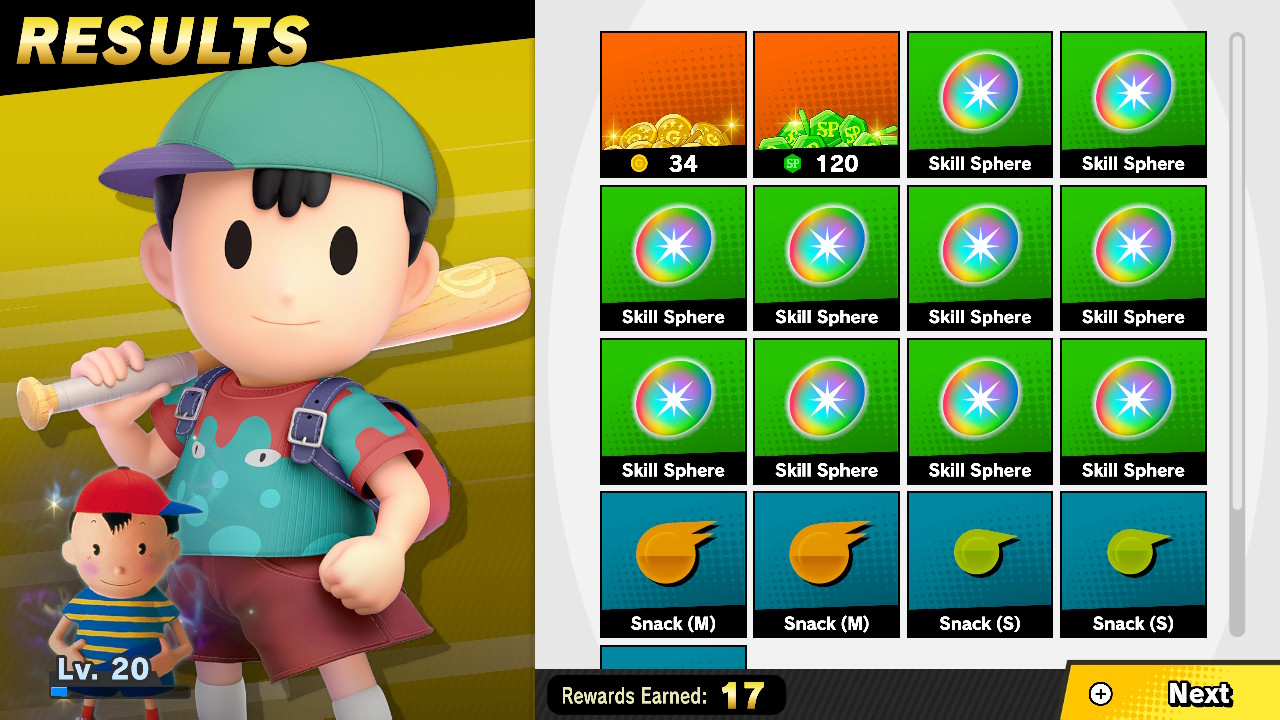
The rewards for Classic mode mostly apply to the Spirits mode.
The rewards for Classic mode mostly apply to the Spirits mode.
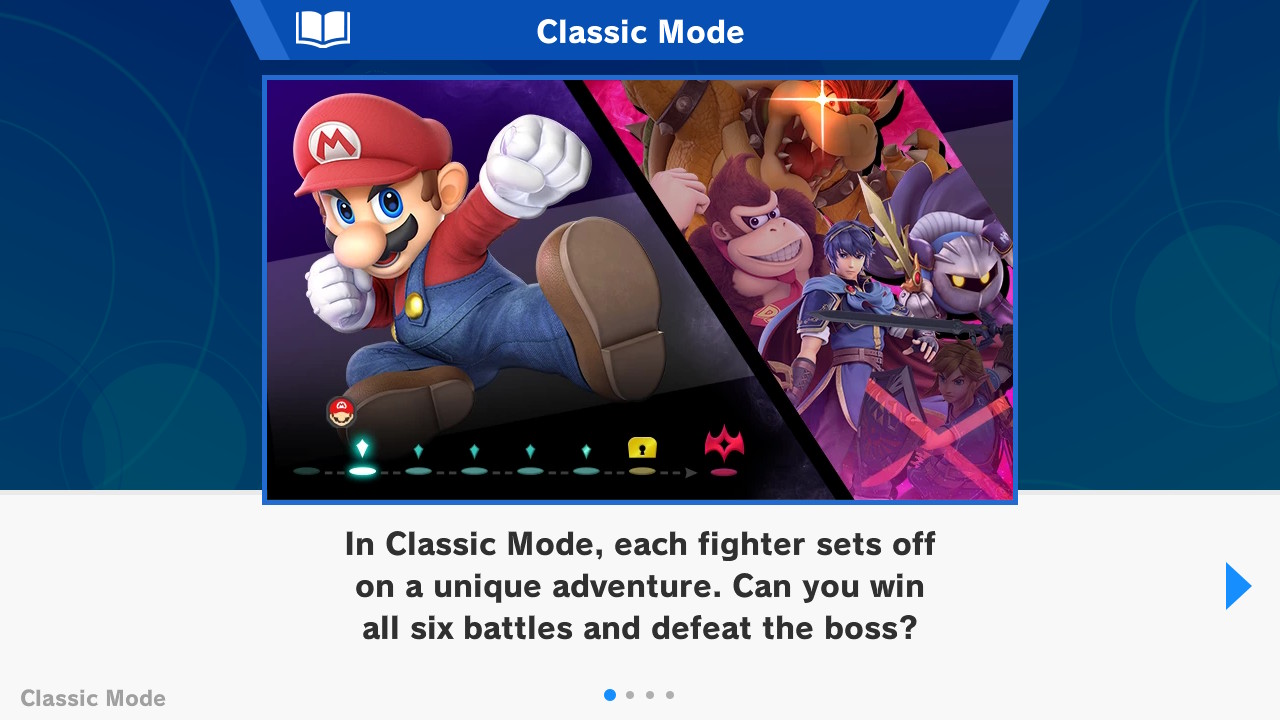
Classic Mode returns for solo Smashin’.
Classic Mode returns for solo Smashin’.
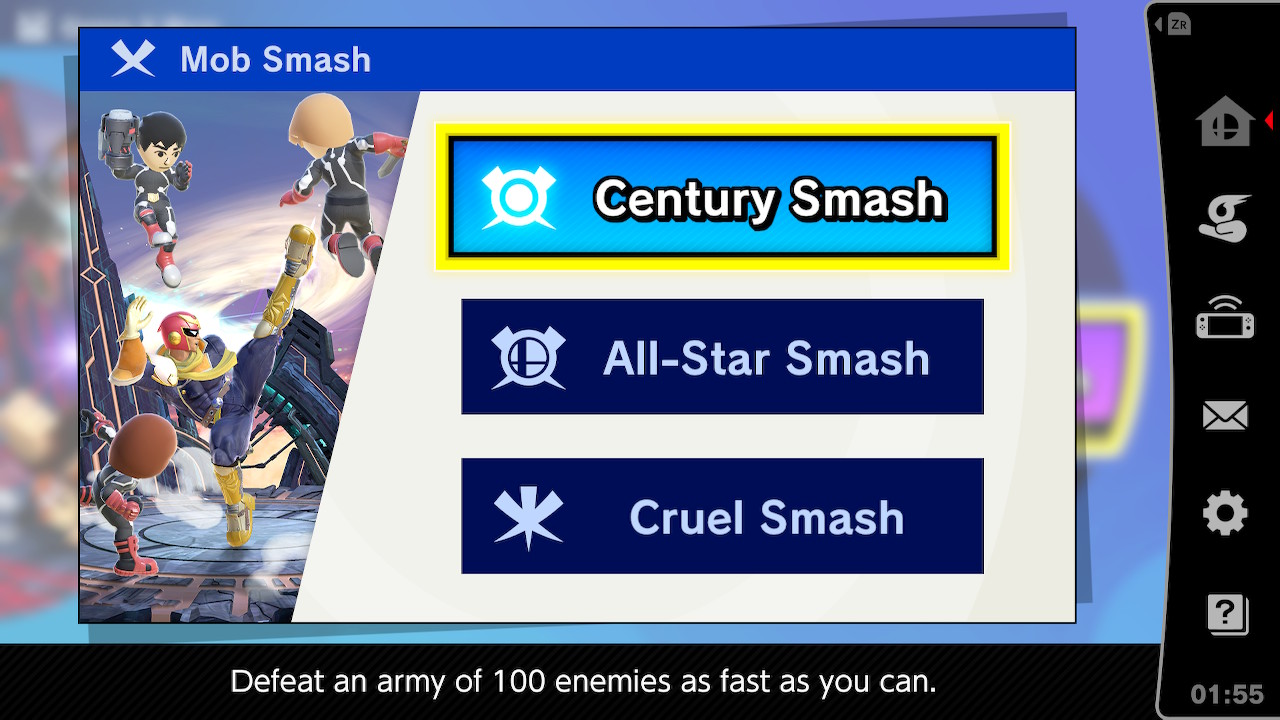
As do a few of the horde-style Smash battles.
As do a few of the horde-style Smash battles.
Classic Mode returns for solo Smashin’.
As do a few of the horde-style Smash battles.
That’s a long, long list of Spirit nitpicks, and they’re crucial because Spirit mode is it for new single-player content in Ultimate. A few familiar modes return, particularly the “Classic” mode, which lets you pick one fighter then proceed in arcade-action style against six other fighters before facing off against a boss. Each fighter gets its own specific Classic roster of combatants, all tuned to reflect that character’s gaming history, and these history-fight rosters are all genuinely smile-worthy. Like in prior games, this mode works in two-player, co-op fashion, and that option is quite welcome.
You can also take on a few of the series’ familiar “multi-man” challenges, in which you hunker down in one battle level and face off against waves of baddies. This game ships with three of those options: a generic “100-man” fight, a more robust “all-star” battle against every character in the game, and a ridiculously difficult “cruel” mode.
And… that’s it. If you’re hoping for a “Target Test”-style mode, where you run, jump, and attack a bunch of targets or items in a platformer-style level, that’s off the table. (This has been replaced with a single “collect all the coins” challenge level—yes, just one—that each fighter runs through as part of its Classic-mode levels. It’s not nearly as good.) Smash 4‘s twist on Target Test, the “Target Blast,” is also gone, as is the series’ beloved Home-Run Contest. The latter is a surprising omission, given that it has been in nearly every Smash game until now and is a pretty simple timesink: beat up an immobile sandbag, then launch it with a big “smash” attack as far as possible.
I point all of this out not to condemn Smash Ultimate for “lacking” content, but to point out how much Spirits mode has edged out the space that other solo content might have occupied. These nitpicks even ignore one important consideration. While the Spirits mode can feel same-samey over an extended gameplay session (the kind that I currently find myself in, trying to review this game as quickly as possible), I have delighted in picking up Spirits after finishing other work or distractions, tearing through roughly five to 10 quirky, surprising fights, and then moving on to some other work task.
Thus, Spirits feels like a very Nintendo kind of design: a mode that benefits from a “play in short, intense chunks” perspective, much like Animal Crossing. It’s clearly designed to deliver new content for however many weeks, months, or years it takes you to finish 1,200 solo fights.
Smash successes: Squad Strike, soundtrack
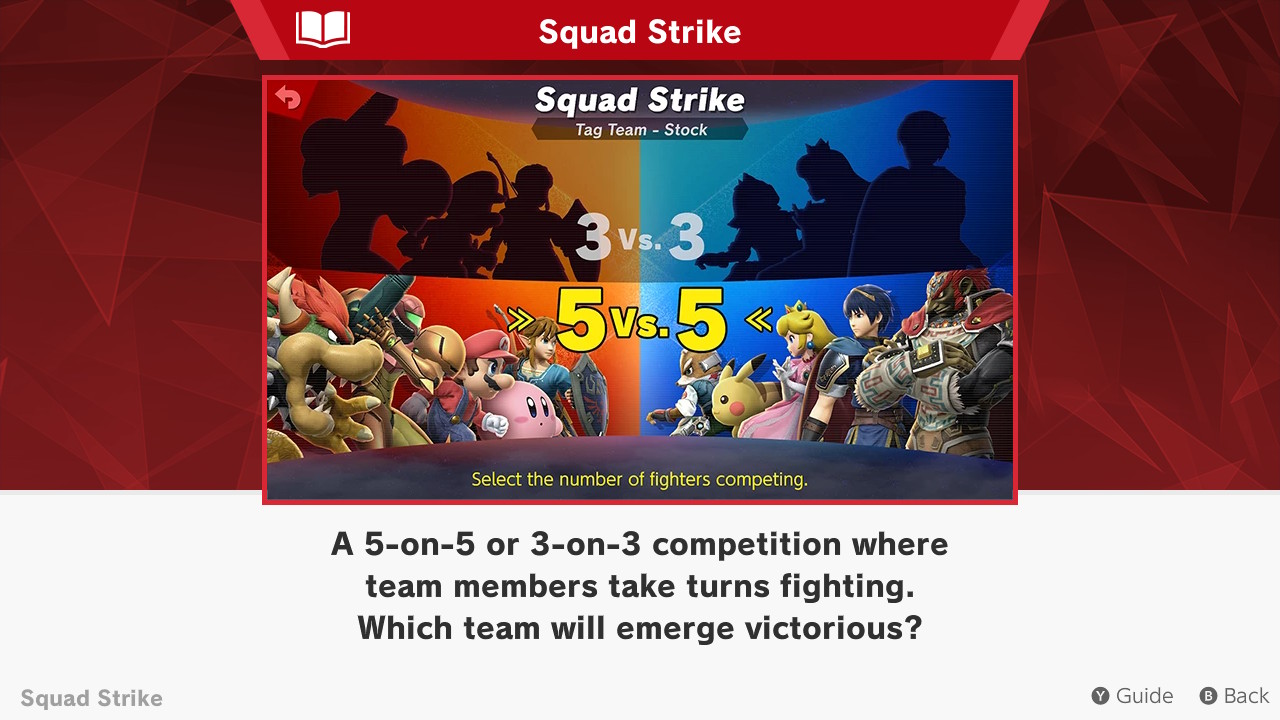
My favorite mode for Smash Ultimate versus play is Squad Strike. It plays as described here.
My favorite mode for Smash Ultimate versus play is Squad Strike. It plays as described here.
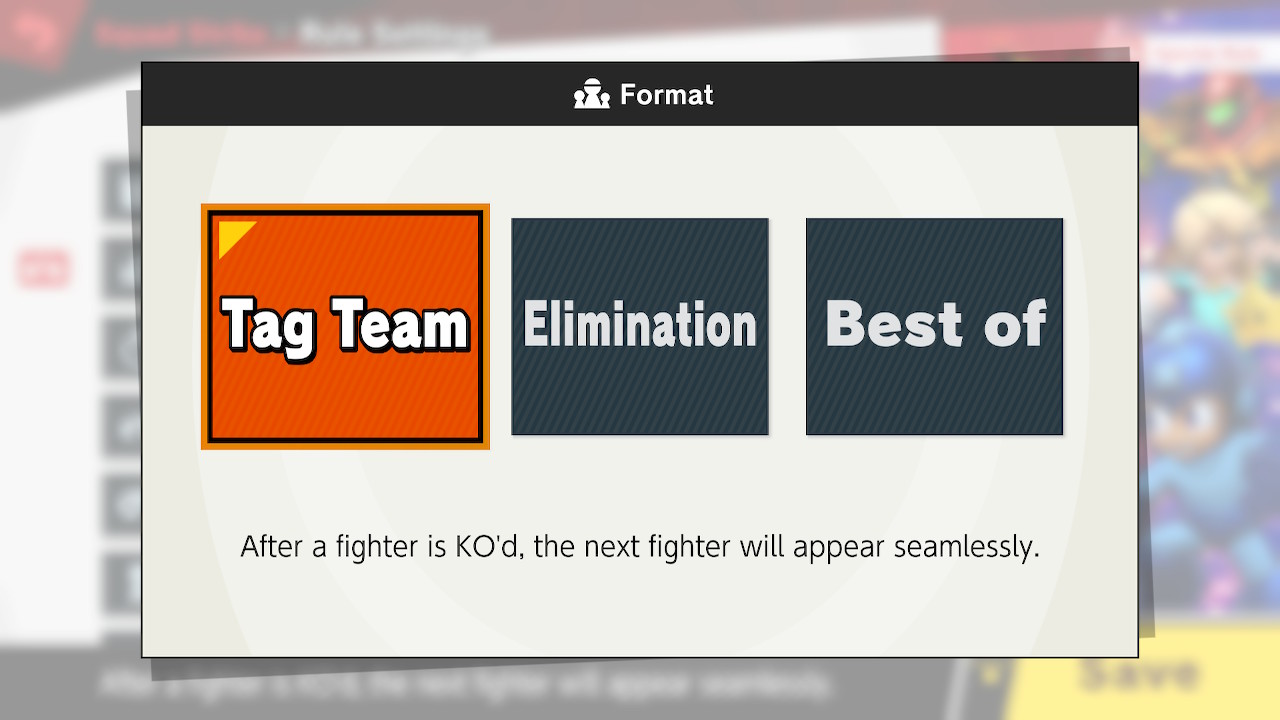
You can customize how you want the mode to unfold; I prefer the default method, which I liken to the King of Fighters series.
You can customize how you want the mode to unfold; I prefer the default method, which I liken to the King of Fighters series.
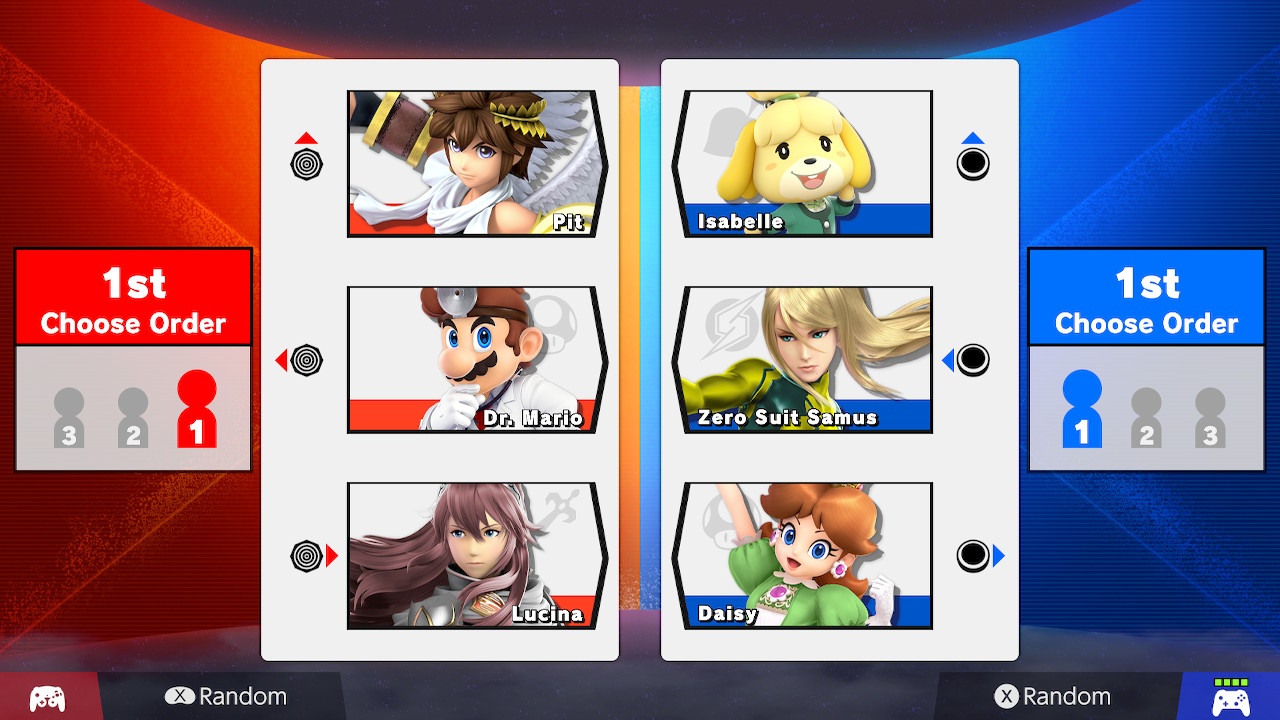
Before every Squad Strike match, use your buttons and joystick to secretly pick your fighter order. Nice touch, Sora Ltd.
Before every Squad Strike match, use your buttons and joystick to secretly pick your fighter order. Nice touch, Sora Ltd.
You can customize how you want the mode to unfold; I prefer the default method, which I liken to the King of Fighters series.
Before every Squad Strike match, use your buttons and joystick to secretly pick your fighter order. Nice touch, Sora Ltd.
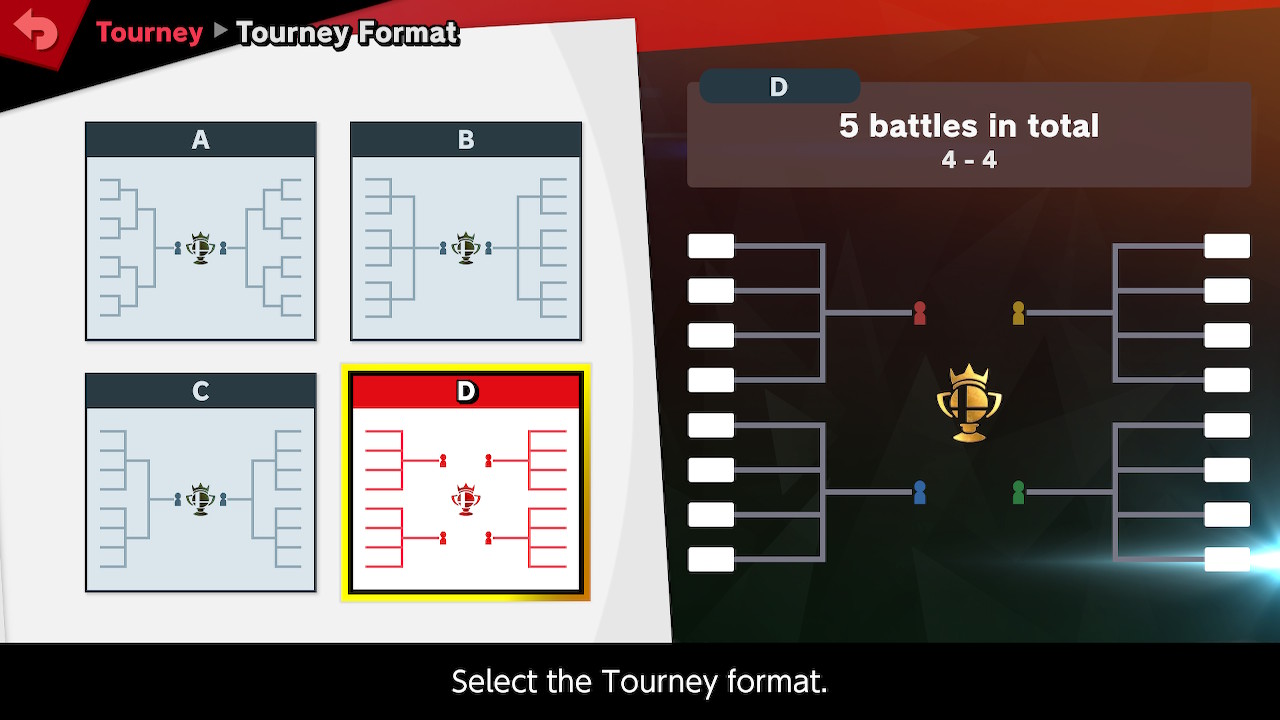
You can also build tournaments, and the game is polite enough to offer a ton of options for how brackets play out.
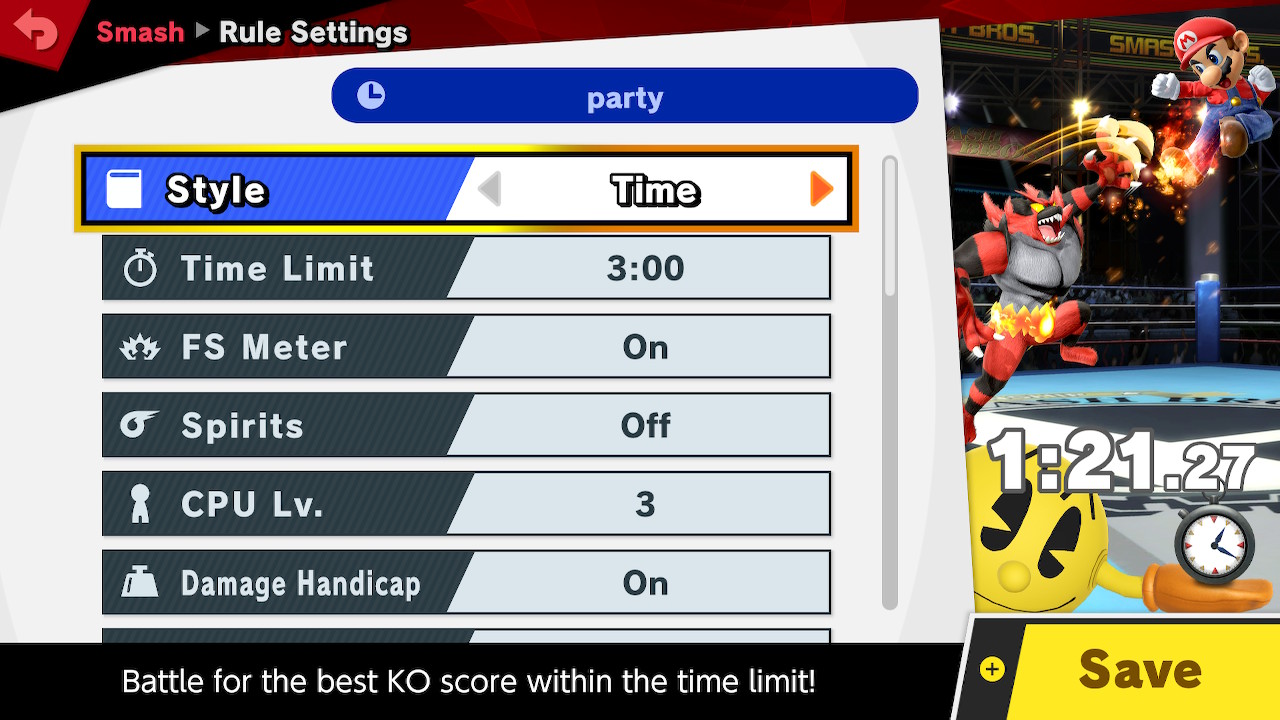
Here’s a sampling of battle-customization options.
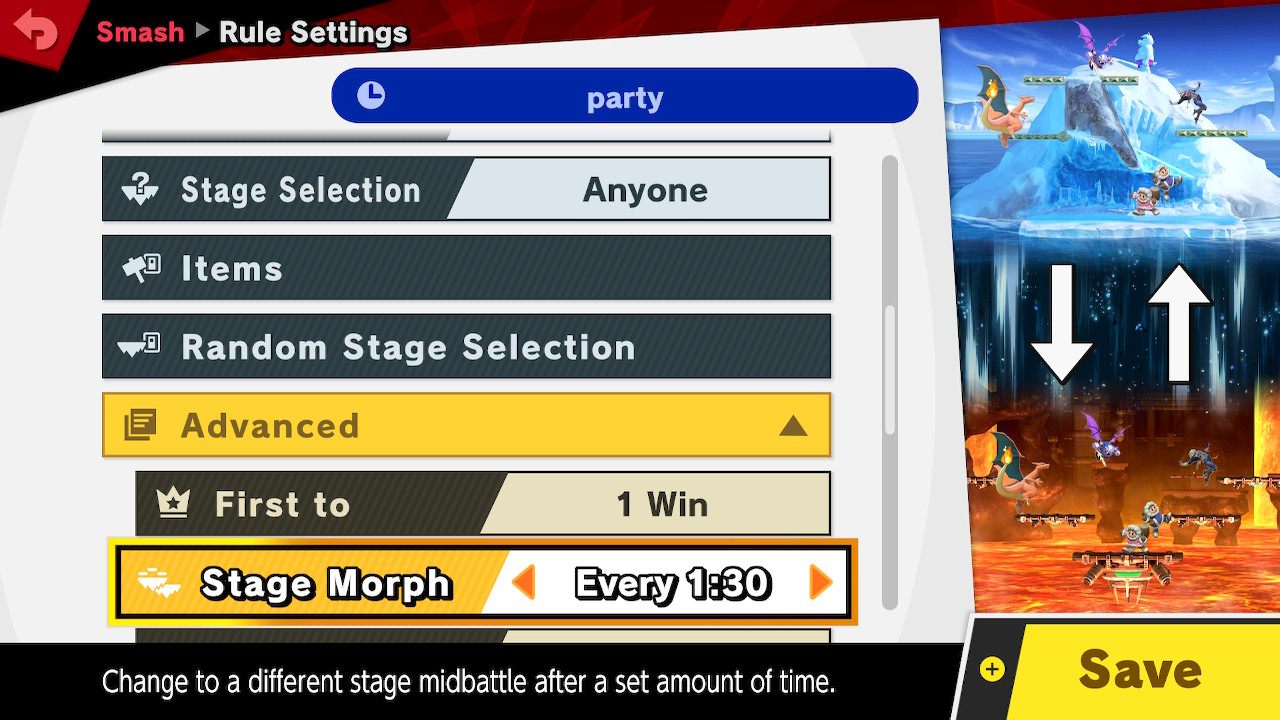
More options.
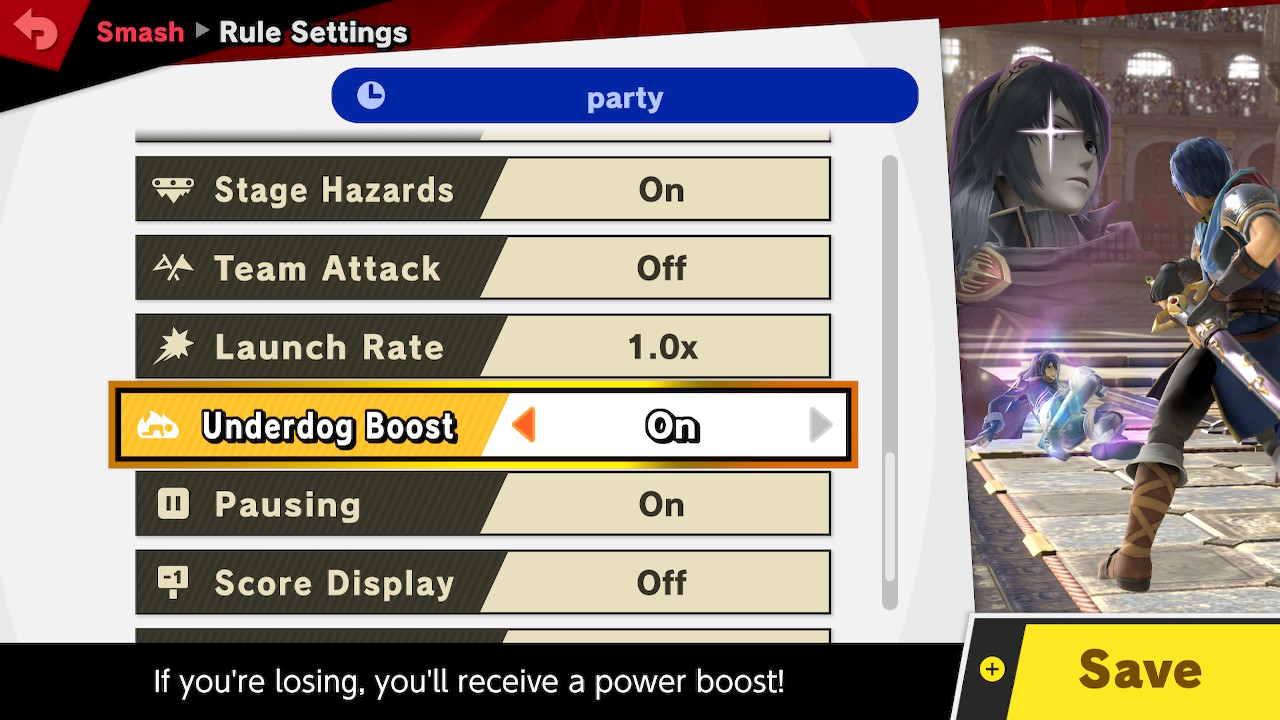
Even more options.
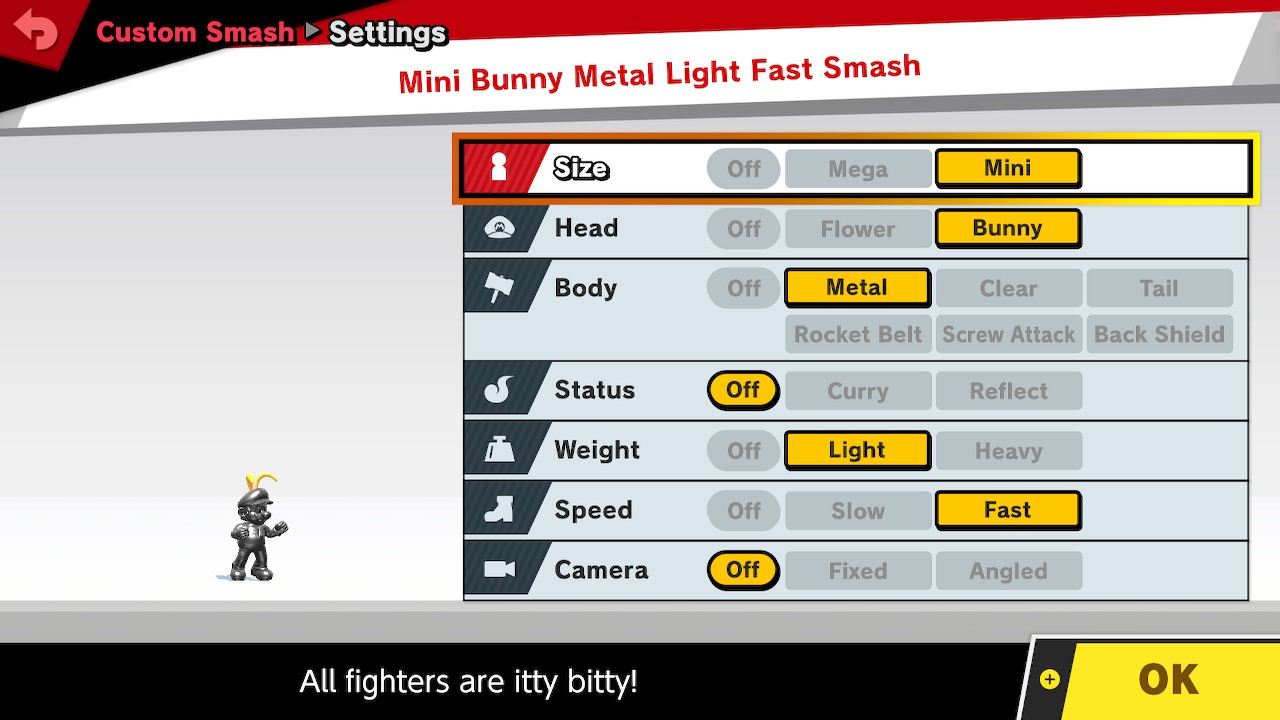
Or take it all the way to the intentionally bonkers options. Mini Bunny Metal Light Fast Smash, ho!
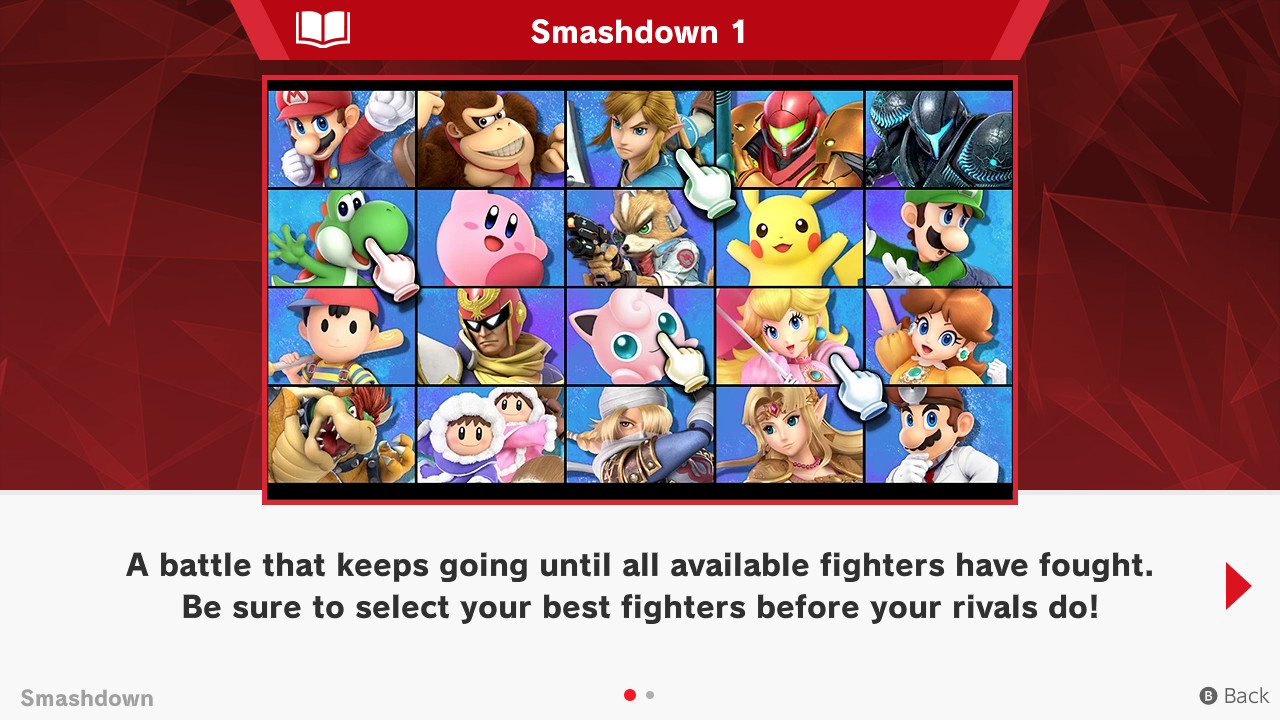
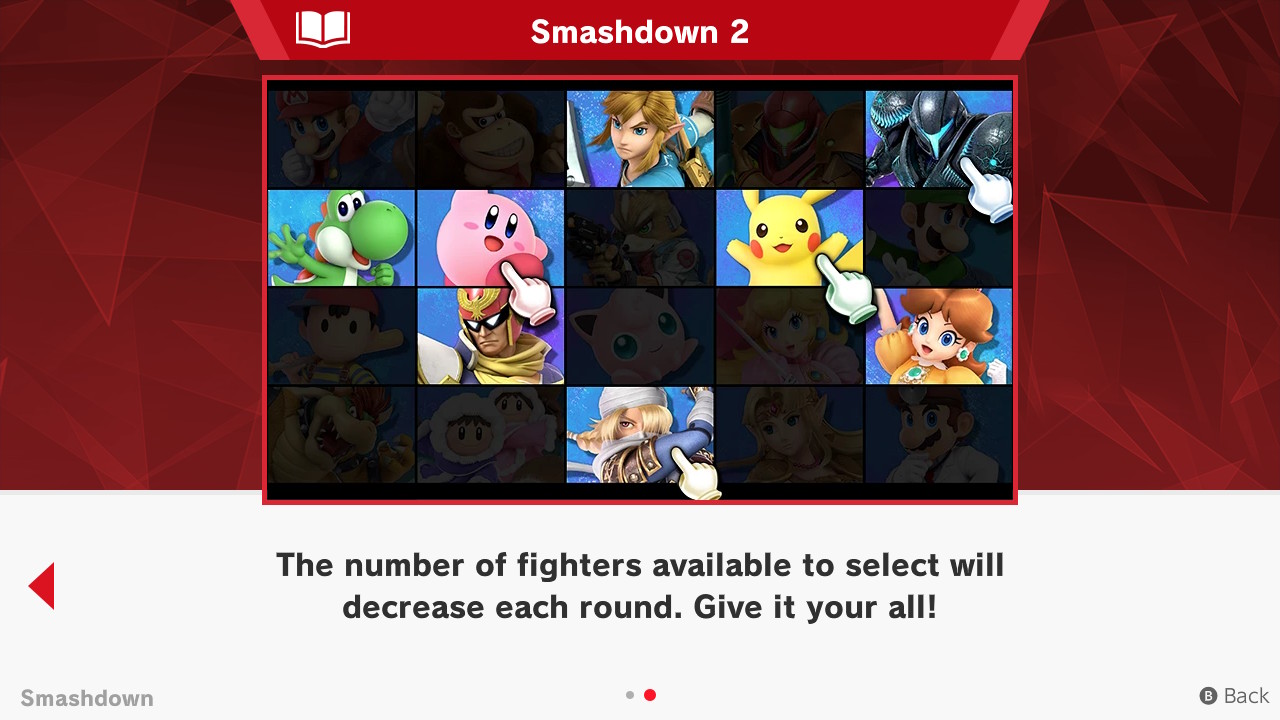
Smashdown isn’t quite as tantalizing in action as Squad Strike, but it’s also a welcome option.
Process of Smash elimination.
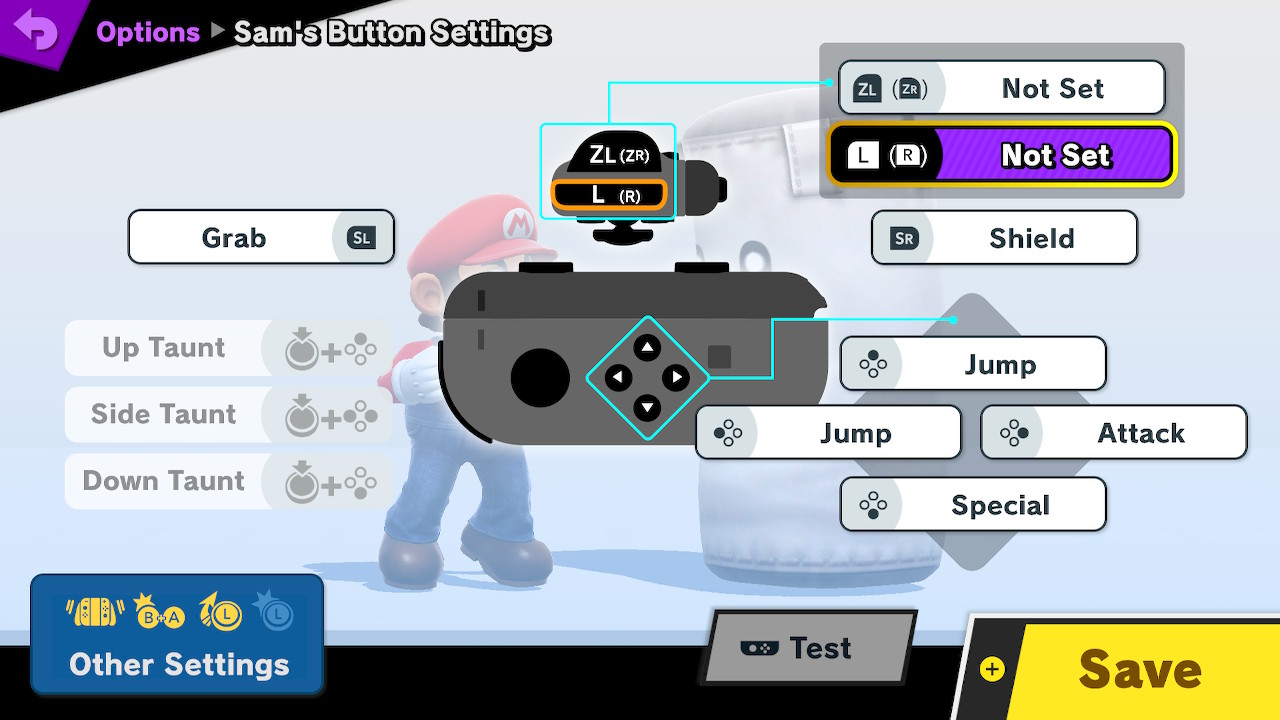
Plenty of controller-customization options, which you can assign to your own profile to be accessed no matter which controller you pick up in a given Smash session.
Those sessions will come between plenty of versus fights, which benefit from one brand-new mode: Squad Strike. In this, you and an opponent pick your own squad of characters (either three or five each), then face off in your choice of elimination style. My favorite way to play Squad Strike is King of Fighters style: after the first one-on-one match, whoever dies brings in their second fighter, totally fresh, while the survivor stays in the match, keeping whatever damage she already accumulated.
Between this thoughtful mode, a range of tournament-bracket options, and a bunch of easy-to-customize, easy-to-save battle presets, Smash Ultimate has left no battle option unturned… at least, in term of couch-combat options. While we’d love to report on what players can expect in the online modes, Nintendo didn’t activate its online-versus servers during the game’s review period. Our optimism on this front is mixed. On the one hand, online performance for Smash 4 on the Wii U was quite solid. But on the other, we’ve seen Switch games like Splatoon 2 face serious online-hacking issues over the past year.
In side-by-side comparisons against Smash 4 on the Wii U, we were surprised to see the older Wii U game enjoy consistently shorter loading times. Even more bizarre, that was with Smash 4‘s slower disc version. As of press time, Smash Ultimate is up to version 1.1 with no signs of improvement. We wonder if some wicked compression system is the culprit.
We typically gloss over soundtracks in Ars game reviews, but that’s impossible to do with Smash Ultimate. Make no mistake: your $60 purchase includes a pass to a gaming-music treasure trove beyond compare. Not even Grand Theft Auto‘s bursting-at-the-seams soundtracks can compare to Smash Ultimate‘s TWENTY-SEVEN HOURS of tunes. (That’s, like, two full seasons of The Wire.) More than 700 ditties unlock by default when you open the game, all organized in a nifty music-player interface that breaks songs down by individual first- and third-party game series. Playing through the game’s variety of modes can unlock other songs, and as of press time, I’m right at the 790 song mark.
More than 100 of those melodies arrive as newly remixed versions, exclusive to Smash Ultimate. (The rest of the songs either come from other Smash games or from the source games’ original chiptune scores.) Since getting my copy of the game, I’ve used that music-player interface, and its handy “custom playlist” feature, to listen to this 4.5-hour block of new remixes, and it’s pretty much everything I want in fresh takes on old tunes. They’re all courtesy of what Sora Ltd. calls the “Smash Orchestra,” and these new compositions emphasize live-instrument sounds over MIDI to dramatic effect.
As a lapsed music critic, I could throw shade on the tone applied to this orchestra’s guitars (even Steve Vai would call their sound “cheesy”), but that’s one drop of pessimism in a pool of holy-cow-yes. These 4.5 hours of tunes are handled with the utmost of care. The “Vs. Ridley” battle music from Super Metroid newly rips with its rock-orchestra take. The Pikmin theme song becomes an epic battle overture. And Donkey Kong Country‘s “Gang-Plank Galleon” jacks up the tempo to deliver a butt-kicking mix of marching-band bravado and Tejano bliss. All of this says nothing about the ample collection of new Mega Man and Castlevania themes, each born anew thanks to the Smash Orchestra. (In the case of Castlevania‘s music, prepare for epic shred-offs between screeching guitars and piercing violins.)
The game also features a first on Nintendo Switch: a music-playing option that turns your screen off, should you wish to use your Switch like an iPod while on the go. (I haven’t done formal tests, but I’ve measured over four hours of portable, screen-off music playback.)
Let me put it this way: if you own a Switch, hate Smash Bros., yet love Nintendo-era game themes, you should seriously consider plunking down $60 for this soundtrack alone.
Settled in Smash
We’re already a few pages deep, but I could go on for a few more with a character-by-character breakdown of strengths and weaknesses. Instead, I’ll leave a rapid-fire, closing list of positive thoughts.
No matter how much shade I shovel onto Smash Ultimate‘s uneven Spirits mode, this game still wins out because it features 74 satisfying characters, all battling within a gently updated Smash 4 engine. Smash Ultimate earns its name not by piling on the content but by understanding what an adjective like “ultimate” means in the context of a fighting game. Gamers want an essential, badass combat experience no matter which characters square off. Even this early, it’s settled: Smash Ultimate nails this expectation. Thus, it is the best fighting-game package to ever land on a Nintendo console.
The Good
The impossible is possible: 74 satisfying, powerful, and (mostly) unique fighters are at your disposal.
Smash 4‘s solid foundation has been tweaked with across-the-board power tweaks, pro-friendly dash considerations.
Local-versus options deliver everything from item-filled wackiness to super-serious tournaments.
Combat may look familiar on a TV, but you’ve never had a portable Smash experience look as crisp as this.
Classic mode delivers a customized set of fun, solo battles for every character.
The 27-hour soundtrack alone is arguably worth the $60 asking price.
The Bad
Spirits mode has great intent and incredible moments but doesn’t live up to the rest of the package.
I’d like the phone number of whoever put this laser-gun mini-game into the Spirits mode, for Pichu’s sake.
The thought and care that went into Spirits’ giant cast apparently didn’t apply to its poorly drawn maps.
The Ugly
Until Nintendo shows us otherwise, we’ll reserve judgment on what to expect from the online mode.
Verdict: If you own a Switch, what are you waiting for? Buy.



 Loading comments...
