

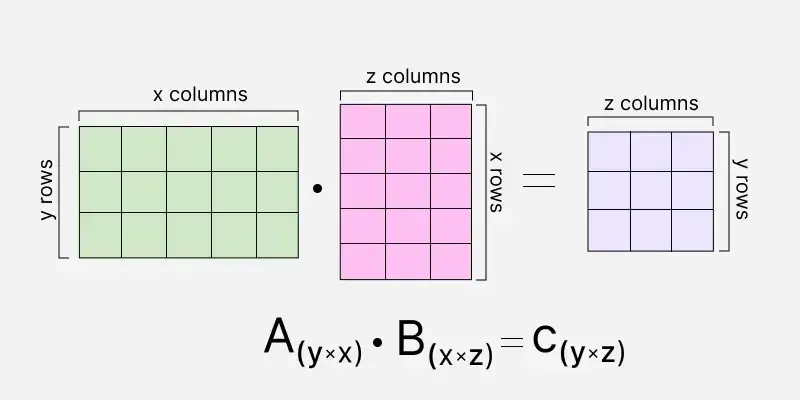
Matrix multiplication is a binary operation that produces a new matrix from two matrices. For multiplication, the number of columns in the first matrix must equal the number of rows in the second matrix. The resulting matrix (matrix product) has the same number of rows as the first matrix and the same number of columns as the second matrix.
Example, If matrix A is of order m × p and matrix B is of order p × n, then their product AB exists and is of order m × n.
How to Multiply Matrices
Let's take two matrices A and B of order 2×2
Rules and Conditions
- If "A = [aij]m×n" and "B = [bij]n×o" are two matrices, then the product of A and B is denoted as AB, whose order is "m × o". This condition is represented as given in the image.

- Matrix multiplication is not commutative, i.e., AB ≠ BA, or, in simple words, the product of A and B matrices is AB, and AB is not equal to BA; it is even possible that AB exists but BA does not exist.
Compatibility Conditions
We can multiply two matrices if the number of columns in the 1st matrix is equal to the number of rows in the 2nd matrix, otherwise, the given matrices cannot be multiplied.
For example:
- A 2×3 matrix can be multiplied by a 3×2 matrix, resulting in a 2×2 matrix.
- A 3×3 matrix cannot be multiplied by a 4×2 matrix because their dimensions are incompatible.
Special Properties of Matrix Multiplication
Apart from compatibility, here are some special properties of matrix multiplication:
- Both AB and BA matrix multiplication are defined if both A and B are square matrices.
- One of the matrices doesn't need to be a zero matrix if the product of two matrices A and B is zero.
Note: French mathematician Jacques Philippe Marie Binet was the first to perform matrix multiplication in 1812.
Step to Solve
To multiply two matrices, A and B, ensure that the number of columns in A equals the number of rows in B.
Calculate Elements: Multiply each element in a row of the first matrix by the corresponding element in a column of the second matrix, and sum these products to compute each element of the product matrix. Repeat this process for all rows and columns.
Form the Product Matrix: Place the computed elements in their respective positions to construct the resulting matrix.'
Example, let’s take a matrix of order (2×3) and another of order (3×2). To multiply these matrices, follow these steps:
Formula
Let's take two matrices A and B of order 2×2 such that

The resultant multiplication matrix X is represented as,
X =
Where
Matrix Multiplication (Scalar)
A matrix can be multiplied by a scalar value, which is called scalar multiplication.

When a matrix
A = \left[\begin{array}{cc} a & b\\ c & d \end{array}\right]
kA = k \times\left[\begin{array}{cc} a & b\\ c & d \end{array}\right]= \left[\begin{array}{cc} ka & kb\\ kc & kd \end{array}\right]