
- Tuesday, 13 October 2026

STS 95
NSSDCA/COSPAR ID: 1998-064A
Description
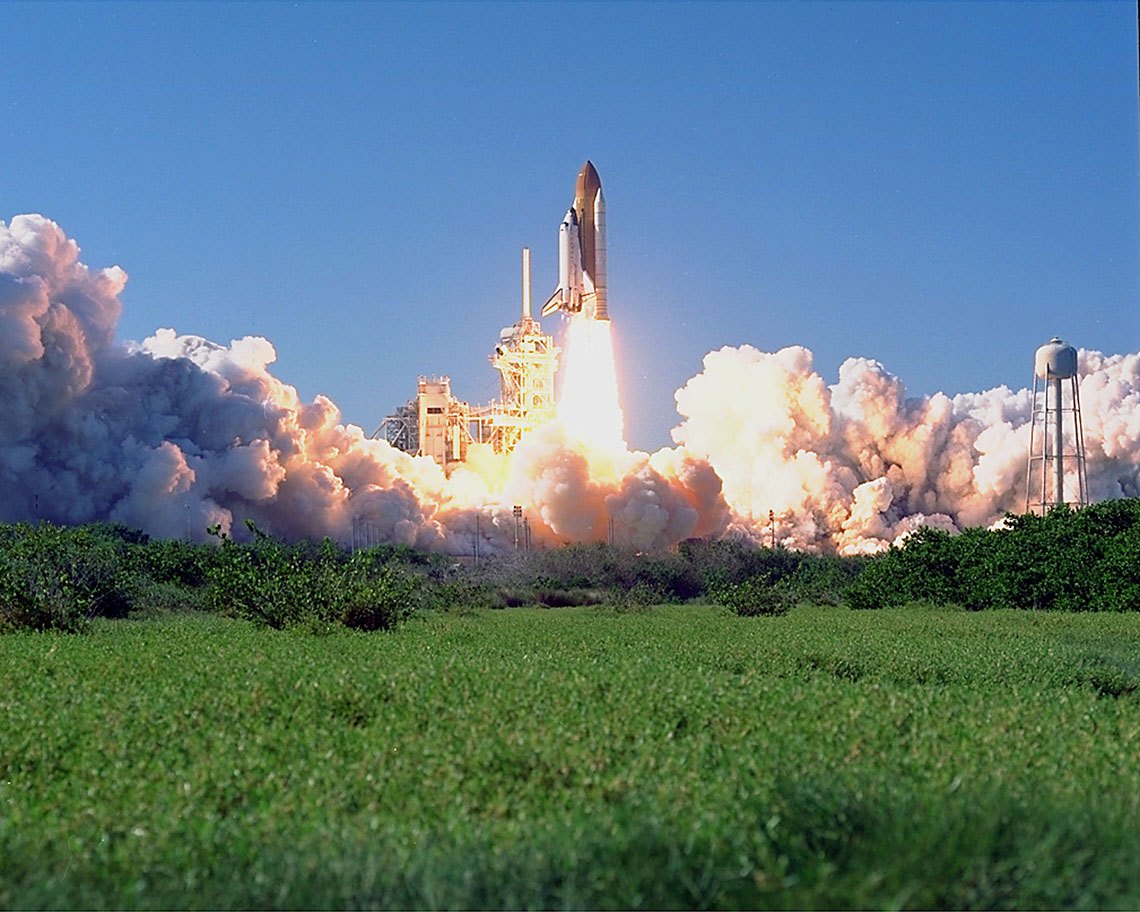
The STS-95 mission conducted a variety of experiments aboard the Space Shuttle Discovery, including the Spartan 201 free-flyer, the HST Orbiting Systems Test, the International Extreme Ultraviolet Hitchhiker, four Get Away Special (GAS) experiment packages, six other Hitchhiker experiments, and experiments conducted in the SPACEHAB module. The crew of STS-95 consisted of commander Curt Brown, pilot Steve Lindsey, mission specialists Scott Parazynski, Steve Robinson, and Pedro Duque, and payload specialists Chiaki Mukai and John Glenn. The shuttle Discovery landed at Kennedy Space Center on 07 November 1998 at 17:04 UT (12:04 p.m. EST) after a duration of 8 days, 22 hours, 44 minutes.
Spartan 201
The Spartan 201 platform was released on the fourth day of the flight by the shuttle's deployable arm and retrieved two days later and returned to Earth. The platform contained instruments including two telescopes to study the solar corona and solar wind. This was a reflight of the Spartan payload flown on Mission STS-87 in November 1997 which developed problems shortly after being deployed from the shuttle. The Spartan also carried tests of a system to transmit real-time to the ground to correct orientation and a video guidance sensor for automated docking systems.
HOST
The Hubble Space Telescope Orbiting Systems Test (HOST) was a platform on the shuttle designed for on-orbit testing of four of the components planned for the third Hubble servicing mission. The NICMOS Cooling System test involved zero-g verification of a Reverse Turbo Brayton Cycle Cooler. The HST 486 Computer test studied radiation effects on the DF-224 replacement parts. The Solid State Recorder test compared on-orbit performance of the flight spare solid state recorder with the current HST unit. The Fiber Optic Line test compared the 4 kbps data stream sent over fiber optic cables to the same stream sent over traditional electric wire.
IEH
The International Extreme Ultraviolet Hitchhiker (IEH) is comprised of six experiments mounted in the shuttle payload bay. These experiments are: (1) the Solar Extreme Ultraviolet Hitchhiker (SEH) designed to measure EUV and FUV fluxes required to study the Earth's upper atmosphere; (2) the Ultraviolet Spectrograph Telescope for Astronomical Research (UVSTAR) which measures EUV fluxes in order to produce images of extended plasma sources; (3) the STAR-LITE payload for observations of extended and diffuse astrophysical targets; (4) the CONCAP-IV payload designed to grow thin films by physical vapor transport; (5) the Petite Amateur Navy Satellite (PANSAT), a small deployable satellite from the DOD Space Test Program which stores and transmits digital communications to ground stations; and, (6) two Get Away Special (GAS) packages.
Spacehab
A Spacehab Module, a 10 x 13.5 foot pressurized laboratory is mounted in the payload bay connected by a tunnel to the shuttle mid-deck. The laboratory provides room for some 30 experiments including plant growth, materials science, microgravity, and medications. Among these experiments are an aerogel production test, the Advanced Gradient Heating Facility (AGHF), the Advanced Protein Crystallization Facility (APCF), the BIOBOX human bone and cell growth experiment, Oceaneering SPACEHAB Refrigerator Freezer (OSRF), the Vestibular Function Experiment Unit (VFEU), the Protein Crystallization Apparatus for Microgravity (PCAM), Organic Crystal Growth (OCC), and the NHK Camera.
Other Hitchhiker and GAS Experiments
In addition to the hitchhiker experiments discussed above (SEH, UVSTAR, STAR-LITE, and PANSAT) the shuttle carried the Solar Constant Experiment (SOLCON), a radiometer designed to measure solar irradiance for calibration of satellite measurements; the Cosmic Dust Aggregate experiment (CODAG) which simulates the aggregation and dynamics of dust particles during early solar system formation; and the Roach Experiment which used a camcorder to monitor the life cycle of cockroaches in space. The two Get Away Specials in addition to the two carried on IEH are the Capillary Pumped Loop (CPL) experiment to demonstrate the performance of a two-phase capillary pumped loop in space, and the Hearts in Space experiment to study why astronauts' hearts become smaller while in space.
Human Crew Life Sciences
Life science experiments on the crew included experiments of the effects of space on a crew member of advanced age (77-year-old John Glenn). Studies on Glenn included wearing electrodes and ingesting a miniature thermometer to study sleep disturbances in space, giving blood and urine samples to learn about protein breakdown in space, monitoring of heart activity in microgravity, and long term effects of weightlessness on balance and muscle loss. Other astronauts also took part in some of these experiments. Additionally, Chiaki Mukai took part in a study on sleep patterns and melatonin.
John Glenn
This shuttle mission received much public attention due to the inclusion of John Glenn as payload specialist. Glenn was one of the original Mercury 7 astronauts and the first American to orbit the Earth on 20 February 1962 on the Mercury Atlas capsule Friendship 7. At 77 years of age, he becomes on this shuttle flight the oldest person to go into space.
Alternate Names
- 25519
- STS95
Facts in Brief
Launch Date: 1998-10-29
Launch Vehicle: Shuttle
Launch Site: Cape Canaveral, United States
Mass: 103069 kg
Funding Agency
- NASA-Office of Space Flight (United States)
Disciplines
- Planetary Science
- Engineering
- Life Science
- Human Crew
- Astronomy
- Earth Science
- Microgravity
Additional Information
Questions and comments about this spacecraft can be directed to: Coordinated Request and User Support Office
Related Information/Data at NSSDCA
Other Sources of STS 95 Information/Data
STS 95 information (NASA Shuttle Web)
STS 95 information (NASA KSC)
![[USA.gov]](/logo/usagov_logo.gif)
