<?xml version="1.0" encoding="UTF-8"?>
<!DOCTYPE html PUBLIC "-//W3C//DTD XHTML 1.0 Transitional//EN" "http://www.w3.org/TR/xhtml1/DTD/xhtml1-transitional.dtd">
<html xmlns="http://www.w3.org/1999/xhtml"><head><title>NASA - NSSDCA - Spacecraft - Details</title><meta http-equiv="Content-Type" content="text/html; charset=utf-8" />
<meta name="description" content="NSSDCA Master Catalog" />
<meta name="keywords" content="NASA, NSSDCA, NSSDCA Master Catalog, NMC, spacecraft, experiments, datasets, data collections, personnel, space events, lunar maps, planetary maps, new data, updated data, lunar events, planetary events, historical events" />
<meta name="orgcode" content="690.1" />
<meta name="rno" content="David.R.Williams.1" />
<meta name="content-owner" content="David.R.Williams.1" />
<meta name="webmaster" content="Edwin.V.Bell.1" />
<link rel="stylesheet" type="text/css" media="screen" href="/style/everyone.css" />

<style type="text/css" media="screen">
@import url("/style/nasa_style.css");
@import url("/style/jin_style.css");
</style>
<!--
<style type="text/css" media="screen">
@import url("/style/style_iefixes.css");
</style>
-->
<link rel="stylesheet" type="text/css" media="print" href="/style/print.css" />
<link rel="stylesheet" type="text/css" media="print" href="/style/jin_print.css" />
<link rel="stylesheet" type="text/css" media="handheld" href="/style/handheld.css" />
<script type="text/javascript" id="_fed_an_ua_tag" src="https://dap.digitalgov.gov/Universal-Federated-Analytics-Min.js?agency=NASA"></script></head><body><div id="paper">


  <div id="nasahead">
    <a href="http://www.nasa.gov/" target="_blank"><img src="/logo/nasa_bigheader_logo.gif" alt="NASA Logo, National Aeronautics and Space Administration" width="288" height="51" vspace="6" /></a>

    <div id="links">
      <ul>
        <li>Tuesday, 13 October 2026</li>
      </ul>
    </div>
  </div>
<div id="contentwrapper"><div id="rightcontent"><div id="headimage"><img height="100" width="530" alt="NASA Space Science Data Coordinated Archive Header" src="/logo/nssdca_header.jpg"/></div><h1>Ranger 6</h1><p><strong>NSSDCA/COSPAR ID:</strong> 1964-007A</p><div class="twocol"><div class="urone"><h2>Description</h2><p><p>Ranger 6 was designed to achieve a lunar impact trajectory and to transmit high-resolution photographs of the lunar surface during the final minutes of flight up to impact. The spacecraft carried six television vidicon cameras, 2 full-scan cameras (channel F, one wide-angle, one narrow-angle) and 4 partial scan cameras (channel P, two wide-angle, two narrow-angle) to accomplish these objectives. The cameras were arranged in two separate chains, or channels, each self-contained with separate power supplies, timers, and transmitters so as to afford the greatest reliability and probability of obtaining high-quality video pictures. No other experiments were carried on the spacecraft. Due to a failure of the camera system no images were returned.
</p>
<h4>Spacecraft and Subsystems</h4>
<p>
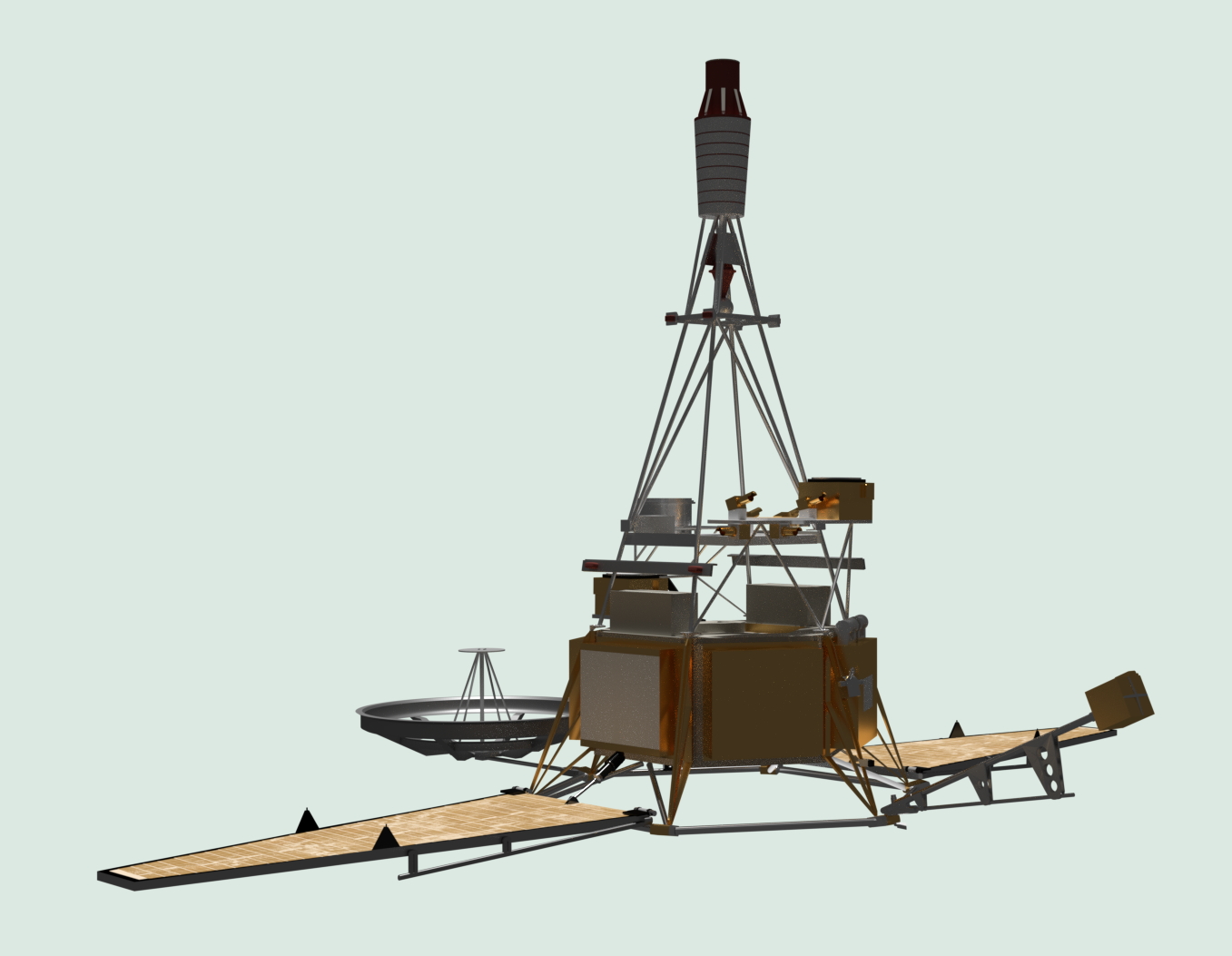
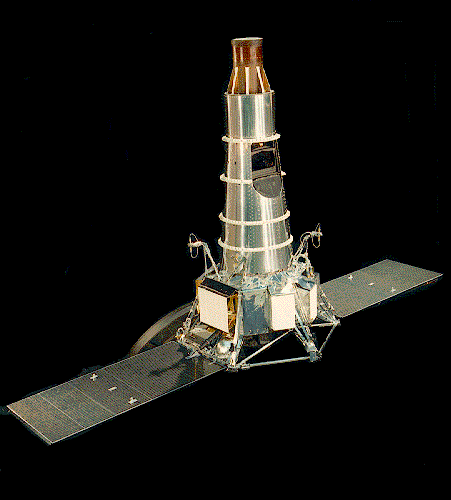
Rangers 6, 7, 8, and 9 were the so-called Block 3 versions of the Ranger spacecraft. The spacecraft consisted of a hexagonal aluminum frame base 1.5 m across on which was mounted the propulsion and power units, topped by a truncated conical tower which held the TV cameras. Two solar panel wings, each 73.9 cm wide by 153.7 cm long, extended from opposite edges of the base with a full span of 4.6 m, and a pointable high gain dish antenna was hinge mounted at one of the corners of the base away from the solar panels. A cylindrical quasiomnidirectional antenna was seated on top of the conical tower. The overall height of the spacecraft was 3.6 m.
</p>
<p>
Propulsion for the mid-course trajectory correction was provided by a 224-N thrust monopropellant hydrazine engine with 4 jet-vane vector control. Orientation and attitude control about 3 axes was enabled by 12 nitrogen gas jets coupled to a system of 3 gyros, 4 primary Sun sensors, 2 secondary Sun sensors, and an Earth sensor. Power was supplied by 9792 Si solar cells contained in the two solar panels, giving a total array area of 2.3 square meters and producing 200 W. Two 1200 Watt-hr AgZnO batteries rated at 26.5 V with a capacity for 9 hours of operation provided power to each of the separate communication/TV camera chains. Two 1000 Watt-hr AgZnO batteries stored power for spacecraft operations.
</p>
<p>
Communications were through the quasiomnidirectional low-gain antenna and the parabolic high-gain antenna. Transmitters aboard the spacecraft included a 60 W TV channel F at 959.52 MHz, a 60 W TV channel P at 960.05 MHz, and a 3 W transponder channel 8 at 960.58 MHz. The telecommunications equipment converted the composite video signal from the camera transmitters into an RF signal for subsequent transmission through the spacecraft high-gain antenna. Sufficient video bandwidth was provided to allow for rapid framing sequences of both narrow- and wide-angle television pictures.
</p>
<h4>Mission Profile</h4>
<p>
Ranger 6 was launched into an Earth parking orbit and injected on a lunar trajectory by a second Agena burn. The midcourse trajectory correction was accomplished early in the flight by ground control. On February 2, 1964, at 9:24:32 UT, 65.5 hours after launch, Ranger 6 impacted the Moon as planned on the eastern edge of Mare Tranquillitatis (Sea of Tranquility) at 9.3864 N, 21.4806 E (impact site identified from Lunar Reconnaissance Orbiter images). The trajectory of the spacecraft was on target and the orientation of the spacecraft to the surface during descent was correct, but no video signal was received and no camera data obtained. A review board determined the most likely cause of failure was due to an arc-over in the TV power system when it inadvertently turned on for 67 seconds approximately 2 minutes after launch during the period of booster-engine separation.
</p>
<p>
Total research, development, launch, and support costs for the Ranger series of spacecraft (Rangers 1 through 9) was approximately $170 million.</p></p></div><div class="urtwo"><h2>Alternate Names</h2><ul><li>00747</li><li>RA-A</li><li>Ranger6</li></ul><h2>Facts in Brief</h2><p><strong>Launch Date:</strong> 1964-01-30<br/><strong>Launch Vehicle:</strong> Atlas-Agena B<br/><strong>Launch Site:</strong> Cape Canaveral, United States<br/><strong>Mass:</strong> 381 kg<br/><strong>Nominal Power:</strong> 200 W<br/></p><h2>Funding Agency</h2><ul><li>NASA-Office of Space Science Applications (United States)</li></ul><h2>Discipline</h2><ul><li>Planetary Science</li></ul><h2>Additional Information</h2><ul><li><a href="/nmc/spacecraft/displayTrajectory.action?id=1964-007A">Launch/Orbital information for Ranger 6</a></li><li><a href="/nmc/spacecraft/displayTelemetry.action?id=1964-007A">Telecommunications information for Ranger 6</a></li></ul><ul><li><a href="/nmc/spacecraft/displayExperiment.action?spacecraftId=1964-007A">Experiments on Ranger 6</a></li><li><a href="/nmc/spacecraft/displayDataset.action?spacecraftId=1964-007A">Data collections from Ranger 6</a></li></ul><h2/><p>
          Questions and comments about this spacecraft can be directed to:
          <a href="mailto:gsfc-dl-nssdca-request@mail.nasa.gov?Subject=NMC+Comment%2FQuestion%3A+Ranger+6+%281964-007A%29">Coordinated Request and User Support Office</a></p></div></div><div class="clear"> </div><h2>Personnel</h2><table cellspacing="0" class="alternate"><thead><tr><th>Name</th><th>Role</th><th>Original Affiliation</th><th>E-mail</th></tr></thead><tbody></tbody></table><h2>Selected References</h2><ul><li>Ranger 6 and 7,
    TRW, Space Log, TRW <em>Space Technol.</em>, Lab., 4, No. 2 17-24, Redondo Beach, Calif., 1964.</li><li>Mission operation reports (1963 - 1964),
    NASA, Off. of Programming, Off. of Prog. Rept., Wash., D.C., 1963-1964.</li></ul>
<a href="http://nssdc.gsfc.nasa.gov/image/spacecraft/ranger_block1.jpg">
<img src="http://nssdc.gsfc.nasa.gov/thumbnail/spacecraft/ranger_block1.gif" alt="Image of Ranger block 1" /></a>


<h2>Other Ranger Information/Data at NSSDCA</h2>

<p>
   <a href="http://nssdc.gsfc.nasa.gov/nmc/spacecraftDisplay.do?id=1961-021A">Ranger 1</a><br/>
   <a href="http://nssdc.gsfc.nasa.gov/nmc/spacecraftDisplay.do?id=1961-032A">Ranger 2</a><br/>
   <a href="http://nssdc.gsfc.nasa.gov/nmc/spacecraftDisplay.do?id=1962-001A">Ranger 3</a><br/>
   <a href="http://nssdc.gsfc.nasa.gov/nmc/spacecraftDisplay.do?id=1962-012A">Ranger 4</a><br/>
   <a href="http://nssdc.gsfc.nasa.gov/nmc/spacecraftDisplay.do?id=1962-055A">Ranger 5</a><br/>
   <a href="http://nssdc.gsfc.nasa.gov/nmc/spacecraftDisplay.do?id=1964-007A">Ranger 6</a><br/>
   <a href="http://nssdc.gsfc.nasa.gov/nmc/spacecraftDisplay.do?id=1964-041A">Ranger 7</a><br/>
   <a href="http://nssdc.gsfc.nasa.gov/nmc/spacecraftDisplay.do?id=1965-010A">Ranger 8</a><br/>
   <a href="http://nssdc.gsfc.nasa.gov/nmc/spacecraftDisplay.do?id=1965-023A">Ranger 9</a><br/>
   <a href="/planetary/lunar/ranger.html">Ranger Home Page</a>
</p>

<a href="http://nssdc.gsfc.nasa.gov/planetary/image/ranger_block_1_render_2.jpg">
<img src="http://nssdc.gsfc.nasa.gov/planetary/thumbnail/ranger_block_1_render_2_sm.jpg" alt="Rendering of Ranger block 1" /></a>

<i>Rendered Ranger block 1 spacecraft image credit NASA/NSSDCA (public domain)</i>
<p/>
<h2>Related Information/Data at NSSDCA</h2>

<p>
   <a href="/planetary/planets/moonpage.html">Moon Home Page</a><br/>
   <a href="/planetary/factsheet/moonfact.html">Moon Fact Sheet</a>
</p>

<h2>Other Sources of Ranger Information/Data</h2>

<p>
<a href="http://history.nasa.gov/SP-4210/pages/Cover.htm">Lunar Impact: A History of Project Ranger</a>
</p></div><div id="leftcontent"><div id="leftnav"><h2>NSSDCA Master Catalog Search</h2>
  <ul>
    <li id="lnone"><a href="/nmc/SpacecraftQuery.jsp">Spacecraft</a></li>
    <li id="lntwo"><a href="/nmc/ExperimentQuery.jsp">Experiments</a></li>
    <li id="lnthree"><a href="/nmc/DatasetQuery.jsp">Data Collections</a></li>
    <li id="lnfour"><a href="/nmc/PersonQuery.jsp">Personnel</a></li>
    <li id="lnfive"><a href="/nmc/PublicationQuery.jsp">Publications</a></li>
    <li id="lnsix"><a href="/nmc/MapQuery.jsp">Maps</a></li>
    <li id="lnseven"><a href="/nmc/NewDataQuery.jsp">New/Updated Data</a></li>
    <li id="lneight"><a href="/nmc/EventQuery.jsp">Lunar/Planetary Events</a></li>
  </ul>
</div><a href="https://nssdc.gsfc.nasa.gov/image/spacecraft/64-041A.gif"><img height="146" width="175" alt="Image of the Ranger 6 spacecraft." src="https://nssdc.gsfc.nasa.gov/thumbnail/spacecraft/64-041A.gif"/></a></div></div>  <div id="nasafoot">
    <a href="http://www.usa.gov/" target="_blank"><img src="/logo/usagov_logo.gif" width="130" height="34" alt="[USA.gov]" /></a>

    <div id="nasafootplus">
      <ul>
        <li>+ <a href="http://www.nasa.gov/about/highlights/HP_Privacy.html">Privacy Policy and Important Notices</a></li>
      </ul>
    </div>

    <a href="http://www.nasa.gov/" target="_blank"><img id="nasafootr" src="/logo/nasa_logo_small.gif" width="61" height="40" vspace="5" alt="NASA Logo - nasa.gov" /></a>

    <div id="nasafootlinks">
      <ul> 
        <li>NASA Official: <a href="mailto:gsfc-dl-nssdca-contact-us@mail.nasa.gov">Thomas H. Morgan</a></li>
        <li>Curator: <a href="mailto:tiffany.r.holden@nasa.gov">T. R. Holden</a></li>
        <li>Version 5.2.0, 08 September 2026</li>
      </ul>
    </div>
  </div></div></body></html>