


The phonetics and phonology of Uspanteko (Mayan)

Abstract
Uspanteko is an endangered Mayan language spoken by up to 6000 people in the Guatemalan highlands. We provide an overview of the phonetics and phonology of Uspanteko, focussing on phenomena which are common in Mayan languages and/or typologically interesting. These include glottalised consonants (ejectives, implosives, and glottal stop), uvular consonants, vowel length contrasts, syllable structure, stress, and lexical tone. Tone is unusual among Mayan languages, especially in Guatemala, and the phonetic description here complements the small handful of existing descriptions of tone in Uspanteko and within the Mayan family.
1 THE USPANTEKO LANGUAGE
Uspanteko (ISO 639-3: usp) is a K’ichean-branch Mayan language spoken in the municipality of San Miguel Uspantán in the department of El Quiché, Guatemala (Figure 1). Autonyms for the Uspanteko language include Tz’unun Tziij (‘Hummingbird Word’), Tz’unun Yolooj (‘Hummingbird Speech’), and Tz’unun Tziijb’al (‘Hummingbird Language’) (Us Maldonado 2010, no date(b)). These names accord with Tz’unun Kaab’ (‘Sweet Hummingbird’), a post-classic fortified city that the Uspanteko people inhabited until the colonial period, which began for the Uspantekos in 1529 (Us Maldonado, no date(b)). The toponym Uspantán, and thus the language name Uspanteko, comes from Nahuatl Uzpantlan (‘Walled City of Hummingbirds’), which owes to the Nahuatl-speaking guides, advisors, and troops that accompanied the colonial Spanish as they moved into Guatemala.

To the left: Map of Guatemala, with the municipality of Uspantán shaded. Boxed region indicates inset area to the right. To the right: Inset showing communities with >200 native speakers of Uspanteko, according to Us Maldonado (no date(b)), with major roads shown dashed
Uspanteko is endangered, with an estimated number of speakers ranging from 1200 (Richards, 2003) to 5850. The latter figure comes from a 2018–2019 survey by the Comunidad Lingüística Uspanteka (CLU), the organisation tasked by the Guatemalan government with supporting and promoting Uspanteko language and culture (see also Us Maldonado, no date(b), who reports about 4000 speakers). The count of 1200 speakers reported by Richards (2003) comes from the official 1994 Guatemalan Census, which systematically undercounts speakers of Indigenous languages and members of Indigenous communities (Fischer & McKenna Brown, 1996). The most recent 2018 census counted 4909 Uspanteko speakers (https://www.censopoblacion.gt/).
In some communities children are still acquiring Uspanteko as their first language, particularly in the town of Las Pacayas (Figure 1). However, many children in the traditional Uspanteko area are now learning Spanish or K’iche’ as their primary language(s). (K’iche’, a closely related Mayan language with over 1 million speakers, sometimes serves as a lingua franca in the Guatemalan highlands.) This pattern of language shift is reinforced in the local school system, which prioritises Spanish and K’iche’ (Can Pixabaj, 2007; Us Maldonado, no date(b):Ch. 3). Essentially all Uspanteko speakers are bilingual in K’iche’ and/or Spanish. Uspanteko-speaking households also sometimes include speakers of Q’eqchi’ and Poqomchi’, two related K’ichean languages spoken mostly to the east. Lastly, speakers of Ixil, a more distantly related Mamean language, are also found in the Uspanteko region. Henderson et al. (to appear) speculate that historical contact with Ixil may be responsible for some of the unique grammatical properties which clearly distinguish Uspanteko from other K’ichean languages.
Documentation of Uspanteko is limited relative to better-studied Mayan languages, including other languages of the K’ichean branch. Still, grammars, dictionaries, and other descriptive materials do exist for Uspanteko, most of which were written with the participation of native speakers (e.g. Comunidad Lingüística Uspanteka, 2001; Can Pixabaj, 2007; Vicente Méndez, 2007; Us Maldonado 2010, no date(a); and other publications by the Comunidad Lingüística Uspanteka). These materials, along with Stoll (1884, 1887, 1888, 1896), Huff and Huff (1971), Grimes (1971, 1972), Kaufman (1976), Campbell (1977), Bennett and Henderson (2013), Bennett et al. (2019, 2022, ms.), and Henderson et al. (to appear), constitute the bulk of the primary descriptive literature on Uspanteko. (For additional sources, see England & Zavala Maldonado, 2013; Us Maldonado, no date(b), and http://www.language-archives.org/language/usp.)
The phonetics and phonology of Uspanteko are particularly interesting because Uspanteko has innovated a system of contrastive, grammatically-controlled lexical tone. No other Guatemalan Mayan language has a comparable tone system, though lexical tone does occur in a few Mayan languages in Mexico which are only distantly related to Uspanteko (Bennett, 2016; Bennett et al., 2022; DiCanio & Bennett, 2021). As discussed in Bennett and Henderson (2013) and Bennett et al. (ms.), the tone system of Uspanteko exhibits complex interactions with word-level prosodic phenomena like stress, weight, and syncope. Additionally, the tone system shows complex interactions with sentence-level prosodic factors related to focus/giveness and intonational boundary tones (Bennett et al., 2019, 2022). The phonetics and phonology of Uspanteko are thus critically important for understanding the prosody of Mayan languages more broadly.
2 DATA COLLECTION
We have carried out regular fieldwork with Uspanteko speakers in Guatemala since 2010. Data for the quantitative analyses presented here were collected from 9 native speakers of Uspanteko in 2018 (3 male, 6 female; 23–50 years old, mean 35, median 30, sd = 9.6). Eight speakers were from the town of San Miguel Uspantán, and one from the nearby village of La Lagunita. The speakers each produced a list of 182 target words (or short phrases), presented on index cards in Spanish with suggested Uspanteko translations on the back. Most speakers were familiar with most of the words on these cards, though they occasionally volunteered variant translations. The speakers also produced different numbers of items due to disfluencies and repetitions during the task. The words were produced in the frame sentence Yaj Tek’ _____ tijb’ij [ˈjaχ ˈtekʔ _____ tiχ.ˈɓ̥iχ] ‘Diego says _____ ’. The analysis is based on 1612 total target words, and 2420 total vowels (see Table A1 in Appendix for further details).
Recordings were made in a quiet room with a headset microphone (Audio-Technica ATM73a) and solid-state portable recorder (Zoom H5), at a 48 kHz sampling rate with 24 bit quantisation. The recordings were transcribed in the Uspanteko orthography, then converted to phonetic transcriptions using custom Python scripts. The recordings were segmented into word- and phoneme-level annotations using forced alignment (McAuliffe et al., 2017). These semi-automatic, time-aligned segmentations were then hand-corrected by trained undergraduate coders.1 The recordings in question may be downloaded in their entirety at https://github.com/rbennett24/articles/tree/master/Uspanteko_phonetic_description; see Garellek et al. (2020) for related recommendations. For purposes of illustration, these recordings were occasionally supplemented by additional recordings made by co-author Méndez López, as well as selected recordings taken from our previous fieldwork on the language.
All plots in this article were drawn with the ggplot2 package in R (Wickham, 2016; R Development Core Team, 2020), and phonetic diagrams were drawn with Praat (Boersma & Weenink, 2020). Spectrograms were generated with a window length of 7.5 ms, a timestep of 1 ms, and a frequency step of 20 Hz.
3 CONSONANTS
There are 22 consonant phonemes in Uspanteko, across 6 places of articulation (Table 1). Voicing is not contrastive in Uspanteko. Instead, voiceless oral stops and affricates /T/ contrast with glottalised counterparts /Tʔ/ at the same place of articulation. Glottalised stops and affricates are typically realised as ejectives, though the glottalised labial stop is normally a voiceless implosive //, and the glottalised uvular stop /qʔ/ often has voiceless implosive realisations [] alongside frequent ejective productions [qʔ].
| Bilabial | Alveolar | Post- alveolar | Velar | Uvular | Glottal | ||||||
|---|---|---|---|---|---|---|---|---|---|---|---|
| Stop | p | /pʔ | t | tʔ | k | kʔ | q | qʔ/ | ʔ | ||
| Affricate | ʔ | ʔ | |||||||||
| Fricative | s | ʃ | x/χ | ||||||||
| Nasal | m | n | |||||||||
| Glide | w | j | |||||||||
| Lateral | l | ||||||||||
| Rhotic | ɾ/r/ | ||||||||||
We transcribe the ‘basic’ form of the glottalised labial as implosive // because that is its most characteristic realisation. Additionally, the phonotactic patterning of // distinguishes it from other glottalised stops in Uspanteko and other Mayan languages (Bennett, 2016), which may further justify treating it as fundamentally implosive rather than ejective (see Section 5.1.8 below). For similar reasons, we transcribe the basic form of the glottalised uvular as an ejective /qʔ/ rather than an implosive, though both phonetic variants of this sound do occur.
The alveolar ejective /tʔ/ is a somewhat marginal phoneme, occurring in relatively few words, many of which have expressive content (Bennett, 2016; England, 2001, p. 26). That said, there are minimal and near-minimal pairs establishing contrast between /t/ and /tʔ/, such as tooj /toːχ/ ‘payment’ and t’ooj [tʔoːχ] ‘throw it!’ (Vicente Méndez, 2007:257,264).
Additionally, palatalised velar /kj kʔj/ occur in Uspanteko, as in (1) and Figure 2.2


Apparent contrast between plain [k] and ‘palatalised’ [kj]: keem /keːm/ ‘a weaving’ versus kee’m /kjeːʔm/ ‘ground (adj)’ (speaker 8 llvm 2018), with approximate F1/F2 values highlighted
We describe these sounds as ‘palatalised’ in deference to past literature on Mayan languages (Bennett, 2016; Campbell, 1977; England & Baird, 2017; Ohala, 1981, 1993 and references there). It may be that they are better analysed phonologically as stop+glide sequences (Section 5.1 below). While the distribution of palatalised velar stops is mostly predictable and allophonic in K’ichean languages, it is possible that they are becoming contrastive in Uspanteko, given doublets like Figure 2 for some speakers (Campbell, 1977; Can Pixabaj, 2007:Ch. 2.1; England, 2001; England & Baird, 2017). This remains a topic for further investigation.
In our phonetic description of consonants we focus on plain and glottalised stops. For commentary on the phonetics of other consonants in Mayan languages, see Bennett (2016), England and Baird (2017), and references there.
3.1 Glottalisation
Glottalised consonants are the most studied aspect of the phonetics of Mayan languages (e.g. Burnett-Deas, 2009; Campbell, 1973; Frazier, 2009a; Herrera Zendejas, 2014; Kingston, 1984; Kuang, 2019; Pinkerton, 1986; Russell, 1997; Shosted, 2009; Wagner & Baker-Smemoe, 2013; see also Bennett, 2016; England & Baird, 2017). One of main takeaways of this literature, as well as the numerous descriptive grammars that consider glottalisation in detail, is that there is extensive variation in the realisation of glottalisation across languages, dialects, speakers, and places of articulation in the Mayan family. Much of this variation is localised in the glottalised labial // and uvular /qʔ/ stops, which vary between implosive and ejective realisations, // tending to be implosive and /qʔ/ tending to be ejective. When realised as implosive, both // and /qʔ/ are typically voiceless [ ] in Uspanteko, though // is sometimes voiced intervocalically (Sections 3.2 and 3.3).
There are some phonetic regularities across glottalised consonants in Uspanteko, be they realised as ejective or implosive. In particular, glottalisation tends to be marked by creakiness, or other kinds of laryngealized non-modal phonation, on adjacent vowels and sonorant consonants (Bennett, 2016). This is evidenced in pairs like [ˈkaːχ] ‘sky’ and [ˈkʔaːm] ‘cord, twine’ (Figure 3). In [ˈkʔaːm] ‘cord, twine’, the onset of the vowel following [kʔ] shows weak and irregular voicing corresponding to creaky voice (Gordon & Ladefoged, 2001; Keating et al., 2015). This creakiness is noticeably absent on the vowel following [k] in [ˈkaːχ] ‘sky’.3

Contrast between plain /k/ and ejective /kʔ/: kaaj [ˈkaːχ] ‘sky’ versus k’aam [ˈkʔaːm] ‘cord, twine’ (speaker 9 pa 2018). X-axis shows segment durations in ms, y-axis shows frequency range of spectrogram in Hz
Relatedly, f0 is lowered following [kʔ]: the spacing between glottal pulses is wider at the onset of the vowel than at the midpoint, indicating reduced f0 at the CV transition (this is easiest to see in the spectrogram). In contrast, f0 is relatively unperturbed following plain [k]: the spacing between glottal pulses is regular and close at the CV transition, and similar to the spacing at vowel midpoint. Lastly, the amplitude rise time on the vowel is longer following [kʔ] than [k], as can be seen by comparing amplitude at vowel onset versus midpoint (e.g. Russell, 1997; Wright et al., 2002). All of these phonetic effects are consequences of coarticulatory creakiness on the vowel, reflecting some degree of additional glottal constriction.
Along with coarticulatory creakiness, [k kʔ] are also distinguished phonetically by the intensity and quality of their release phases: the burst for [kʔ] is louder in Figure 3, and is followed by a period of silence corresponding to sustained glottal closure after the oral stop release. Additionally, the release phase for [kʔ] is overall longer than the release phase for [k] (about 71 vs. 38 ms), though the release noise associated with [kʔ] is perhaps shorter (about 28 vs. 38 ms).
The phonetic differences described above reliably distinguish plain versus ejective stops in Uspanteko, at least in careful speech (we discuss implosives below in Sections 3.2 and 3.3). In spontaneous speech, some of these phonetic cues may be less salient (e.g. the intensity of release bursts and duration of release phases may be reduced in ejectives). Given the extensive phonetic variability associated with glottalised stops in Mayan languages, it seems worthwhile to verify the reliability of these phonetic differences across a larger sample of spoken Uspanteko, from a range of speech styles and genres.
Another sporadic difference between plain stops and ejectives is that ejectives are sometimes realised with a brief interval of voicing following the release of glottal constriction (Figure 4). Brief voicing after ejective release is most often observed in word-final position.

Brief voiced intervals following glottal release in word-final ejective /kʔ qʔ/: ek’ [ˈʔekʔ] ‘chicken’ and jq’aaq’ [ˈχqʔaːqʔ] ‘its fire, light’ (speaker 9 pa 2018)
We suspect that these short intervals of voicing at stop release owe to mechanical, aerodynamic factors (Westbury & Keating, 1986). If the glottis is tightly constricted during the production of an ejective, air pressure may build-up below the glottis during stop closure (Demolin, 2011). When the oral constriction is released, oral air pressure will begin to drop, provided that the glottis remains closed (see Pinkerton, 1986 and Kuang, 2019 for oral pressure traces illustrating exactly this phenomenon in Mayan languages). At this point, sub-glottal air pressure may be substantially higher than oral air pressure, especially if there is a long lag between the release of the oral constriction and the release of the glottal constriction, as in Figure 4. When the glottal constriction is released, a large disparity between sub-glottal air pressure (high) and oral air pressure (low) will drive rapid airflow through the glottis, encouraging brief passive voicing. In the absence of actual aerodynamic data this proposal remains speculative, but nonetheless strikes us as a plausible explanation for the occasional short bursts of voicing found at ejective release in Uspanteko.4
To reiterate, these voicing bursts only sometimes occur after glottal release in ejectives. Ejectives are frequently produced without voiced intervals following release, even in final position (Figure 5). Voiced intervals are never observed for plain stops (Figure 5), which lack the sub-glottal pressure build-up which may be responsible for occasional, transient voicing after glottal release in ejectives.

Lack of post-release voicing for word-final plain /k/ and ejective /kʔ/: chaak [ˈaːk] ‘work, job’ and xiik’ [ˈʃiːkʔ] ‘hawk’ (speaker 2 jct 2018)
3.2 Uvular stops /q qʔ/
The uvular stops /q qʔ/ are sometimes realised with frication noise during the transition from a preceding vowel (Figure 6). This is particularly true for plain /q/, which is commonly realised with a noisy, affricate-like release in coda position as well (Figure 6). Even in pre-vocalic position, plain /k q/ are often produced with fairly long and noisy releases (Figures 6 and 7; see also Figure 33 below).5

Frication noise preceding and following closure for plain /q/, but not ejective /qʔ/: b’aaq /aːq/ → [ˈaː] ‘bone’ versus kinaq’ [ki.ˈnaqʔ] ‘bean’ (speaker 6 jms 2018)

Long, noisy release intervals for dorsal /k q/: qalaaq /qalaːq/ → [qa.ˈlaːqχ] ‘our dish, bowl’ versus kinaq’ /kinaqʔ/ → [ki.ˈnaqʔ] ‘bean’ (speaker 5 deip 2018). Mid-frequency noise during stop closures reflects ambient environmental sound, not speech
These noisy transitions probably reflect the fact that the dorsum is a slow-moving articulator: the formation and release of dorsal stops may involve extended phases in which oral constriction is incomplete, but narrow enough to produce frication noise. Glottalised [kʔ qʔ] lack these noisy transitions, likely because glottal closure during [kʔ qʔ] inhibits frication by reducing airflow through the oral tract.6
As noted above, the glottalised uvular /qʔ/ is often realised as ejective [qʔ], but also as the voiceless implosive []. This variation can occur in the speech of a single speaker, and seems unconditioned in that [qʔ] and [] variants occur in essentially the same phonetic environments (Figure 8).7

Variation between ejective and implosive realisations of /qʔ/: q’aaq’ /qʔaːqʔ/ → [ˈqʔaːqʔ] ‘fire, light’ versus q’iij /qʔiːχ/ → [ˈiːχ] ‘sun, day’ (speaker 5 deip 2018). Mid-frequency noise during stop closures reflects ambient environmental sound, not speech
Ejective [qʔ] is produced with a clear release burst, followed by a period of silence corresponding to glottal closure. Implosive [] lacks an egressive release burst (Clements & Osu, 2002). Both [qʔ] and [] allophones can occur with coarticulatory creakiness on adjacent vowels and sonorants.
When implosive, the glottalised uvular /qʔ/ → [] is sometimes auditorily quite similar to [ʔ]. Figure 9 illustrates: the formant transitions out of /qʔ/ → [] and into the following vowel are relatively flat, as found for glottal stop (e.g. Borroff, 2007 and Figure 18 below); this contrasts with the more dynamic formant movements (particularly F2 lowering) observed during the transition from the vowel into the following uvulars [χ] and [qʔ] (e.g. Alwan, 1986, Reetz & Jongman, 2011:Ch. 10).

Relatively flat CV formant transitions in /qʔ/ → []: q’iij /qʔiːχ/ ‘sun, day’ (speaker 4 dap 2018) and jq’aaq’ /χqʔaːqʔ/ ‘its fire, light’ (speaker 8 llvm 2018), with approximate F1/F2 values highlighted
In certain dialects of other K’ichean-branch Mayan languages, historical /qʔ/ is described as pharyngeal or pharyngealised (e.g. England, 2001; Larsen, 1988; Patal Majzul et al., 2000:25-6). These innovative pronunciations may be related to the [ʔ]-like realisation of implosive /qʔ/ → [] seen in Figure 9.
Ejective realisations of /qʔ/ may also have flat, steady formant transitions into a following vowel, as in for example, Figure 14 below. However, ejective [qʔ] is more easily distinguished from [ʔ] by its clear release burst, which may include acoustic cues to its uvular articulation (e.g. the duration, intensity, and spectral shape of the burst; Alwan, 1986; Cho & Ladefoged, 1999; Raphael, 2005).
The flat formant transitions sometimes found after ejective [qʔ] and implosive [] probably reflect the fact that the tongue body can move towards the posture for a following vowel as soon as the uvular constriction is released, before the release of the glottal constriction. Formant transitions associated with tongue body movement may not be audible (or visible) if produced with simultaneous glottal closure, since a tight glottal constriction will sharply restrict airflow through the vocal tract.
3.3 Implosive //
The glottalised labial in Uspanteko is normally produced as a voiceless implosive [] (Figure 10).

Voiceless implosive []: inrab’iin [ʔin.ra.ˈiːn] ‘my daughter (of a man)’ (speaker 1 fies 2018) and jb’iij [ˈχiːχ] ‘his/her name’ (speaker 4 dap 2018)
Implosive [] usually lacks anything resembling a release burst, though sometimes a clear negative impulse can be seen in the waveform at the transition between stop closure and a following vowel. This negative impulse plausibly corresponds to ingressive airflow associated with implosion at the release of the oral constriction. A negative impulse of this type can be seen in Figure 10 (right panel), and in Figure 9 above for implosive /qʔ/ → [] (left panel).
As with all other glottalised stops in Uspanteko, the glottalised labial // may condition creakiness on adjacent vowels and sonorants (Figure 11, and also Figure 6 above).

Creakiness preceding []: mab’aa’ [ma.ˈaːʔ] ‘poor’ (speaker 4 dap 2018)
Additionally, brief periods of voicing can sometimes be found at or just before the release of implosive [] (Figures 10-12). We again assume that this transitory voicing is a mechanical by-product of increased transglottal airflow, which occurs when the glottal closure for the implosive is released, and the compressed air below the glottis begins to flow outward again.8

Brief voicing preceding [] release: xb’ixaan [ʃi.ˈʃaːn] ‘(s)he sang’ (speaker 1 fies 2018)
Implosive // is sometimes realised as ejective [pʔ], particularly in word-final position (Figure 13). Even in word-final position, ejective [pʔ] realisations of the glottalised labial vary with implosive [] (Figure 14).

Ejective realisations of // in final position: ojob’ /oχo/ → [ʔo.ˈχopʔ] ‘cough’ and jq’aab’ /χqʔaː/ → [ˈχaːpʔ] ‘his/her hand’ (speaker 9 pa 2018)

Implosive realisation of // in final position: inq’aab’ /inqʔaː/ → [ʔin.ˈqʔaː] (speaker 2 jct 2018)
Glottalised // is occasionally produced as something closer to a plain voiced stop [b] (Figure 15). This tends to occur between voiced sounds, particularly voiced consonants, and is more likely in rapid or casual speech.

Plain [b] realisation of //: kúmb’al /kúmal/ → [ˈkúmbl] ‘medicine’ (speaker 4 dap 2018)
Plain [b] renditions of // are relatively infrequent, and seem best analysed as an example of lenition or hypoarticulation. Indeed, [b]-like realisations of // seem to be on a cline of reduction that also includes voiced [ɓ] variants produced in essentially the same environments during running speech (Figure 16). So while Figure 15 includes a weak [b]-like release burst absent from Figure 16, both examples show weak, irregular voicing during stop closure, suggesting a similar laryngeal articulation.

Voiced [ɓ] realisation of //: tinb’an /tinan/ → [tin.ˈɓan] ‘I do it’ (speaker vtm 2019)
Like /qʔ/, // is sometimes auditorily similar to [ʔ] (Section 3.2). This can be seen in Figure 17: again, the formant transitions from // to the following vowel are relatively flat, resembling the transitions for [ʔ].

Relatively flat CV formant transitions in []: b’aa /aː/ ‘head’ (speaker 8 llvm 2018), with approximate F1/F2 values highlighted
In a number of Mayan languages both /qʔ/ and // have sometimes merged with [ʔ], at least sporadically: Comalapa Kaqchikel, for example, has [ˈʃʔe] and [nu.ˈqʔaʔ] for historical [ˈʃe] ‘(s)he went’ and [nu.ˈqʔa] ‘my hand’ (e.g. Chacach Cutzal, 1990; Patal Majzul et al., 2000:25–6; García Matzar & Rodríguez Guaján, 1997, p. 30). We speculate that mergers between /qʔ / and [ʔ] may have been facilitated by [ʔ]-like realisations of both /qʔ/ and // (Figures 9 and 17).
3.4 Glottal stop /ʔ/
Glottal stop /ʔ/ is phonemic in Uspanteko, as evidenced by pairs like (2).9
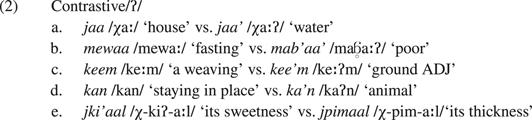
Along with phonemic glottal stop, an epenthetic glottal stop also occurs at the beginning of words which are underlyingly vowel-initial (see Bennett, 2016, 2018; England & Baird, 2017). Epenthesis can be diagnosed by alternations like those in (3), which show that word-initial glottal stops often disappear under prefixation. Figure 18 illustrates both phonemic /ʔ/ and epenthetic word-initial [ʔ].


Stop realization of /ʔ/, with full closure, in pre-consonantal position: ala’s /alaʔs/ → [ʔa.ˈlaʔs] ‘doll’ (speaker 9 pa 2018)
Some word-initial phonetic glottal stops do not alternate with zero, suggesting that they are underlying and phonemic rather than inserted. For example, aab’ [ˈʔaː] ‘hammock’ retains its initial glottal stop under possession, as in in’aab’ [ʔin.ˈʔaː] ‘my hammock’. This implies that [ʔ] is underlying rather than inserted in this noun.
Supporting evidence for this claim comes from prefixal allomorphy. Possessive prefixes take different forms when attaching to vowel-initial versus consonant-initial stems. The noun aab’ [ˈʔaː] ‘hammock’ takes possessive allomorphs like [ʔin-] ‘my’ that otherwise only occur with consonant-initial stems, not vowel-initial stems (e.g. inb’aatz’ [ʔin-ˈaːʔ] ‘my thread’ vs. [ˈw-íʃim] ‘my corn’ (3)). This is consistent with treating the non-alternating [ʔ] in aab’ [ˈʔaː] ‘hammock’ as underlying. See Bennett (2016, 2018) and Kaufman (2015) for more discussion.
Word-initial glottal stop can be realised as a full stop and/or creakiness on adjacent sonorants, as in Figure 18 and other examples in Section 3.3 above. Still, word-initial glottal stop is not always phonetically salient, especially in running speech. However, epenthetic word-initial glottal stop is sometimes retained under prefixation, and in these cases the glottal stop is quite clear (Figure 19).10

Phonetically salient epenthetic [ʔ] in post-consonantal position: x’ooq’ [ʃʔoːqʔ] ‘(s)he cried’ versus xin’ook [ʃʔoːk] ‘I entered’ (speaker taml 2020)
After consonants, glottal stop is typically realised with full closure, often with creakiness on neighbouring vowels and sonorants, as in Figure 19. Between vowels, glottal stop may be realised as a full stop, but is more commonly realised as creakiness on the vowels themselves, or as an interval of creaky voicing with significantly reduced amplitude reflecting glottal constriction between the two vowels (Figure 20). Note again that creakiness often involves lowering of f0, as is apparent from the wide spacing of voicing striations in the spectrograms in Figure 20, along with reduced amplitude.

/ʔ/ realised as creakiness and/or partial closure between vowels: ti’ook /tiʔoːk/ → [t.ˈːk] ‘(s)he enters’ (speaker taml 2020) and ti’élik /tiʔélik/ → [ti.ˈélik] ‘(s)he leaves’ (speaker 6 jms 2018)
Glottal stop is commonly found in two other environments, /Vʔ#/ and /VʔC#/. Three different phonetic outcomes for /ʔ/ are typical in these environments. First, /ʔ/ may be realised as a true stop, as in Figures 18, 19 and 21. In final position, this variant of /ʔ/ includes a clear release burst, along with possible creaky voice on the preceding vowel (Figure 21; see also Figure 11).

Stop realisation of /ʔ/, with full closure, in final position: ja’ /χaʔ/ → [ˈχʔ] ‘water’ (speaker 8 llvm 2018)
Second, /ʔ/ may be realised primarily as extensive creakiness on the preceding vowel, and/or any following sonorant consonant. This is very common for /Vːʔ#/ and /V(ː)ʔC#/ sequences, as in Figure 22 (see also Figure 2 above). The glottal stop itself may or may not have an audible release in these cases.

Creaky realisations of /ʔ/ in final and pre-consonantal position: kaa’ /kaːʔ/ → [ˈkʔ] ‘grinding stone’ and ka’n /kaʔn/ → [ˈk] ‘animal’ (speaker 3 acal 2018)
Impressionistically, extensive creakiness of this sort is less common following short vowels in final position, /Vʔ#/. It may be that glottal stop is phonetically and phonologically more like a vowel feature in /Vːʔ#/ and /V(ː)ʔC#/ sequences, and more like an independent consonant in /Vʔ#/ sequences (see also Sections 5.1.5 and 5.2 on the fact that /ʔC#/ coda clusters only occur in stressed final syllables, much like long vowels). If this is correct, it seems plausible that /ʔ/ is realised as a vowel feature rather than a consonant in /V(ː)ʔC#/ due to a restriction on the size, weight, and/or composition of syllable rimes in Uspanteko. For further discussion of the consonantal versus featural status of [ʔ] in Mayan languages, see Bennett and Henderson (2013), Bennett (2016, 2018), England and Baird (2017) and references there. This is a clear topic for future investigation.
Lastly, /Vʔ#/ and /VʔC#/ sequences may be realised with a ‘rearticulated’ or ‘broken’ vowel. Auditorily, these sound like a modal-voiced vowel that has been interrupted by a glottal stop. Phonetically, the glottal interruption is usually just creaky voice, though true stop realisations do occur as well (Figure 23).

/ʔ/ realised as vowel ‘rearticulation’ in final and pre-consonantal position: kutz’ii’j /kuʔiːʔχ/ → [ku.ˈʔχ] ‘flower’ and jaa’ /χaːʔ/ → [ˈχaː] ‘water’ (speaker 7 jvc 2018). Diagrams are segmented to emphasise changes between modal and non-modal portions of vowel+/ʔ/ sequences
There are some cases where laryngealization associated with /ʔ/ is audible, but not readily apparent as creak in the corresponding audio recording (Figure 24). Such weak laryngealization may involve dips in intensity and/or f0, without any of the other potential correlates of non-modal phonation (see Gerfen & Baker, 2005; Keating et al., 2015).

/ʔ/ realised as weak glottalisation in pre-consonantal position: ka’n /kaʔn/ ‘animal’ (speaker 4 dap 2018). f0 superimposed on waveform, with scale in Hz
Much of what we have said about the phonetics of [ʔ] concerns stressed syllables. In unstressed syllables, [ʔ] may be substantially weakened, sometimes to the point of apparent deletion (Figure 25).

Apparent /ʔ/-deletion in unstressed positions: xye’ /ʃ-jeʔ/ → [ˈʃj] ‘(s)he gave it’ versus xye’saj /ʃ-jeʔ-saχ/ → [ʃje.ˈsaχ] ‘it was given’ (speaker 36 2020)
We are unsure whether coda glottal stop is phonologically deleted in unstressed syllables, or simply phonetically reduced. Understanding the phonetics and phonology of word-medial [ʔ], especially in coda position and in unstressed syllables, is an area of future research.
On the phonetics of glottal stop in other Mayan languages, see Frazier (2009a,b, 2013), Baird (2011), Baird and Francisco Pascual (2011), Bennett (2016), England and Baird (2017), Sobrino Gómez (2018), and references there. On glottal variability more generally, see Borroff (2005, 2007), Garellek (2013, 2014), Keating et al. (2015), Whalen et al. (2016), Davidson (2021), Garellek et al. (to appear), and references there.
3.5 Other phonetic observations
For reasons of space, we do not discuss the phonetics of other consonants or consonant types in Uspanteko in this paper. On the phonetics of rhotics in Mayan languages, see Romero (2009), Bennett (2016), England and Baird (2017), and references there, as well as Solé (2002). On the phonetics of the dorsal fricative /x/ ∼ /χ/, see Redmon & Jongman (2018), whose phonetic observations about such fricatives accurately characterise the phonetic properties of these sounds in Uspanteko and K’ichean-branch Mayan languages.
4 VOWELS
Uspanteko has a fairly common phonemic vowel system: a five-vowel /a e i o u/ inventory, with a length contrast for all vowel qualities (Figure 26, Campbell, 1977; Can Pixabaj, 2007; Grimes, 1972; Maddieson, 1984). Length contrasts are restricted, as long vowels can only occur in word-final stressed syllables (Section 5). Additionally, short [a] is quite centralised relative to other short vowels, an observation we verify below.

Uspanteko vowel inventory, including common inter-speaker and/or context-free phonetic variation

4.1 Vowel length and vowel duration
The phonemic vowel system /a(ː) e(ː) i(ː) o(ː) u(ː)/ is common in the Mayan family (Bennett, 2016; England & Baird, 2017). Still, the phonetic realisation of this vowel inventory varies even among K’ichean-branch Mayan languages. For example, in closely related K’ichean languages like Tz’utujiil (Dayley, 1985), K’iche’ (Baird, 2010), and Q’eqchi’ (Berinstein, 1991), long vowels are about twice as long as their short counterparts (see also Herrera Zendejas, 2014; Sobrino Gómez, 2010 on other Mayan languages). But in Uspanteko — a language which may have diverged from other K’ichean languages fairly early on (e.g. Campbell, 1977) — long vowels are not as widely separated from short vowels in terms of their duration.
Figure 27 reports average vowel duration in Uspanteko, grouped by vowel length and accent type (see Section 2 on data collection for this analysis). Vowels longer than 300 ms were excluded from this analysis (7 tokens, 0.3% of the data). Here we focus on how vowel length and stress influence duration, and return to the effect of lexical high tone on duration in Section 5.3.4. In this data set, phonemic long vowels, which are always stressed (Section 5), have an average duration of 167 ms. In contrast, stressed short vowels have an average duration of 105 ms. Duration thus clearly distinguishes phonemic long and short vowels (p < 0.001, by two-sided t-test).

Vowel duration by phonological vowel length and accent type. Short vowels may be stressed or unstressed, long vowels are always stressed
Unstressed short vowels are reduced relative to stressed short vowels, with an average duration of 74 ms (p < 0.001). This is particularly true for short vowels in post-tonic, unstressed syllables (e.g. ínpx [ˈʔímpiʃ] ‘my tomato’), which average 60 ms in our data compared to the 75 ms average of pre-tonic, unstressed short vowels (e.g. knaq’ [k.ˈnaqʔ] ‘bean’; p < 0.05). For related discussion on pre-tonic versus post-tonic position, see Bennett et al. (ms.).
4.1.1 Vowel duration in a Mayan context
Vowel length contrasts in Mayan involve durational differences of various sizes. The surveys in Bennett (2016) and England and Baird (2017) report durational ratios ranging from 1.25:1 to 2:1 for long versus short vowels in Mayan languages. Proportionally, stressed long vowels in Uspanteko seem to be about 62% longer than stressed short vowels, at least in non-tonal, word-final syllables (Section 5). This amounts to a ratio of about 1.6:1, somewhere in the middle of the durational ranges reported for other Mayan languages.
Berinstein (1979) examines the correlates of stress in two other K’ichean languages, Kaqchikel and Q’eqchi’. She reports that vowel duration is a correlate of stress in Kaqchikel, but not in Q’eqchi’. She attributes this difference to the fact that Q’eqchi’ has true vowel length contrasts, which may inhibit the use of duration as a cue to stress. Kaqchikel makes use of centralisation (‘tense-lax’) contrasts in its vowel system instead, such as /a e i o u/ versus /ə ɛ ɪ ɔ ʊ/, though such contrasts did develop historically from earlier length contrasts (e.g. Bennett, 2019; Campbell, 1977; see also Vogel et al., 2016; Lunden et al., 2017; van Heuven & Turk, 2021 for critical discussion).
Uspanteko does not quite follow the predictions of Berinstein’s (1979) work, as stressed short vowels do seem to be longer than unstressed short vowels (there are no unstressed long vowels, so nothing can be said about cues to stress for long vowels specifically; Section 5). However, the phonetic differences between stressed and unstressed short vowels may reflect the fact that unstressed short vowels are often heavily reduced in Uspanteko, sometimes to the point of deletion (Figure 28; see the right panel of Figure 20 for another example, and Bennett et al. (ms). for extensive discussion).

Unstressed vowel reduction in pre-tonic (left) and post-tonic (right) positions: tijkunaj [tiχ.ku.ˈnaχ] ‘(s)he cures him/her’ and kútz’ij [ˈkú.ʔiχ] ‘flower’(speaker 9 pa 2018)
4.2 Vowel quality as a function of vowel length and stress
It common for length contrasts to be augmented by a quality difference, with short vowels being more centralised than their long vowel counterparts. This correlation between length and centralisation has been observed in a number of Mayan languages, belonging to several different major subgroups (e.g. Baird, 2010; Barrett, 1999; Dayley, 1985; Du Bois, 1981; Edmonson, 1988; England, 1983; see also Bennett, 2016; England & Baird, 2017).
However, it has also been reported that some Mayan languages implement vowel length contrasts almost entirely by means of duration, without any significant differences in quality between long and short vowels (e.g. England, 2001; England & Baird, 2017). Uspanteko appears to be a language of this type, with only very limited centralisation of most short vowels (Figures 29 and 30). The phonetic results presented here are in keeping with our own auditory impressions as fieldworkers: the qualities of short /e i o u/ are very similar to the qualities of long /eː iː oː uː/, while short /a/ shows a tendency to raise and/or centralise relative to long /aː/.
To assess vowel quality for short and long vowels, formants were measured by averaging values for F1, F2, and F3 over the middle 20% of each vowel, using a custom Praat script (Boersma & Weenink, 2020). We used a vowel-intrinsic normalisation method — F3-normalisation (F1/F3 and F2/F3 for each vowel) — in order to pool formant measurements across speakers (Monahan & Idsardi, 2010 and references there). The F3-normalised data is highly correlated with the output of two alternative formant normalisation methods, Lobanov’s z-score normalisation (F1: r = 0.95, F2: r = 0.95; Lobanov, 1971) and Barreda-Neary log-additive regression normalisation (F1: r = 0.96, F2: r = 0.96; Barreda & Nearey, 2018) (see too Adank et al., 2004, Hillenbrand et al., 1995, Johnson, 2020). It is also highly correlated with the original data as measured in Hz (F1: r = 0.96, F2: r = 0.94), Bark (F1: r = 0.96, F2: r = 0.95), and ERB (F1: r = 0.96, F2: r = 0.95), suggesting that our speakers had similar vowel spaces and vocal tract lengths. To remove outliers and potential measurement errors, F3-normalised formant values were converted to z-scores, and tokens were excluded from analysis if they had z-scores for F1/F3 or F2/F3 which were greater than 2.5 z-units from the mean value for vowels of the same quality (pooling over length, stress, and tone). This procedure trimmed 88 tokens (3.6% of the data; Figures 29 and 30).

F3-normalised vowel spaces separated by vowel length and stress. Data ellipses include 68% of the tokens (≈1 sd) for each vowel category

F3-normalised vowel spaces pooled across vowel length and stress. Data ellipses include 68% of the tokens (≈1 sd) for each vowel category
Overall, vowel quality does not vary widely with differences in stress or phonemic vowel length. Long, stressed vowels [ˈVː] are somewhat more peripheral and more tightly clustered than short vowels, which show a tendency towards slight centralisation regardless of stress. The short low vowel /a/ is often quite audibly centralised, sounding something like [ɐ] or [ə] when unstressed (Bennett & Henderson, 2013). For some speakers, stressed short /a/ is also quite centralised, so that for example, pach /pa/ ‘friend, partner’ is pronounced as [ˈpa] by many speakers, but as something closer to [ˈpɐ] or [ˈpə] by others.
5 PROSODY
A fairly comprehensive description and phonological account of the word-level prosody of Uspanteko can be found in Can Pixabaj (2007), Bennett and Henderson (2013), Bennett et al. (2022), and Bennett et al. (ms.). These sources describe a system of default word-final stress, which interacts in complex ways with a separate system of tonal contrast, based on the presence or absence of a high tone [h]. Interactions between stress and tone lead to cascading effects in foot structure, syncope, and utterance-level prosody. We focus here on word-level prosody, and direct readers to Bennett et al. (2022) for some discussion of phrasal prosody and its interaction with word-level stress and tone in Uspanteko.
5.1 Syllable structure
Syllable structure in Uspanteko is typically CV(C), with a number of important caveats and exceptions we outline below. An example of this basic template is shown in (5).

5.1.1 Vowel-final roots and suffixes
Most roots in Uspanteko are /(C)VC/ in shape, and most suffixes end in a consonant. These tendencies, which are shared by Mayan languages more generally, contribute to a preponderance of words ending in coda consonants (e.g. Du Bois, 1985; Can Pixabaj, 2007:Ch. 3; Us Maldonado, 2010:Ch. 1; Bennett, 2016; England & Baird, 2017; DiCanio & Bennett, 2021).
Still, there are a relatively small number of roots which end in a vowel. In most cases vowel-final roots have long vowels (6), but several such roots do have short vowels as well (7).
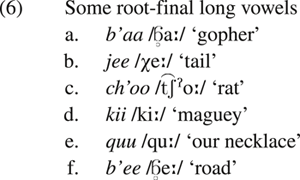

5.1.2 Initial /ʔ/ insertion and hiatus
There are many roots and prefixes which begin with vowels in Uspanteko, but as noted in Section 3.4, there are no surface vowel-initial words: all words which begin with an underlying vowel receive an epenthetic initial glottal stop (8) (see also Figure 33). Evidence that surface forms like (8a) are underlyingly vowel-initial comes from patterns of allomorphy: ergative and possessive agreement prefixes vary in form depending on whether the following stem is vowel-initial (8b) or consonant-initial (8c) (Can Pixabaj, 2007, Bennett, 2018, and Section 3.4 above).


5.1.3 Prefixation
While roots generally begin with a single consonant, complex clusters can arise word-initially as the result of prefixation (10).
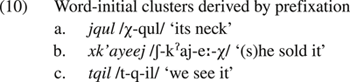
There are few, if any clear diagnostics for syllabification in Uspanteko. Consequently, we are unsure if clusters like (10) constitute complex onsets, or extrasyllabic consonants. Additionally, word-initial clusters are sometime avoided via epenthesis of [i] (11).

Prefixation also produces surface contrasts between the plain affricates [ ] and stop + fricative [ts tʃ] sequences in initial position (12). The clusters [ts tʃ] are audibly distinct from the corresponding affricates [ ], possibly due to differences in duration and/or articulatory coordination (e.g. Shaw, 2022).

5.1.4 Underived complex onsets
A handful of roots begin with complex onsets, in which the first consonant is an obstruent and the second is an approximant (13).

5.1.5 Underived complex /ʔC/ codas
As discussed in Section 3.4, some roots end in a /ʔC#/ sequence, for example, malka’n /malkaʔn/ ‘widow’. It is unclear whether these sequences should be analysed as true coda clusters, or whether the glottal stop in word-final /ʔC#/ is instead a laryngeal feature on the preceding vowel.
There are at least two arguments for treating [VʔC#] as a laryngealized long vowel followed by a single coda consonant, [VːʔC#]. First, contrastive […ʔC]σ coda clusters only occur in word-final stressed syllables, just like simple long vowels (Section 5.2).12 Second, morphologically-assigned tone (Section 5.3) cannot typically be assigned to the penult in words ending in [ʔC] clusters (Bennett & Henderson, 2013; Can Pixabaj, 2007). In contrast, penultimate tone is normally possible for words with final short vowels, including words ending in simple [ʔ] (14).


On the other hand, vowel length is apparently contrastive in words ending in a [ʔC#] cluster, implying that vowels before [ʔC#] are not uniformly long in a phonological sense (16) (see also Du Bois, 1981:Ch 4.2 on Sacapulteco).

5.1.6 Syncope
Syncope, which is widespread in Uspanteko, variably targets unstressed short vowels in specific positions (Bennett & Henderson, 2013, Bennett et al. ms.). When stress is final, syncope frequently targets the immediately pre-tonic syllable (17).


Bennett and Henderson (2013) and Bennett et al. (ms.) analyse vowel deletion in terms of foot structure (Section 5.2): under the assumption that final stress involves an iamb […()], and penultimate stress involves a trochee […], then syncope can be said to consistently target the weak branch of the foot.
Syncope appears to create complex consonant clusters (19), Figure 31.

Apparent consonant clusters derived by syncope: áb’aj /á aχ/ → [ˈʔáaχ] ∼ [ˈʔá χ] ‘stone’ (speaker 6 jms 2018, and speaker 5 deip 2018)

However, Bennett et al. (ms.) argue that syncope does not involve actual vowel deletion. Instead, it is a species of extreme phonetic vowel reduction, which leads to acoustic forms that sound like the vowel has been deleted (on vowel reduction, see Sections 4.1 and 4.1.1 above). Their evidence for this claim comes, in part, from the observation that weak vocal fold vibration associated with ‘deleted’ vowels is sometimes observable in electroglottographic recordings of Uspanteko even when those vowels are seemingly absent from the acoustic recording. Phonologically, then, the consonant clusters derived by syncope (19) may in fact be [CVC] sequences after all, but with a highly reduced vowel that is essentially inaudible, though weakly articulated.
5.1.7 Syllable-conditioned phonotactics
There are few, if any phonotactic or allophonic patterns in Uspanteko which are clearly conditioned by syllable structure — a state of affairs common in Mayan languages (Bennett, 2016). Glottal stop insertion to avoid onsetless syllables is perhaps the best candidate for a truly syllable-based phonological rule in Uspanteko (Sections 3.4, 5.1.2). Otherwise, all consonants can occur in either onset or coda position, and there are no allophonic rules which specifically target onset versus coda consonants (or at least, none that do so consistently; see Section 3). There do seem to be some syllable-based restrictions on combinations of consonants (e.g. Sections 5.1, 5.1.4), but consonant clusters derived by prefixation (Section 5.1.3) or syncope (Section 5.1.6) defy those generalisations, which is one reason why the syllabification of such derived clusters is itself quite unclear.
5.1.8 Root co-occurrence restrictions
Mayan languages often have restrictions on which consonants can co-occur in a /CV(ː)C/ root (Bennett, 2016; Gallagher & Coon, 2009). Typically, if both consonants are glottalised, they must be identical, as in ch’iich’ /ʔiːʔ/ ‘metal, metallic object, machine’ or q’uuq’ /qʔuːqʔ/ ‘quetzal (species of bird, pharomachrus mocinno)’. Labial b’ // is unrestricted within roots, for example, ch’uub’ /ʔuː/ ‘wasp’. A similar co-occurrence restriction holds for sibilant consonants: two sibilants in a /CV(ː)C/ root must have the same place of articulation, as in sotz’ /soʔ/ ‘bat’ or choox /oːʃ/ ‘godmother’. See Gallagher and Coon (2009), Bennett (2016) for other similar restrictions in Mayan.
We have not yet verified that these restrictions hold across the Uspanteko lexicon, or that native speakers are sensitive to these root-based phonotactics (as assessed by well-formedness judgements, speech error patterns, or lexical decision tasks; see e.g. Berent & Shimron, 2003, Rose & King, 2007). Sound changes during the development of Uspanteko do seem to have created some exceptions to these patterns, such as ch’uuk’ /ʔuːkʔ/ ‘elbow’, which derives historically from */ʔuːʔk/ or */ʔuʔuk/ (Campbell, 1977, p. 41, Kaufman, 2003, p. 343). It is perhaps relevant that in other Mayan languages root co-occurrence restrictions may be weaker when the vowel of the root is long (e.g. Edmonson, 1988; Smith-Stark, 1983). This remains an area for future work on the phonology and morphology of Uspanteko.
5.2 Stress
Primary stress occurs by default on the rightmost syllable of the word in Uspanteko. There is no evidence of secondary stress. In these respects, the Uspanteko stress system resembles the stress systems of related K’ichean-branch Mayan languages, which also strongly tend towards fixed final stress (apart from loanwords, and a few lexical and morphological exceptions; e.g. Baird, 2014b, Bennett, 2016, Berinstein, 1979, Henderson, 2012, England & Baird, 2017, Can Pixabaj, 2017, and references there).

There is also phonological evidence for final stress: long vowels, and thus vowel-length contrasts, are limited to word-final stressed syllables (Bennett et al., 2022). This again has parallels in other K’ichean-branch Mayan languages (e.g. Bennett, 2016, 2019; Can Pixabaj, 2017; Dayley, 1985). This restriction is clearly illustrated by vowel length alternations that occur under suffixation: when an underlying lexical long vowel occurs outside the stressed final syllable, it is systematically shortened (21).

Major intonational contours also tend to align with final syllables, again implying that these are prominent positions (e.g. Hayes, 1995; for Mayan languages, Gussenhoven & Teeuw, 2008; Baird, 2014a; Bennett, 2016; England & Baird, 2017; Adell, 2019; DiCanio & Bennett, 2021). Lastly, native speakers do have the intuition that stressed final syllables are more prominent than other syllables in the word.
Stress can also occur on the penultimate syllable, but only in words bearing lexical high tone, which we now turn to.
5.3 Lexical tone
5.3.1 Historical sources of lexical tone
Uspanteko stands out from other K’ichean-branch Mayan languages in having innovated a system of contrastive, grammatically-controlled lexical tone (Bennett et al., 2022; Bennett & Henderson, 2013; Campbell, 1977; Can Pixabaj, 2007; Grimes, 1971). Historically, tone may have developed from pitch perturbations associated with the post-vocalic laryngeals [h] and [ʔ]. Post-vocalic [h ʔ] were then lost in some contexts, plausibly leading to the phonologisation of tone. The same pathway of tonogenesis happened sporadically in a number of otherwise unrelated Mayan languages, and seems to be currently ongoing in several Mamean languages near the Guatemala-Mexico border; see Campbell (1977, 2017), Bennett (2016), England and Baird (2017), DiCanio and Bennett (2021), Bennett et al. (2022) for details and further citations.
Still, the precise historical development of tone in Uspanteko is somewhat obscure: most proposals regarding the development of tone only account for tonal long vowels, not tonal short vowels; and many roots and affixes associated with tone cannot be reconstructed to earlier forms containing laryngeals. Henderson et al. (to appear) speculate that contact with Ixil, a Mayan language of the Mamean branch, may have influenced the development of word-level prosody in Uspanteko, particularly penultimate stress and tone. Additionally, sources on Uspanteko differ fairly widely on what tones they report for particular roots, which complicates reasoning about tonogenesis; see Bennett et al. (2022) for details.
5.3.2 The synchronic system of lexical tone
Long vowels only occur in word-final stressed syllables (Section 5.2). In final position, stressed long vowels may be toneless, or may bear a high tone [h] (22). As Figure 32 illustrates, tonal long vowels have higher pitch than non-tonal long vowels, and may also have more dramatic pitch excursions (rises and falls). The slightly raised pitch on the final stressed syllable of non-tonal qaxoot [qa.ˈʃoːt] ‘our comal’ (Figure 32, lower-left) arguably represents intonational prominence rather than any f0 effects associated with stress as such; see Bennett et al. (2022) and Section 5.3.3 below for discussion.

Lexical tone contrasts on long vowels: (qa)xoot [(qa.)ˈʃoːt] ‘(our) comal’ versus (qa)jóoj [(qa.)ˈχóːχ] ‘(our) crow’ (speaker 7 2016). f0 superimposed on waveform, with scale in Hz
There are very few minimal pairs for tone on long vowels in Uspanteko. Further, as a result of lexical variation in the Uspanteko community, some speakers do not have any minimal pairs at all for tone on long vowels (Bennett et al., 2022). Still, there are various near-minimal pairs like Figure 32 which show lexically-specific pitch differences that cannot be reduced to conditioning by the segmental or morphological environment (see Snider, 2014; Herrera Zendejas, 2014:Ch. 9 for related discussion). Such pairs firmly establish that Uspanteko has a system of lexical tone on long vowels, even if the functional load of tonal contrasts is low (Hyman, 2006, 2009).
In words with final short vowels, the interaction of tone and stress is more complex. When the final vowel is short, tone can only occur on the penultimate syllable. Stress then retracts to coincide with tone (22).


Tone-driven stress retraction to penult: aqan /aqan/ → [ʔa.ˈqan] ‘leg’ versus wáqan /wáqan/ → [ˈwá.qan] ‘my leg’ (speaker jbat 2014)
Bennett and Henderson (2013) analyse the distribution of tone in Uspanteko by appealing to moras, a prosodic unit below the level of the syllable which distinguishes short vowels (1 mora) from long vowels (2 moras) (Trubetzkoy, 1939, Hyman, 1985, etc.). They propose that high tone [h] only occurs on the penultimate mora of the word. It follows directly that [h] tone will occur on final long vowels (which contain two moras), or will occur on the penultimate vowel when the final vowel is short.
Tone is associated with morphology in Uspanteko, as documented by Can Pixabaj (2007), Bennett and Henderson (2013), and Bennett et al. (2022). For example, the plural suffix /-V/ introduces high tone on the preceding syllable (23) (capital /V/ here stands for a vowel of varying quality; see also Figure 33 for tone introduced by a possessive prefix).13

5.3.3 Phonetic analysis of lexical tone
Pitch contours on target items were analysed in Praat (Boersma & Weenink, 2020). The recordings were downsampled to 16 kHz, then pitch values were automatically extracted in Hz with a script specifying by-speaker pitch ranges following the recommendations of De Looze & Rauzy (2009) and Evanini et al. (2011). Along with measurements of mean and maximum f0 for each vowel, time-normalised pitch measurements were produced by averaging pitch values over 1/7 intervals of the duration of each vowel.
F0 measurements were z-score normalised for each speaker, so that the data could be pooled for analysis. Pitch measurements more than 2.5 z-units away from each speaker’s mean were treated as outliers and removed from the data. This resulted in the elimination of 0.4% of the mean f0 measurements (8 tokens), 1.2% of the maximum f0 measurements (26 tokens), and 1.2% of the time-normalised f0 interval measurements (175 measurements). For all three measures, the z-score normalised data was closely correlated with the results of two other normalisation methods: semitone transformation relative to each speaker’s mean pitch in Hz (Zhang, 2019), and range normalisation using 2% and 98% estimates of floor and ceiling values in semitones (Bardiaux & Mertens, 2014) (lowest correlation r = 0.96; see also Ladd, 2008:192–202).
In our wordlist data, tonal vowels are not sharply distinguished by mean or maximum f0 (Figures 34 and 35). This is particularly true for short tonal vowels [ˈ], which have f0 distributions which largely overlap those of non-tonal, stressed short vowels [ˈV] (that said, f0 differences between short [ˈ] vs. [ˈV] are statistically significant by two-sided t-test: mean f0: Δ = 0.15 z-units, p < 0.05; maximum f0: Δ = 0.17 z-units, p < 0.05).14 (There are just 15 tonal long vowels in this dataset, so we avoid making any quantitative claims about the phonetics of tone on long vowels here, though we do include this data in plots and statistical models.)

Mean f0 for different vowel types (z-scores over Hz). Short vowels may be stressed or unstressed, long vowels are always stressed

Maximum f0 for different vowel types (z-scores over Hz). Short vowels may be stressed or unstressed, long vowels are always stressed
The modest f0 increase associated with tone in Figures 34 and 35 arguably reflects the fact that intonational prominences may also occur on toneless vowels, leading to some degree of phonetic neutralisation between tonal and non-tonal syllables (Bennett et al., 2019, 2022). Rising (L)H% contours often occur utterance-finally in K’ichean-branch Mayan languages, including Uspanteko (e.g. Baird, 2014a,b; Bennett, 2016; Bennett et al., 2022; Berinstein, 1991; England & Baird, 2017). These intonational rises occur in both declarative sentences and questions, and may be associated with the right-edge of clause-sized prosodic units (e.g. Intonational Phrases, or IPs; for detailed discussion of K’iche’, see Nielsen, 2005; Henderson, 2012; Burdin et al., 2015; Baird, 2018, and citations there; for more distantly related Mayan languages, see e.g. Clemens, 2021; Royer, 2022).
Final intonational rises are common in our wordlist data, likely as a result of eliciting words in a repeated frame sentence. In such tasks, the target word is pragmatically or metalinguistically focussed, and may be produced with intonation characteristic of a full, independent utterance or IP (Himmelmann, 2006; Himmelmann & Ladd, 2008; Hyman, 2014; Jun & Fletcher, 2014; Pike, 1948; Snider, 2014; Yu, 2014). A particularly dramatic example is shown in Figure 36.

Final intonational H% rise: qawinaaq [qa.wi.ˈnaːq] ‘our people’ (speaker 7 jvc 2018). Y-axis shows f0 in Hz
These intonational rises plausibly obscure f0 differences between tonal and non-tonal vowels in Uspanteko, both in our specific wordlist data, and in the language more generally (Bennett et al., 2022).
Further evidence for an IP/utterance-final H% boundary tone in Uspanteko comes from the analysis of f0 on unstressed vowels. Fig. 37 shows f0 trajectories across vowels, grouped by stress, length, tone, and position in the word. These plots again show that f0 is somewhat higher for tonal than non-tonal vowels, though not by a wide margin. The key observation here is that unstressed short vowels have a substantially raised pitch in final syllables (i.e. in words with penultimate accent, e.g. kútz’j [ˈkú.χ] ‘flower’). This is consistent with the presence of an H% boundary tone in final position, corresponding to the large final rise in examples like Figure 36. An example illustrating an H% target on an unstressed, final vowel is shown in Figure 38. (The rising f0 on tonal and non-tonal long vowels in Figure 37 may also corroborate the presence of an H% boundary tone in much of our data.)

f0 trajectories for different vowel types (z-scores over Hz). Grey bands indicate confidence intervals around the estimate of the position of the smoothed loess regression line at each time step. Short vowels may be stressed or unstressed, long vowels are always stressed

Final intonational H% on unstressed, final vowel: ínb’a [ˈʔ´ı n.ɓa] ‘my head’ (speaker 1 fies 2018)
To assess the effect size of lexical tone on Hz in our study, we fit a linear-mixed effects model to predict mean vowel f0 using the lme4 package in R (Bates et al., 2020). This model included fixed effects for stress (ˈ vs. ), tone ([h] vs. ∅), vowel length ([V] vs. [Vː]), vowel height (low vs. mid vs. high), vowel position (final σ in the word vs. non-final σ), and a tone × vowel length interaction. The vowel position predictor was intended to control for the H% boundary tone observed in Figure 36. The vowel height predictor was a control for the fact that high vowels are often produced with higher pitch than non-high vowels (e.g. Sapir, 1989 and references there). This initial model also included a random intercept for speaker, and a by-speaker random slope for tone. A random effect for word could not be included because some words only occur once in our corpus. Adding a by-speaker random slope for stress led to convergence errors during model comparison, so this random effect was not included in the model.
Step-down model criticism using the log-likelihood test with a threshold of α = 0.1 led to the omission of the stress predictor from the final model.15 No further model simplification was possible, largely because the simple vowel length predictor could not be dropped from the model while the higher-order interaction tone × vowel length was retained. A summary of this model is given in Table 2; p-values were estimated from the t statistic using an upper-bound 2386 degrees of freedom (2393 observations less the 7 fixed-effect parameters in the final model; Baayen, 2008, p. 297). The final model has very low collinearity between predictors (κ = 4.37). Very similar results emerge if maximum f0 is used as the dependent variable rather than mean f0, as maximum and mean f0 on vowels are highly correlated in our data (r = 0.94).
| Predictor | β (in Hz) | se(β) | |t| | p < |
|---|---|---|---|---|
| Intercept | 180 | 12.4 | 14.51 | 0.001 |
| tone () | 54 | 3.98 | 13.51 | 0.001 |
| v position (final) | 51 | 1.47 | 34.33 | 0.001 |
| tone () × v length (long) | −38 | 7.79 | 4.94 | 0.001 |
| v height (high vs. low) | 24 | 1.3 | 18.67 | 0.001 |
| v height (mid vs. low) | 6 | 1.49 | 4.24 | 0.001 |
| v length (long) | −7 | 1.40 | 4.74 | 0.001 |
The main takeaway from Tab. 2 is that tone does have a substantial effect on f0 (particularly for short vowels) once the intonational H% tone observed on isolation forms is controlled for. On the other hand, the effect of stress on mean f0 is essentially nil — the stress predictor was dropped from the final model. The apparent correlation between stress and raised f0 seems to be reducible to the fact that word-final stress often coincides with an intonational H% tone.
5.3.4 Vowel duration and tone
Stressed short vowels are significantly longer when bearing high tone (Figure 27; [ˈV] mean = 102 ms, [ˈ] = 122 ms, p < 0.001). Despite this lengthening, tonal short vowels remain phonetically shorter than true long vowels ([ˈVː] = 167 ms, p < 0.001). This suggests that tonal vowels in accented penults are still phonologically short — lengthening of [ˈ] is a gradient phonetic effect, rather than a categorical, neutralising process in the phonology proper.16 It is relevant, we think, that vowel length is not contrastive in penultimate syllables, and so stressed short vowels have greater freedom to phonetically lengthen in this position without risk of neutralising lexical contrasts (Berinstein, 1979; Bennett & Henderson, 2013; Bennett et al., 2022; Can Pixabaj, 2007; for related discussion, see; Lunden et al., 2017; van Heuven & Turk, 2021; Vogel et al., 2016).
6 CONCLUSION
Uspanteko provides many phonetic and phonological phenomena which are either understudied, uncommon typologically, or uncommon within the Mayan family. Some of these phenomena — such as the inventory of derived versus underlying clusters, the interaction between tone and stress placement, and the suprasegmental versus segmental status of [ʔ] — should be of substantial interest to phonologists, as they push the limits of what is typologically expected under certain theories of phonological representation and derivation (e.g. Bennett & Henderson, 2013; Bennett et al. ms.; Duanmu, 2010a,b; Golston, 2004; Hyman, 2009; Kawahara & Shaw, 2018; Kehrein & Marlo, 2004; Macaulay & Salmons, 1995; etc.).
Uspanteko also illustrates some phonetic patterns which deserve further attention. The phonemic inventory of Uspanteko is in some ways typical: many languages have /a(ː) e(ː) i(ː) o(ː) u(ː)/ vowel contrasts, and even glottalised stops and affricates are cross-linguistically widespread (e.g. in a survey of 566 languages, Maddieson, 2009 finds that 151 = 27% have phonemic ejectives or implosives). Still, some aspects of the phonetics of glottalised consonants in Uspanteko seem typologically unusual, or at least underdescribed, outside the Mayan family (e.g. apparent free variation between voiceless implosive and ejective variants of / qʔ/, or the voiced releases sometimes found with ejectives; Bennett, 2016).
The lexical tone system of Uspanteko is especially interesting in this light. Tone is not common in Mayan languages, and the interdependence of tone and stress placement in Uspanteko is also typologically rare (e.g. Bennett & Henderson, 2013; van der Hulst et al., 2010). Additionally, the phonetic implementation of tone is sometimes subtle in Uspanteko, in part due to interactions between tone and intonation. Tone also has a low functional load in the language — despite being deeply ingrained in its word-level phonology and morphology — which may also affect its phonetic implementation (Bennett et al., 2022).
At several points we’ve highlighted phonetic observations which seem relevant for understanding recurrent sound changes within the Mayan family. These include historical mergers between glottalised sounds (e.g. / qʔ/ > /ʔ/), and the ongoing puzzle of tonogenesis in Uspanteko, which we only partially understand at present. We hope that these observations will prove valuable for historical linguists, beyond their interest for comparative phonetics and phonology.
There are many high-quality descriptions of the phonetics and phonology of Mayan languages, but such publications often lack phonetic illustrations of the sort provided here, or focus on just one specific aspect of a language’s sound structure (e.g. glottalised consonants; see Bennett, 2016; England & Baird, 2017). We are grateful for the opportunity to provide a broader panorama on the phonetics and phonology of Uspanteko in this article.
ACKNOWLEDGEMENT
We thank the Uspanteko speakers whose recordings we describe here, and all the speakers who have helped us better understand their language – k’omo chawe chaq! We also thank the Comunidad Lingüística Uspanteka for their generous support of our work, and for making this research possible. We are particularly grateful to Salvador Pinula Ical, Rosa Lidia Ajpoop, Alejandro Pedro Vázquez Tay, Devora Ixcoy Patzan, and Juana Bernardina Ajpop Tiquiram for their help over the years. Two reviewers provided thoughtful feedback which helped improve the content and presentation of this paper. This research was supported by NSF grants BCS/DEL-1757473 (to Bennett) and BCS/DEL-1551666 (to Henderson). Any opinions, findings, and conclusions or recommendations expressed in this material are those of the authors and do not necessarily reflect the views of the National Science Foundation.
ENDNOTES
- 1 We thank Ivona Borissova, Zarya Mejia, Edward Martínez, Michael Ward, and Sonia Domínguez for their excellent work on these corrections.
- 2 Recordings corresponding to the figures and examples in this paper are available at https://github.com/rbennett24/articles/tree/master/Uspanteko_phonetic_description. In segmenting waveforms and spectrograms, we follow the recommendations of Turk et al. (2006): segmental boundaries are marked at points of significant amplitude change (particularly in the F2 region and above), which often coincide with sudden changes in the overall quality of the acoustic spectrum (e.g. the appearance of aperiodic noise for fricatives). These segmental boundaries are necessarily approximate, and segmentation of this sort is an idealisation which abstracts away from coarticulatory overlap between segments. In cases of extreme coarticulatory overlap, particularly between glottal stop /ʔ/ and neighbouring segments, we opt to include the overlapped segments in a single interval, as in Figure 2 and Section 3.4.
- 3 We use the term ‘creakiness’ with two caveats. So-called ‘creaky’ voice may have a range of distinct phonetic manifestations (Keating et al., 2015), and coarticulatory laryngealization in Mayan languages does not always involve the irregular, low-frequency vocal fold vibration found in prototypical creaky voice.
- 4 A reviewer suggests that our aerodynamic proposal predicts that passive voicing should be a characteristic of ejective releases in all languages. However, the articulation of ejectives varies widely across languages (and even speakers), which makes it hard to generalise from the phonetics of ejectives in Uspanteko to other cases (e.g. Lindau, 1984; Kingston, 1984, 2005; Warner, 1996; Wright et al., 2002; etc.). We also suspect that passive voicing associated with ejective release may be underreported, as most phonetic research on ejectives only considers CV contexts, where passive voicing at release would be hard to observe (and in some languages, ejectives only occur in CV contexts, e.g. Fallon, 2002).
- 5 Can Pixabaj (2007:Ch. 2) reports that plain stops are allophonically aspirated before consonants and word-finally — essentially, in coda position. Comparable patterns of allophonic aspiration are often reported for other Mayan languages (Bennett, 2016; England & Baird, 2017). In our own experience with Uspanteko and the related Mayan language Kaqchikel, aspiration of plain stops (and affricates) mostly occurs in utterance-final position, and even then, only variably (see e.g. Figure 32 below). Unreleased and/or unaspirated stops are quite common in coda position, contrary to standard descriptions. See Sobrino Gómez (2018:p. 92–5) and Adell (2019:Ch. 2) for similar observations in more distantly related Mayan languages.
- 6 Shigeto Kawahara points out that the relatively small volume of air behind a dorsal constriction may lead to greater oral air pressure during closure for dorsal stops than for stops at other places of articulation. This increase in oral air pressure could also contribute to frication at stop release for dorsals.
- 7 Implosives can be acoustically distinguished from ejectives and plain stops by the lack of a clear release burst, particularly at CV transitions (see e.g. Clements & Osu, 2002; Henton et al., 1992; Lindau, 1984; Pinkerton, 1986). Though a release burst is sometimes present for implosives, it always involves an initial period of ingressive airflow, which appears as a negative pressure impulse on the waveform (e.g. Figure 9 and elsewhere). Implosives, unlike ejectives, may also be produced with voicing during closure.
- 8 Words like [ʃi.ˈʃaːn] (Figure 12) and tk’ixib’ [tkʔi.ˈʃi] ‘(s)he gets embarrassed’ imply that onset clusters can contain consonants which disagree in their values for the feature [±constricted glottis], contra Kehrein and Golston (2004). However, such examples are usually morphologically complex (e.g. /ʃ-iːʃ-aːn/ and /t-kʔiʃ-i/), and their actual syllabification is not entirely clear (see Section 5.1).
- 9 There is extensive lexical variation in the quality and length of phonemic vowels in the Uspanteko community: for example, some speakers have ja /χa/ for jaa /χaː/ ‘house’, ja’ /χaʔ/ for jaa’ /χaːʔ/ ‘water’, meb’a’ /meaʔ/ for mab’aa’ /maaːʔ/ ‘poor’, and so on. Compare for example, Figures 21 and 23. Similarly, whether or not individual roots or affixes introduce high tone (Section 5) also varies between speakers. Compare for example, [ku.ˈʔiːʔχ] ∼ [ˈkú.ʔiχ] ‘flower’: both variants are widely attested in Uspanteko, though some speakers characterise the non-tonal form [ku.ˈʔiːʔχ] as reflecting linguistic influence from K’iche’, a closely-related language spoken by many Uspanteko speakers. See Bennett et al. (2022, ms.) for additional discussion of these patterns of lexical variation.
- 10 The conditions under which prefixation co-occurs with epenthetic glottal stop are not well-described for Uspanteko. See Barrett (2007), Kaufman (2015), Bennett (2016, 2018), Coon (2017) for parallel patterns in other Mayan languages.
- 11 This is reminiscent of the distribution of aspiration on plain stops and affricates; see footnote 5 and AnderBois (2011).
- 12 A reviewer asks whether the restriction limiting […ʔC]σ coda clusters to word-final stressed syllables can be reduced to the more general pattern of coda [ʔ] reduction or deletion in unstressed positions (Section 3.4). We think not: the general reduction of unstressed coda [ʔ] is variable, whereas coda […ʔC]σ clusters are simply never observed outside of word-final stressed syllables.
- 13 In a sense, then, Uspanteko has ‘grammatical tone’ — specifically the sub-type of grammatical tone that co-occurs with overt segmental affixes, dubbed ‘auxiliary prosodic exponence’ by Rolle (2018).
- 14 Stated over semitones relative to each speaker’s median, the values are: mean f0: Δ = 0.54, p < 0.05; maximum f0: Δ = 0.38, p < 0.005. For reference, Frazier (2009a, 2013) finds that lexical high tones in Yucatec Maya begin about 2 semitones above each speaker’s average pitch at vowel midpoint for low-toned vowels. Kuang (2013) reports that tonal contrasts typically involve differences of at least 20–30 Hz, or 2–3 semitones.
- 15 The vowel position predictor is correlated with accent type, because default stress is word-final, and non-final stress only occurs with tonal short vowels. To verify that dropping stress from the model improves fit better than dropping vowel position, both models were compared using the Akaike information criterion (AIC; see e.g. Burnham & Anderson, 2004, Burnham et al., 2011). The model omitting stress is clearly selected as the superior model by the AIC (dropping stress: AIC = 22,692; dropping vowel position, AIC = 22,760; Δaic = 68; models with lower AIC values receive more support, and a model with an AIC value more than 15 points higher than a competing model can be safely dismissed).
- 16 We do not have enough tokens of tonal long vowels in this data set to meaningfully assess the effect of lexical high tone on the duration of long vowels. Using a different data set, Bennett et al. (2022) also find that short vowels are phonetically longer when bearing high tone, but tone does not comparably impact the duration of long vowels.
APPENDIX A: vowel counts
| Vowel type | /a(ː)/ | /e(ː)/ | /i(ː)/ | /o(ː)/ | /u(ː)/ | Total |
|---|---|---|---|---|---|---|
| 230 | 79 | 69 | 270 | 95 | 743 | |
| ˈV | 248 | 66 | 114 | 168 | 72 | 668 |
| ˈ | 33 | 15 | 21 | 45 | 15 | 129 |
| ˈVː | 313 | 70 | 135 | 198 | 149 | 865 |
| ˈː | 2 | 1 | 1 | 4 | 7 | 15 |
| All | 826 | 231 | 340 | 685 | 338 | 2420 |
Biographies
Ryan Bennett is Associate Professor of Linguistics at the University of California, Santa Cruz. His research deals with the relationship between phonological patterning and other grammatical domains (phonetics, morphology, and syntax). He has published on a range of topics related to word- and phrase-level prosody, as well as segmental phonetics. His work combines phonological theorising with language documentation, drawing on extensive original fieldwork with Mayan languages in Guatemala, as well as fieldwork in Mexico and Ireland.
Meg Harvey is a PhD candidate at the University of Arizona. Much of her research focuses on language revitalisation in North and Central American contexts. Currently, she is working with the Tunica-Biloxi tribe in Louisiana on revitalisation efforts for Tunica, a reawakening language, and on documentation and pedagogical grammar creation for Hiaki, a Uto-Aztecan language of Arizona and Northern Mexico. She also works on questions of morphology and phonology, including phonological and phonetic research in Uspanteko and the morphology of deictic words in Hiaki.
Robert Henderson is Associate Professor of Linguistics at the University of Arizona. His research is in formal semantics with a special focus on the indigenous languages of Mesoamerica (especially Mayan languages), languages on which he has done many years of fieldwork. Currently he is working on the phonetics and phonology of Uspanteko, as well as a new National Science Foundation project on the semantics and morphology of pluractionality and plurality in Hiaki and Seri.
Tomás Alberto Méndez López is a bilingual educator working in the Uspanteko community to support and revitalise the Uspanteko language and culture. He is a native speaker of Uspanteko, K’iche’, and Spanish. He has collaborated with Ryan Bennett, Robert Henderson, and Megan Harvey on the academic study of Uspanteko grammar since 2018.


